

Class: Primary Three
Term: Second Term
Subject: Basic Science and Technology
Curriculum Theme: Basic Science
Previous Lesson: Uses And Sources of Chemical Energy
Topic: Conversion of Energy
Content/Learning Area: Identifying and explaining energy conversion, appreciating the role of energy conversion, demonstrating understanding through group discussions, participating actively in class discussions
Time Allocation: 40 minutes
Performance Objectives
By the end of the lesson, pupils should be able to:
- Cognitive Domain:
1. Identify and explain two examples of energy conversion and the technology products that use these conversions.
2. Explain the process of energy conversion.
- Affective Domain:
1. Appreciate the role of energy conversion in daily life.
- Psychomotor Domain:
1. Demonstrate understanding through group discussions.
- Social Domain:
1. Participate actively in the class discussion on energy conversion.
Reference Materials
- 9 – Years Basic Education Curriculum
- Abuja Educational Resource Center Scheme of Work
- NAPPS national Unified Scheme of Work
- relevant textbooks
Instructional Materials
To deliver this lesson, the teacher will use the following materials:
- Whiteboard or chart
- Markers or chalk
- Pictures or diagrams showing examples of energy conversion
Rationale for the Lesson
Understanding energy conversion is crucial for pupils to grasp how various technologies function and appreciate the importance of energy in daily life. This knowledge forms a foundation for future science lessons and helps them understand the world around them better.
Prerequisite/Previous Knowledge
The teacher will start by asking pupils what they remember from the previous lesson on different forms of energy.A brief review will be conducted, followed by introducing the concept of energy conversion as a natural extension of their prior knowledge.
Lesson Content
Conversion of Energy
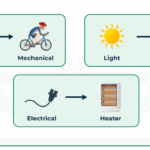
Energy conversion is the process of changing one form of energy into another. Energy itself can’t be created or destroyed, only changed from one type to another.
Examples of Conversion of Energy
Energy conversion involves transforming energy from one form to another. These include:
- Solar energy to electricity: Solar panels convert sunlight (solar energy) into electricity. This is a common example of energy conversion used in many homes and businesses.
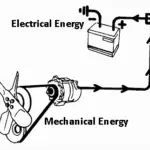
- Mechanical energy to electrical energy: Generators convert mechanical energy (like the spinning of a turbine) into electrical energy. This is how many power plants create the electricity we use.
- Chemical energy to heat energy: Cooking gas stoves convert the chemical energy stored in the gas into heat energy for cooking. This is a daily example of energy conversion.
- Kinetic energy to electrical energy: wind turbines convert the kinetic energy (movement) of wind into electrical energy. This is a clean energy source.
- electrical energy to light energy: Light bulbs convert electrical energy into light energy, allowing us to illuminate our homes and streets.
- Chemical energy to mechanical energy: Cars convert the chemical energy stored in fuel into mechanical energy to power the engine and move the vehicle.
Teaching Methods
To deliver this lesson, the teacher will adopt the following methods: Discussion, Question and answer, Group work
Instructional procedures
To deliver this lesson, the teacher will adopt the following steps:
Step 1: Introduction
Time: 5 minutes
Teaching Skill: set Induction
Teacher’s Activity: review previous lesson on energy forms. Introduce the topic: Conversion of energy.Pupils’ Activity: Recall and share knowledge on different energy forms. Listen attentively to the introduction.
Step 2: Clarification of Key concepts
Time: 10 minutes
Teaching Skill: Explaining
Teacher’s Activity: Explain what energy conversion is, using simple language and real-world examples.
Pupils’ Activity: Listen attentively and ask clarifying questions.
Step 3: Demonstration/Guided Practice
Time: 10 minutes
Teaching Skill: Demonstrating
Teacher’s Activity: Show pictures/diagrams of energy conversion examples (solar panels, generators, etc.). guide pupils through each example.
Pupils’ Activity: Observe the examples and participate in discussions.
Step 4: Self-reliant Practice
Time: 5 minutes
Teaching Skill: Facilitating
Teacher’s Activity: Divide pupils into groups and assign them tasks related to identifying energy conversion in daily life.Pupils’ Activity: Work in groups to complete the assigned tasks.
Step 5: Note-Taking
Time: 5 minutes
Teaching Skill: Note-taking
Teacher’s Activity: Guide pupils in taking notes on key concepts and examples.
Pupils’ Activity: Write down crucial points and examples.
Step 6: Evaluation/Review
Time: 5 minutes
Teaching skill: Questioning
Teacher’s Activity: Ask review questions to assess understanding.
Pupils’ Activity: Answer the review questions.
Objective-aligned checks:
- Identify and explain two examples of energy conversion and the technology products that use these conversions.
- Explain the process of energy conversion.
- Demonstrate understanding through group discussions.
Step 7: Conclusion
Time: 5 minutes
Teaching Skill: Summarizing
Teacher’s activity: Summarize the key concepts of energy conversion and assign homework.
Pupils’ Activity: Listen to the summary and note the homework assignment.
Lesson Keywords
- Energy Conversion – The process of changing energy from one form to another.
- Solar Energy – Energy derived from the sun.
- Mechanical Energy – Energy associated with motion or movement.
- Electrical energy – Energy resulting from the flow of electric charge.
- Chemical Energy – Energy stored in the bonds of chemical compounds.
- Kinetic Energy – Energy possessed by an object due to its motion.
Lesson Evaluation
To evaluate the learning, the teacher asks pupils to:
- Give an example of energy conversion and explain how it works.
- Why is it vital to understand energy conversion?
- Can you name other examples of energy conversion we see every day?
- How does energy conversion help us use different types of energy?
Assignment/Homework
- Find and draw additional examples of energy conversion you see around you.
- Write a short paragraph explaining one example of energy conversion in your home.
Differentiation
- For slower learners: Provide one-on-one assistance and use simpler examples.
- For advanced learners: Encourage them to research and present additional examples of energy conversion.
- For visual/auditory/kinesthetic learners: Use visual aids, verbal explanations, and hands-on activities to cater to different learning styles.
Note for Teachers
Ensure to use real-life examples and visual aids to make the concept of energy conversion more relatable and understandable for the pupils. Encourage active participation and group discussions to enhance learning.

Community Join the conversation Open discussion +