

Class: Junior Secondary School 2 (JSS 2 / JS2)
Term: Third Term
Week: 5
Age: 13 years
Duration: 45 minutes
Subject: Mathematics
Curriculum Theme: Mathematics
Previous Lesson: Volume of Cylinders and Cones: Deriving Formulae for.
Topic: APPROXIMATION II
Subject Matter: Problems using the basic arithmetic operations involving, Money (ii) population, Exports (iv) Imports: Quantitative Reasoning involving the above
Specific Objectives
By the end of the lesson, pupils should be able to:
Cognitive Domain:
- Solve problems involving approximation of money to a given degree of accuracy.
- Approximate population figures to significant figures or nearest thousands/millions.
- Apply approximation to problems involving exports and imports.
- Solve quantitative reasoning problems that require approximation.
Affective Domain:
- Appreciate the importance of approximation in real-life situations.
- Develop a careful approach to rounding off numbers in practical contexts.
Psychomotor Domain:
- Accurately round off numerical values related to money, population, exports, and imports.
- Demonstrate the steps for approximating numbers in various problem types.
Social Domain:
- Work collaboratively to solve problems involving approximation.
- Discuss and compare different methods of approximation for practical scenarios.
Reference Materials
The following resources were used in planning this lesson:
- 9 Years Basic Education Curriculum (Mathematics for JSS 2)
- State Unified Scheme of Work
- New General Mathematics for Junior Secondary Schools Book 2
Instructional Materials
The teacher will teach this lesson with the aid of:
- Whiteboard/blackboard
- Markers/chalk
- Textbooks
- Charts showing examples of approximated figures (e.g., population statistics)
Rationale for the Lesson
This lesson helps pupils understand how to use approximation in everyday financial, demographic, and economic contexts. It enables them to simplify calculations and make reasonable estimates, which is important for practical decision-making.
Prerequisite/Previous Knowledge
Pupils have prior knowledge of basic arithmetic operations (addition, subtraction, multiplication, division) and have been introduced to approximation, including rounding off to decimal places and significant figures.
Lesson Content/Board Summary
APPROXIMATION II
Approximation of Money
Approximation of money involves rounding off monetary values to the nearest whole number (Naira or Kobo), significant figures, or a specified decimal place. This is useful for estimating costs or simplifying financial figures.
Example 1: A shirt costs N1,249.75. Approximate the cost to the nearest Naira.
- Step 1: Identify the place value for the nearest Naira, which is the unit digit (9).
- Step 2: Look at the digit immediately to the right of the unit digit, which is 7.
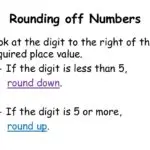
- Step 3: Since 7 is 5 or greater, round up the unit digit. Add 1 to 9, making it 10.
- Step 4: The cost becomes N1,250.00.
Therefore, N1,249.75 approximated to the nearest Naira is N1,250.
Example 2: A bag of rice costs N45,892.30. Approximate the cost to the nearest N100.
- Step 1: Identify the hundreds place value, which is 8.
- Step 2: Look at the digit immediately to the right, which is 9.
- Step 3: Since 9 is 5 or greater, round up the hundreds digit. Add 1 to 8, making it 9.
- Step 4: Replace the digits to the right with zeros.
Therefore, N45,892.30 approximated to the nearest N100 is N45,900.
Approximation of Population
Population figures are often very large and are usually approximated to significant figures or the nearest thousand, million, or billion for easier understanding and reporting.
Example 1: The population of a town is 347,215. Approximate this population to 3 significant figures.
- Step 1: Identify the first three significant figures: 3, 4, 7.
- Step 2: Look at the digit immediately after the third significant figure, which is 2.
- Step 3: Since 2 is less than 5, keep the third significant figure as it is (7).
- Step 4: Replace all digits to the right of the third significant figure with zeros.
Therefore, 347,215 approximated to 3 significant figures is 347,000.
Example 2: The population of a state is 12,854,390. Approximate this population to the nearest million.
- Step 1: Identify the millions place value (the digit 2 in 12,000,000).
- Step 2: Look at the digit immediately to the right of the millions place, which is 8.
- Step 3: Since 8 is 5 or greater, round up the millions digit. Add 1 to 2, making it 3.
- Step 4: Replace all digits to the right of the millions place with zeros.
Therefore, 12,854,390 approximated to the nearest million is 13,000,000.
Approximation of Exports and Imports
Export and import values, which are usually large monetary figures or quantities, are often approximated to simplify economic reports and analyses.
Example: A country’s annual export value is $5,321,780,000. Approximate this value to the nearest billion dollars.
- Step 1: Identify the billions place value (the digit 5).
- Step 2: Look at the digit immediately to the right, which is 3.
- Step 3: Since 3 is less than 5, keep the billions digit as it is (5).
- Step 4: Replace all digits to the right with zeros.
Therefore, \(5,321,780,000 approximated to the nearest billion dollars is\)5,000,000,000.
Quantitative Reasoning involving Approximation
Quantitative reasoning problems often require pupils to use approximation to solve real-world scenarios quickly or to estimate answers before precise calculations. This involves applying rounding rules to numbers within a word problem.
Example: A farmer harvested 876 yams. If he wants to package them into sacks, each holding approximately 50 yams, how many sacks would he need?
- Step 1: Approximate the total number of yams to the nearest hundred: 876 rounds up to 900.
- Step 2: Approximate the number of yams per sack to the nearest ten: 50 (already rounded).
- Step 3: Divide the approximated total yams by the approximated yams per sack: 900 ÷ 50 = 18.
The farmer would need approximately 18 sacks.
Teaching Methods/Instructional Techniques
Discussion, Lecture, Demonstration, Question and Answer, Visual Aids
Instructional Procedures
Step 1: Introduction
Time: 5 minutes
Teaching Skill: Set Induction
Teacher’s Activity: The teacher greets the pupils and reviews the previous lesson on basic approximation (rounding to decimal places and significant figures). The teacher then introduces the topic “Approximation II” by explaining that they will apply approximation to real-life situations involving money, population, exports, and imports.
Pupils’ Activity: Pupils respond to greetings and recall previous knowledge about approximation. They listen attentively to the introduction.
Learning Point: Pupils connect prior knowledge to the new topic and understand the scope of the lesson.
Step 2: Approximation of Money
Time: 8 minutes
Teaching Skill: Explanation/Demonstration
Teacher’s Activity: The teacher explains how to approximate monetary values to the nearest Naira, Kobo, or significant figures, providing clear examples from the board summary. The teacher demonstrates solving problems involving money approximation.
Pupils’ Activity: Pupils listen, ask questions for clarification, and copy the examples into their notebooks.
Learning Point: Pupils learn the rules and methods for approximating money.
Step 3: Approximation of Population
Time: 8 minutes
Teaching Skill: Explanation/Demonstration
Teacher’s Activity: The teacher explains the necessity of approximating large numbers like population figures. The teacher demonstrates how to approximate population to significant figures or the nearest thousand/million, using the examples from the board summary.
Pupils’ Activity: Pupils pay attention, participate in discussions, and copy the examples.
Learning Point: Pupils understand how to approximate large numbers like population figures.
Step 4: Approximation of Exports and Imports
Time: 7 minutes
Teaching Skill: Explanation/Illustration
Teacher’s Activity: The teacher explains that export and import values are often very large and are approximated for economic reporting. The teacher provides examples of how to approximate these figures, similar to population figures, to the nearest billion or million.
Pupils’ Activity: Pupils listen and note down the key points and examples.
Learning Point: Pupils grasp the application of approximation in economic contexts.
Step 5: Quantitative Reasoning involving Approximation
Time: 7 minutes
Teaching Skill: Problem-Solving/Guidance
Teacher’s Activity: The teacher introduces quantitative reasoning problems that require approximation. The teacher guides pupils through an example, emphasizing how to identify when and how to apply approximation in word problems.
Pupils’ Activity: Pupils attempt to solve the example with teacher’s guidance and ask questions.
Learning Point: Pupils learn to apply approximation skills to solve practical word problems.
Step 6: Class Activity/Practice
Time: 5 minutes
Teaching Skill: Group Work/Monitoring
Teacher’s Activity: The teacher provides a few short practice problems related to money, population, and exports/imports, asking pupils to solve them individually or in pairs. The teacher moves around to monitor and assist.
Pupils’ Activity: Pupils work on the practice problems, applying the concepts learned.
Learning Point: Pupils reinforce their understanding through practical application.
Step 7: Evaluation/Review
Time: 5 minutes
Teaching Skill: Questioning/Assessment
Teacher’s Activity: The teacher evaluates the learning by asking the following questions:
- Approximate N7,845.60 to the nearest Naira.
- Round off a population of 2,389,120 to the nearest hundred thousand.
- A country’s import value is $12,750,000. Approximate this to the nearest million dollars.
- Explain why approximation is important when dealing with large numbers like population.
Pupils’ Activity: Pupils answer orally and in writing.
Learning Point: Pupils demonstrate understanding of the lesson.
Step 8: Conclusion
Time: 2 minutes
Teaching Skill: Summarization/Assignment
Teacher’s Activity: The teacher summarizes the main points of the lesson, reiterating the importance of approximation in various real-life scenarios. The teacher assigns homework from the textbook.
Pupils’ Activity: Pupils listen to the summary and copy down the homework.
Learning Point: Pupils consolidate their learning and prepare for independent practice.
Lesson Keywords
- Approximation – Making a number simpler but keeping its value close to what it was.
- Rounding off – Changing a number to a more convenient or less precise value.
- Money – Currency used for transactions.
- Population – The total number of people living in a specific area.
- Exports – Goods and services sold to other countries.
- Imports – Goods and services bought from other countries.
- Quantitative Reasoning – The ability to understand and use numerical data to solve problems.
Differentiation
For pupils who grasp the concepts quickly, the teacher will provide more complex word problems involving multiple steps of approximation. For those who need more support, the teacher will provide additional guided examples and focus on one type of approximation at a time, offering simplified problems and one-on-one assistance.
Note for teachers using this lesson plan
Teachers should ensure pupils have a strong foundation in basic rounding rules before proceeding with this lesson. Emphasize the practical relevance of approximation by relating examples to local contexts (e.g., local market prices, state population figures). Encourage pupils to discuss when and why approximation is used in real life. Ensure sufficient practice time for both individual and group work.


Community Join the conversation Open discussion +