

Class: Senior Secondary School 1 (SS1, SS 1, SSS1, SSS 1)
Term: Second Term
Week: 2
Age: 15 years
Duration: 45 minutes
Subject: General Mathematics
Curriculum Theme: General Mathematics
Previous Lesson: Factorization of Quadratic Expression: Forms and Solving.
Topic: APPROXIMATION
Subject Matter: Rounding up and rounding down of numbers to significant figures, decimal places and nearest whole numbers., Application of approximation to everyday life, Percentage error.
Specific Objectives
By the end of the lesson, pupils should be able to:
Cognitive Domain:
- Round numbers to significant figures, decimal places, and the nearest whole number.
- Apply approximation to solve daily life problems.
- Calculate percentage error in measurements.
Affective Domain:
- Appreciate the importance of approximation in practical situations.
- Develop accuracy and precision in numerical calculations.
- Show interest in solving problems involving approximation.
Psychomotor Domain:
- Work out problems involving rounding of numbers correctly.
- Demonstrate the steps for calculating percentage error.
Social Domain:
- Collaborate with peers to solve approximation problems.
- Share different approaches to rounding and error calculation.
Reference Materials
The following resources were used in planning this lesson:
- 9 Years Basic Education Curriculum for Mathematics.
- State Unified Scheme of Work for Senior Secondary School Mathematics.
- New General Mathematics for Senior Secondary Schools 1.
Instructional Materials
The teacher will teach this lesson with the aid of:
- Given values in integers and fractions.
- An incomplete table showing various numbers and their approximation to various significant figures and decimal places.
- Whiteboard and markers/chalk.
Rationale for the Lesson
This lesson helps pupils understand how to estimate numbers in different contexts. It enables them to simplify complex numbers for easier use and apply these skills to solve practical problems encountered in daily life and other subjects.
Prerequisite/Previous Knowledge
Pupils have a basic understanding of place values, whole numbers, and decimal numbers.
Lesson Content/Board Summary
APPROXIMATION
Definition of Approximation
Approximation is the process of finding a value that is close enough to the true value, often done by rounding numbers to a specified degree of accuracy.
Rounding to the Nearest Whole Number
To round a number to the nearest whole number, consider the digit in the first decimal place:
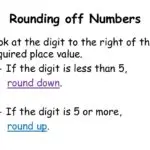
- If the digit is 5 or more, round up by adding 1 to the whole number part.
- If the digit is less than 5, round down by keeping the whole number part as it is.
Example: 7.6 rounded to the nearest whole number is 8. 7.3 rounded to the nearest whole number is 7.
Rounding to Decimal Places
To round a number to a specific number of decimal places (d.p.):
- Identify the digit in the required decimal place.
- Look at the digit immediately to its right.
- If this digit is 5 or more, add 1 to the digit in the required decimal place and drop all subsequent digits.
- If this digit is less than 5, keep the digit in the required decimal place as it is and drop all subsequent digits.
Example: 3.14159 rounded to 2 d.p. is 3.14. 0.678 rounded to 1 d.p. is 0.7.
Rounding to Significant Figures
Significant figures (s.f.) are the digits in a number that carry meaning contributing to its precision. To round a number to a specific number of significant figures:
- Count the significant figures from the first non-zero digit.
- If the digit immediately after the last required significant figure is 5 or more, round up the last required digit.
- If it is less than 5, keep the last required digit as it is.
- Replace any digits between the last significant figure and the decimal point with zeros if they are before the decimal point.
The rules for identifying significant figures are:
- Non-zero digits are always significant (e.g., 123 has 3 s.f.).
- Zeros between non-zero digits are significant (e.g., 102 has 3 s.f.).
- Leading zeros (before non-zero digits) are not significant (e.g., 0.005 has 1 s.f.).
- Trailing zeros (at the end of a number) are significant only if the number contains a decimal point (e.g., 12.00 has 4 s.f., but 1200 has 2 s.f. unless otherwise stated).
Example: 23456 rounded to 3 s.f. is 23500. 0.004567 rounded to 2 s.f. is 0.0046.
Application of Approximation in Everyday Life
Approximation is used in various daily life situations. The following are examples:
- Estimating costs when shopping.
- Calculating travel time or distance.
- Budgeting and financial planning.
- Measurements in cooking or construction.
- Reporting population figures or statistics.
Percentage Error
Percentage error is the difference between an approximate or measured value and the actual or exact value, expressed as a percentage of the actual value.
The formula for percentage error is:
Percentage Error = (|Approximate Value – Actual Value| / Actual Value) x 100%
Example: If the actual length is 10 cm and a measurement gives 9.8 cm, the percentage error is: (|9.8 – 10| / 10) x 100% = (0.2 / 10) x 100% = 2%.
Teaching Methods/Instructional Techniques
Discussion, Lecture, Demonstration, Question and Answer, Visual Aids
Instructional Procedures
Step 1: Introduction
Time: 5 minutes
Teaching Skill: Set Induction
Teacher’s Activity: The teacher greets the pupils and asks them if they have ever estimated quantities like the number of people in a room or the cost of items in a market. The teacher explains that estimation is a form of approximation.
Pupils’ Activity: Pupils respond to the teacher’s questions and share their experiences with estimation.
Learning Point: Pupils relate approximation to their daily experiences.
Step 2: Presentation of Topic
Time: 5 minutes
Teaching Skill: Explanation/Introduction
Teacher’s Activity: The teacher formally introduces the topic “APPROXIMATION” and writes it on the board. The teacher states the specific objectives for the lesson.
Pupils’ Activity: Pupils listen attentively and copy the topic into their notebooks.
Learning Point: Pupils are aware of the lesson’s focus and expected learning outcomes.
Step 3: Explanation of Rounding to Nearest Whole Number
Time: 8 minutes
Teaching Skill: Explanation/Demonstration
Teacher’s Activity: The teacher explains and demonstrates how to round numbers to the nearest whole number using examples like 15.4 and 15.7. The teacher uses the “5 or more, round up; less than 5, round down” rule.
Pupils’ Activity: Pupils pay attention, ask questions, and practice rounding numbers provided by the teacher.
Learning Point: Pupils learn how to round numbers to the nearest whole number.
Step 4: Explanation of Rounding to Decimal Places
Time: 8 minutes
Teaching Skill: Explanation/Illustration
Teacher’s Activity: The teacher explains the concept of decimal places and demonstrates how to round numbers to a given number of decimal places (e.g., 2 d.p., 3 d.p.) using examples like 5.6789 to 2 d.p. and 0.12345 to 3 d.p.
Pupils’ Activity: Pupils observe the examples, take notes, and attempt similar problems given by the teacher.
Learning Point: Pupils understand how to round numbers to specified decimal places.
Step 5: Explanation of Rounding to Significant Figures
Time: 8 minutes
Teaching Skill: Explanation/Clarification
Teacher’s Activity: The teacher explains the rules for identifying significant figures and demonstrates how to round numbers to a given number of significant figures (e.g., 1 s.f., 2 s.f., 3 s.f.). Examples like 4567 to 2 s.f. and 0.00782 to 1 s.f. are used.
Pupils’ Activity: Pupils listen carefully, ask for clarifications, and work through practice questions.
Learning Point: Pupils learn to round numbers to specified significant figures.
Step 6: Explanation of Percentage Error and Application
Time: 6 minutes
Teaching Skill: Explanation/Problem-solving
Teacher’s Activity: The teacher defines percentage error and presents the formula. The teacher provides a simple example to calculate percentage error, showing its application in real-world scenarios like measurement errors. The teacher also discusses other applications of approximation.
Pupils’ Activity: Pupils copy the formula and example, and discuss possible applications of approximation in their daily lives.
Learning Point: Pupils understand percentage error and the practical uses of approximation.
Step 7: Evaluation/Review
Time: 5 minutes
Teaching Skill: Questioning/Assessment
Teacher’s Activity: The teacher evaluates the learning by asking the following questions:
- Define approximation.
- Round 18.47 to the nearest whole number.
- Round 0.0567 to 2 decimal places.
- Round 23,450 to 2 significant figures.
- State the formula for calculating percentage error.
Pupils’ Activity: Pupils answer orally and in writing.
Learning Point: Pupils demonstrate understanding of the lesson.
Step 8: Conclusion
Time: Remaining minutes
Teaching Skill: Summarization/Assignment
Teacher’s Activity: The teacher summarizes the key points of the lesson on approximation, emphasizing the different methods of rounding and the concept of percentage error. The teacher then gives pupils an assignment.
Assignment:
- Round 567.89 to: (a) the nearest whole number (b) 1 decimal place (c) 3 significant figures.
- A student measured the length of a table as 155 cm. If the actual length is 150 cm, calculate the percentage error.
Pupils’ Activity: Pupils listen to the summary and copy the assignment.
Learning Point: Pupils consolidate their learning and apply their knowledge independently.
Lesson Keywords
- Approximation – Finding a value close to the true value.
- Rounding up – Increasing a number to the next higher value based on a rule.
- Rounding down – Keeping a number at its current value or decreasing it based on a rule.
- Decimal places – The number of digits after the decimal point.
- Significant figures – The digits in a number that are considered reliable or important.
- Nearest whole number – Rounding a number to its closest integer.
- Percentage error – The relative error expressed as a percentage.
Differentiation
For pupils who grasp concepts quickly, the teacher can provide more complex problems involving multiple rounding steps or real-world scenarios requiring critical thinking. For pupils needing more support, the teacher will provide additional guided practice with simpler numbers and use visual aids to reinforce the rounding rules.
Note for teachers using this lesson plan
Ensure that pupils understand the rules for rounding thoroughly before moving to percentage error. Encourage pupils to practice regularly with different types of numbers to build confidence and accuracy. Emphasize the practical relevance of approximation in various fields.

Community Join the conversation Open discussion +