

Class: Junior Secondary School 2 (JSS 2 / JS2)
Term: 3rd Term
Week: 4
Age: 13 years
Duration: 45 minutes
Subject: Mathematics
Curriculum Theme: Mathematics
Previous Lesson: Cylinders and Cones: Curved Surface Area of Cylinders.
Topic: VOLUME OF CYLINDERS AND CONES
Subject Matter: Deriving formulae for, Volume of cylinders, Volume of cones: Compound shapes i.e. a cone mounted on a cylinder
Specific Objectives
By the end of the lesson, pupils should be able to:
Cognitive Domain:
- Define the term “volume.”
- State the formula for the volume of a cylinder.
- State the formula for the volume of a cone.
- Apply the correct formulae to calculate the volume of cylinders and cones.
Affective Domain:
- Appreciate the importance of calculating volume in everyday life.
- Show interest in solving problems involving the volume of 3D shapes.
Psychomotor Domain:
- Calculate the volume of given cylinders and cones accurately.
- Solve problems involving the volume of compound shapes (e.g., a cone mounted on a cylinder).
Social Domain:
- Work collaboratively to solve volume-related problems.
Reference Materials
The following resources were used in planning this lesson:
- 9 Years Basic Education Curriculum for Mathematics (JSS 2)
- State Unified Scheme of Work for Mathematics
- New General Mathematics for Junior Secondary Schools Book 2
- https://www.mathworld.wolfram.com/
- https://www.bbc.co.uk/bitesize/
Instructional Materials
The teacher will teach this lesson with the aid of:
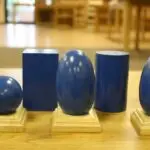
- Models of cylinders and cones
- Charts displaying the formulae for the volume of cylinders and cones
- Rulers and calculators
Rationale for the Lesson
This lesson helps pupils understand how to calculate the space occupied by three-dimensional objects. This knowledge is important for practical applications such as determining the capacity of containers, estimating materials for construction, and understanding engineering designs.
Prerequisite/Previous Knowledge
Pupils have prior knowledge of the area of a circle, basic properties of 3D shapes, and simple algebraic manipulation.
Lesson Content/Board Summary
VOLUME OF CYLINDERS AND CONES
1. Definition of Volume
Volume is the amount of three-dimensional space occupied by a solid object or enclosed by a surface. It is measured in cubic units (e.g., cm³, m³).
2. Volume of a Cylinder
A cylinder is a 3D solid with two parallel circular bases connected by a curved surface. The volume of a cylinder is found by multiplying the area of its circular base by its height.
Formula:
V = πr²h
Where:
- V = Volume
- π (pi) ≈ 3.142 or 22/7 (a constant)
- r = radius of the circular base
- h = height of the cylinder
Worked Examples:
Example 1: Calculate the volume of a cylinder with a radius of 7 cm and a height of 10 cm. (Use π = 22/7)
Step 1: Write down the formula.
V = πr²h
Step 2: Substitute the given values.
V = (22/7) × (7 cm)² × 10 cm
V = (22/7) × 49 cm² × 10 cm
Step 3: Calculate the volume.
V = 22 × 7 cm² × 10 cm
V = 1540 cm³
The volume of the cylinder is 1540 cm³.
Example 2: A cylindrical tank has a volume of 3080 m³ and a radius of 7 m. Find its height. (Use π = 22/7)
Step 1: Write down the formula.
V = πr²h
Step 2: Substitute the known values.
3080 = (22/7) × (7)² × h
3080 = (22/7) × 49 × h
3080 = 22 × 7 × h
3080 = 154 × h
Step 3: Solve for h.
h = 3080 / 154
h = 20 m
The height of the cylindrical tank is 20 m.
3. Volume of a Cone
A cone is a 3D geometric shape that tapers smoothly from a flat base (usually circular) to a point called the apex. The volume of a cone is one-third the volume of a cylinder with the same base radius and height.
Formula:
V = (1/3)πr²h
Where:
- V = Volume
- π (pi) ≈ 3.142 or 22/7
- r = radius of the circular base
- h = perpendicular height of the cone
Worked Examples:
Example 1: Find the volume of a cone with a base radius of 3 cm and a height of 7 cm. (Use π = 22/7)
Step 1: Write down the formula.
V = (1/3)πr²h
Step 2: Substitute the given values.
V = (1/3) × (22/7) × (3 cm)² × 7 cm
V = (1/3) × (22/7) × 9 cm² × 7 cm
Step 3: Calculate the volume.
V = (1/3) × 22 × 9 cm³
V = 22 × 3 cm³
V = 66 cm³
The volume of the cone is 66 cm³.
Example 2: A cone has a volume of 462 cm³ and a base radius of 7 cm. Find its height. (Use π = 22/7)
Step 1: Write down the formula.
V = (1/3)πr²h
Step 2: Substitute the known values.
462 = (1/3) × (22/7) × (7)² × h
462 = (1/3) × (22/7) × 49 × h
462 = (1/3) × 22 × 7 × h
462 = (1/3) × 154 × h
Step 3: Solve for h.
462 × 3 = 154 × h
1386 = 154 × h
h = 1386 / 154
h = 9 cm
The height of the cone is 9 cm.
4. Volume of Compound Shapes (Cone Mounted on a Cylinder)
To find the volume of a compound shape made of a cone mounted on a cylinder, calculate the volume of each individual shape and then add them together.
Total Volume = Volume of Cylinder + Volume of Cone
Worked Example:
Example 1: A solid is made up of a cylinder with a radius of 5 cm and a height of 10 cm, and a cone mounted on top with the same radius and a height of 6 cm. Find the total volume of the solid. (Use π = 3.142)
Step 1: Calculate the volume of the cylinder.
V_cylinder = πr²h
V_cylinder = 3.142 × (5 cm)² × 10 cm
V_cylinder = 3.142 × 25 cm² × 10 cm
V_cylinder = 3.142 × 250 cm³
V_cylinder = 785.5 cm³
Step 2: Calculate the volume of the cone.
V_cone = (1/3)πr²h
V_cone = (1/3) × 3.142 × (5 cm)² × 6 cm
V_cone = (1/3) × 3.142 × 25 cm² × 6 cm
V_cone = 3.142 × 25 cm² × 2 cm (since 6/3 = 2)
V_cone = 3.142 × 50 cm³
V_cone = 157.1 cm³
Step 3: Add the volumes to find the total volume.
Total Volume = V_cylinder + V_cone
Total Volume = 785.5 cm³ + 157.1 cm³
Total Volume = 942.6 cm³
The total volume of the solid is 942.6 cm³.
Teaching Methods/Instructional Techniques
Discussion, Lecture, Demonstration, Question and Answer, Visual Aids
Instructional Procedures
Step 1: Introduction
Time: 5 minutes
Teaching Skill: Set Induction
Teacher’s Activity: The teacher displays models of cylinders and cones, asking pupils to identify them and discuss where they see these shapes in real life. The teacher then asks what “volume” means.
Pupils’ Activity: Pupils identify the shapes, give examples, and offer definitions for volume based on prior knowledge.
Learning Point: Pupils recall basic knowledge of 3D shapes and introduce the concept of volume.
Step 2: Deriving the Formula for Volume of a Cylinder
Time: 10 minutes
Teaching Skill: Explanation/Derivation
Teacher’s Activity: The teacher guides pupils to recall the formula for the area of a circle. The teacher then explains that the volume of a cylinder is the area of its base multiplied by its height, leading to the formula V = πr²h.
Pupils’ Activity: Pupils state the area of a circle formula and participate in deriving the volume of a cylinder formula.
Learning Point: Pupils understand and can state the formula for the volume of a cylinder.
Step 3: Calculating Volume of Cylinders (Worked Examples)
Time: 7 minutes
Teaching Skill: Demonstration/Problem Solving
Teacher’s Activity: The teacher works through examples on the board, demonstrating how to apply the formula to calculate the volume of cylinders, including finding missing dimensions.
Pupils’ Activity: Pupils observe, ask questions, and copy the worked examples into their notebooks.
Learning Point: Pupils learn to apply the cylinder volume formula to solve problems.
Step 4: Deriving the Formula for Volume of a Cone
Time: 8 minutes
Teaching Skill: Explanation/Analogy
Teacher’s Activity: The teacher uses the analogy of a cone fitting exactly inside a cylinder of the same base and height to explain that the volume of a cone is one-third the volume of the cylinder, leading to the formula V = (1/3)πr²h.
Pupils’ Activity: Pupils listen, observe the demonstration (if applicable), and state the formula for the volume of a cone.
Learning Point: Pupils understand and can state the formula for the volume of a cone.
Step 5: Calculating Volume of Cones (Worked Examples)
Time: 7 minutes
Teaching Skill: Demonstration/Problem Solving
Teacher’s Activity: The teacher demonstrates how to apply the cone volume formula by solving examples on the board, including finding missing dimensions.
Pupils’ Activity: Pupils pay attention, ask questions, and copy the worked examples.
Learning Point: Pupils learn to apply the cone volume formula to solve problems.
Step 6: Volume of Compound Shapes
Time: 5 minutes
Teaching Skill: Integration/Problem Solving
Teacher’s Activity: The teacher explains how to find the volume of compound shapes by adding the individual volumes of the component shapes (e.g., a cone mounted on a cylinder) and demonstrates one example.
Pupils’ Activity: Pupils listen and contribute ideas on how to combine the formulae for compound shapes.
Learning Point: Pupils understand how to calculate the volume of compound shapes.
Step 7: Evaluation/Review
Time: 5 minutes
Teaching Skill: Questioning/Assessment
Teacher’s Activity: The teacher evaluates the learning by asking the following questions:
- Define volume.
- State the formula for the volume of a cylinder.
- State the formula for the volume of a cone.
- A cylindrical can has a radius of 4 cm and a height of 10 cm. Calculate its volume. (Use π = 3.142)
Pupils’ Activity: Pupils answer orally and in writing.
Learning Point: Pupils demonstrate understanding of the lesson.
Step 8: Conclusion
Time: 3 minutes
Teaching Skill: Summarization
Teacher’s Activity: The teacher summarizes the key learning points, emphasizing the formulae for the volume of cylinders and cones and their application in compound shapes. The teacher then assigns homework.
Pupils’ Activity: Pupils listen, ask any final questions, and copy down the assigned homework.
Learning Point: Pupils recap the lesson and consolidate their understanding.
Lesson Keywords
- Volume – The amount of 3D space occupied by an object.
- Cylinder – A 3D shape with two parallel circular bases and a curved side.
- Cone – A 3D shape with a circular base and a single vertex (apex).
- Radius – The distance from the center to the edge of a circle.
- Height – The perpendicular distance from the base to the top of a 3D shape.
- Pi (π) – A mathematical constant approximately equal to 3.142 or 22/7.
- Compound shapes – Shapes made by combining two or more simple geometric shapes.
Differentiation
For pupils who are struggling, the teacher will provide simpler examples with whole numbers and guide them step-by-step. For advanced learners, the teacher will provide more complex problems involving compound shapes or require them to find missing dimensions given the volume.
Note for teachers using this lesson plan
Teachers should ensure pupils understand the difference between radius and diameter. Emphasize the correct units for volume (cubic units). Encourage pupils to draw diagrams for each problem, especially for compound shapes, to visualize the components.

Community Join the conversation Open discussion +