

Class: Junior Secondary School 2 (JSS2, JSS 2)
Term: 1st Term
Week: 3
Age: 13 years
Duration: 45 minutes
Subject: Mathematics
Curriculum Theme: Mathematics
Previous Lesson: Approximation to Decimal Places and Significant Figures
Topic: Factors And Multiples (Part 1)
Subject Matter: Factors of numbers, Prime factors of numbers not greater than 200, Expressing numbers as product of its prime factors, Rules of divisibility, H.C.F of numbers.
Specific Objectives
By the end of the lesson, pupils should be able to:
- Cognitive Domain:
(a) Identify and find the factors of given numbers.
(b) Express numbers not greater than 200 as products of their prime factors.
(c) Apply the rules of divisibility to determine if a number can divide another.
(d) Find the Highest Common Factor (H.C.F) of two or more numbers. - Affective Domain:
(a) Appreciate the importance of understanding factors and multiples in solving real-life mathematical problems. - Psychomotor Domain:
(a) Perform factorization of given numbers correctly using factor trees and prime factor methods. - Social Domain:
(a) Work in pairs or groups to solve factorization and H.C.F exercises cooperatively.
Reference Materials
The following resources was used in planning this lesson:
- 9 Years Basic Education Curriculum
- Lagos State Unified Scheme of work for Junior Secondary Schools
- Math is Fun – “Factors and Multiples” (https://www.mathsisfun.com/numbers/factors-multiples.html)
- Relevant Textbooks
Instructional Materials
The teacher will teach this lesson with the aid of:
- Factor tree charts
- Number cards and divisibility charts
- Whiteboard and marker
- Flash cards showing prime numbers
- Worksheets on factors and multiples
Rationale for the Lesson
This lesson helps pupils understand how to break down numbers into their factors, identify prime factors, and find the Highest Common Factor, which are foundational for arithmetic and algebra.
Prerequisite/Previous Knowledge
Pupils can already identify whole numbers and perform basic multiplication and division operations from previous lessons.
Lesson Content/Board Summary
Factors and Multiples
Factors of Numbers
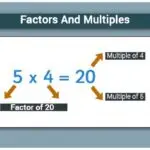
A factor is a number that divides another number exactly without leaving a remainder. Every number has at least two factors: 1 and the number itself.
The following are examples of factors:
- Factors of 12 are 1, 2, 3, 4, 6, 12.
- Factors of 15 are 1, 3, 5, 15.
- Factors of 20 are 1, 2, 4, 5, 10, 20.
Prime Factors of Numbers Not Greater Than 200
Prime factors are factors of a number that are prime numbers. Prime numbers have only two factors — 1 and the number itself.
Examples include:
- Prime factors of 24 are 2 × 2 × 2 × 3.
- Prime factors of 60 are 2 × 2 × 3 × 5.
- Prime factors of 150 are 2 × 3 × 5 × 5.
Expressing Numbers as Product of Their Prime Factors
We can express any number as a product of its prime factors using a factor tree or division method.
Examples include:
- 36 = 2 × 2 × 3 × 3 = 2² × 3²
- 84 = 2 × 2 × 3 × 7 = 2² × 3 × 7
- 100 = 2 × 2 × 5 × 5 = 2² × 5²
Rules of Divisibility
Rules of divisibility help us to know quickly whether a number can divide another number exactly.
The following are the basic rules of divisibility:
- A number is divisible by 2 if it ends in 0, 2, 4, 6, or 8.
- A number is divisible by 3 if the sum of its digits is divisible by 3.
- A number is divisible by 4 if its last two digits form a number divisible by 4.
- A number is divisible by 5 if it ends in 0 or 5.
- A number is divisible by 6 if it is divisible by both 2 and 3.
- A number is divisible by 9 if the sum of its digits is divisible by 9.
- A number is divisible by 10 if it ends in 0.
Highest Common Factor (H.C.F) of Numbers
The Highest Common Factor (H.C.F) of two or more numbers is the largest number that divides all of them exactly.
To find the H.C.F:
- List all the factors of each number, then choose the greatest factor common to all.
- Or use the prime factorization method — multiply all the common prime factors.
Examples:
- H.C.F of 12 and 18 = 6
- H.C.F of 20 and 30 = 10
- H.C.F of 15, 25, and 35 = 5
Teaching Methods/Instructional Techniques:
Discussion, Lecture, Explanation, Demonstration, Guided Practice, Group Work, Question and Answer
Instructional Procedures
To deliver this lesson, the teacher will adopt the following steps:
Step 1: Introduction
Time: 5 minutes
Teaching Skill: Set Induction
Teacher’s Activity: Teacher reviews the previous lesson on multiples and asks pupils to mention numbers that can divide others exactly.
Pupils’ Activity: Pupils respond by mentioning examples like 2 divides 8, 3 divides 9, etc.
Learning Point: Pupils recall the concept of divisibility and prepare to learn about factors and prime factors.
Step 2: Factors of Numbers
Time: 10 minutes
Teaching Skill: Explanation
Teacher’s Activity: Teacher explains the concept of factors and writes examples on the board using small numbers.
Pupils’ Activity: Pupils identify and write out factors of given numbers.
Learning Point: Pupils understand what factors are and how to find them.
Step 3: Prime Factors and Rules of Divisibility
Time: 10 minutes
Teaching Skill: Demonstration
Teacher’s Activity: Teacher demonstrates how to find prime factors using factor trees and explains divisibility rules using number cards.
Pupils’ Activity: Pupils follow and apply the rules to test divisibility of given numbers.
Learning Point: Pupils learn how to identify prime factors and apply divisibility rules correctly.
Step 4: Finding H.C.F of Numbers
Time: 10 minutes
Teaching Skill: Guided Practice
Teacher’s Activity: Teacher shows examples of finding H.C.F by listing factors and by prime factorization method.
Pupils’ Activity: Pupils work in groups to find H.C.F of given numbers.
Learning Point: Pupils can find H.C.F accurately using either method.
Step 5: Note-Taking
Time: 5 minutes
Teaching Skill: Explanation
Teacher’s Activity: Teacher dictates or writes the summarized board notes for pupils to copy.
Pupils’ Activity: Pupils copy the notes neatly into their exercise books.
Learning Point: Pupils record the key points of the lesson for future study.
Step 6: Evaluation/Review
Time: 3 minutes
Teaching Skill: Questioning
Teacher’s Activity: The teacher evaluates the learning by asking the following questions:
- What is a factor?
- Find the prime factors of 60.
- State the rule of divisibility by 5.
- Find the H.C.F of 12 and 18.
Pupils’ Activity: Pupils answer the questions orally and write some on the board.
Learning Point: Pupils demonstrate mastery of the lesson objectives.
Step 7: Conclusion
Time: 2 minutes
Teaching Skill: Reinforcement
Teacher’s Activity: Teacher summarizes the lesson and emphasizes the importance of factors and H.C.F in simplifying fractions and solving number problems.
Pupils’ Activity: Pupils listen attentively and ask clarifying questions.
Learning Point: Pupils appreciate the importance of factors and multiples in mathematics.
Lesson Keywords
- Factor – a number that divides another number exactly.
- Prime Number – a number with only two factors, 1 and itself.
- Divisibility – ability of one number to divide another without remainder.
- Prime Factorization – expressing a number as a product of its prime factors.
- H.C.F (Highest Common Factor) – the largest factor common to two or more numbers.
Differentiation
Provide simpler numbers for slower learners during practice and allow advanced pupils to handle larger numbers or three-number H.C.F problems.
Note for teachers using this lesson plan
Ensure pupils actively participate in factorization exercises. Use visual aids like factor trees for clarity. Encourage group work for peer learning.

Community Join the conversation Open discussion +