

Class: Junior Secondary School 2 (JSS2, JSS 2)
Term: 1st Term
Week: 10
Age: 13 years
Duration: 45 minutes
Subject: Mathematics
Curriculum Theme: Mathematics
Previous Lesson: Linear Inequalities, Solving and Graphical Representation
Topic: Everyday Arithmetic (Transactions in Homes and Offices)
Subject Matter: Percentage and ratio, Conversion of fractions to ratio, decimals and percentages, Profit and loss, Simple interest, Discount, Commission
Specific Objectives
By the end of the lesson, pupils should be able to:
- Cognitive Domain:
(a) Distinguish between percentage, ratio, and fraction.
(b) Solve problems involving profit, loss, discount, simple interest, and commission in daily transactions. - Affective Domain:
(a) Appreciate the importance of accurate calculation in home and office transactions. - Psychomotor Domain:
(a) Demonstrate how to convert fractions to decimals, ratios, and percentages using examples. - Social Domain:
(a) Collaborate with classmates to solve real-life arithmetic problems.
Reference Materials
The following resources was used in planning this lesson:
- 9 Years Basic Education Curriculum
- Lagos State Unified Scheme of Work for Junior Secondary Schools
- Math Goodies – “Understanding Percentages” (https://www.mathgoodies.com/lessons/vol4/percent)
- Investopedia – “Simple Interest Definition and Formula” (https://www.investopedia.com/terms/s/simple_interest.asp)
- Relevant Textbooks
Instructional Materials
The teacher will teach this lesson with the aid of:
- Charts showing examples of daily financial transactions
- Flash cards with arithmetic questions
- Calculators
- Graph sheets
- Whiteboard and markers
Rationale for the Lesson
This lesson helps students understand how to apply basic arithmetic—percentage, ratio, and simple financial calculations—in real-life home and office transactions.
Prerequisite/Previous Knowledge
Pupils have learned about basic arithmetic operations, fractions, decimals, and simple percentage calculations in previous lessons.
Lesson Content/Board Summary
Everyday Arithmetic (Transactions in Homes and Offices)
Percentage and Ratio
Percentage and ratio are ways of comparing quantities. A percentage shows a part out of 100, while a ratio shows the relation between two or more quantities.
The following are examples and facts about percentages and ratios:
- Percentage is expressed using the symbol (%). For example, 25% means 25 out of 100.
- Ratio compares quantities using “:”. For example, 2:3 means for every 2 parts of one quantity, there are 3 parts of another.
- To convert a ratio to a percentage, divide the first number by the total and multiply by 100.
- Percentages are often used in reporting results, discounts, and profit.
Conversion of Fractions to Ratios, Decimals, and Percentages
Fractions, ratios, decimals, and percentages express parts of a whole in different forms.
The following are examples of conversions:
- To convert a fraction to a decimal: divide the numerator by the denominator.
Example: ½ = 1 ÷ 2 = 0.5 - To convert a decimal to a percentage: multiply by 100.
Example: 0.5 × 100 = 50% - To convert a fraction to a ratio: write the numerator and denominator separated by a colon.
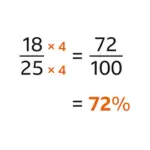
Example: ½ = 1:2 - To convert a percentage to a fraction: divide by 100 and simplify.
Example: 25% = 25/100 = ¼
Profit and Loss
Profit and loss occur in business transactions when selling goods or services.
The following are key points:
- Profit occurs when selling price (SP) is greater than cost price (CP).
Profit = SP – CP - Loss occurs when cost price is greater than selling price.
Loss = CP – SP - Profit Percentage = (Profit ÷ CP) × 100
- Loss Percentage = (Loss ÷ CP) × 100
- Profit and loss help determine the performance of a business.
Simple Interest
Simple interest is the money paid on borrowed or invested money for a specific time at a given rate.
The formula for simple interest is:
SI = (P × R × T) / 100
Where:
- P = Principal (the money borrowed or invested)
- R = Rate (percentage interest)
- T = Time (in years)
Examples include bank loans, savings, and investments.
Discount and Commission
Discount and commission are common in sales and business transactions.
The following are important points:
- Discount is a reduction from the marked price of goods.
Discount = Marked Price – Selling Price - Commission is money paid to an agent for helping to sell goods or services.
Commission = (Rate × Total Sales) ÷ 100 - Both discount and commission encourage sales and improve business relationships.
Teaching Methods/Instructional Techniques:
Lecture, Discussion, Explanation, Problem Solving, Demonstration, Group Work, Question and Answer
Instructional Procedures
To deliver this lesson, the teacher will adopt the following steps:
Step 1: Introduction
Time: 5 minutes
Teaching Skill: Set Induction
Teacher’s Activity: The teacher begins the lesson by asking pupils how money is used in homes and offices and connects their answers to the concept of everyday arithmetic.
Pupils’ Activity: Pupils respond by giving examples of buying, selling, and saving money.
Learning Point: Pupils link real-life transactions to arithmetic operations.
Step 2: Explanation of Percentage and Ratio
Time: 10 minutes
Teaching Skill: Explanation
Teacher’s Activity: The teacher explains percentages and ratios with examples on the board and uses charts for visual understanding.
Pupils’ Activity: Pupils observe, ask questions, and take notes.
Learning Point: Pupils understand how to express quantities using percentages and ratios.
Step 3: Conversion and Profit & Loss
Time: 10 minutes
Teaching Skill: Demonstration
Teacher’s Activity: The teacher demonstrates conversion of fractions, decimals, and ratios and explains profit and loss using examples.
Pupils’ Activity: Pupils solve similar problems in their exercise books.
Learning Point: Pupils learn how to convert and calculate profit or loss accurately.
Step 4: Simple Interest, Discount, and Commission
Time: 10 minutes
Teaching Skill: Application
Teacher’s Activity: The teacher uses examples from banks, stores, and agencies to explain simple interest, discount, and commission.
Pupils’ Activity: Pupils participate by giving real-life examples and computing given tasks.
Learning Point: Pupils understand how arithmetic is applied in financial transactions.
Step 5: Note-Taking
Time: 5 minutes
Teaching Skill: Reinforcement
Teacher’s Activity: The teacher writes the board summary for pupils to copy.
Pupils’ Activity: Pupils copy the summary neatly.
Learning Point: Pupils have a written record of the lesson content.
Step 6: Evaluation/Review
Time: 3 minutes
Teaching Skill: Questioning
Teacher’s Activity: The teacher evaluates the learning by asking the following questions:
- What is the difference between profit and loss?
- State the formula for simple interest.
- Explain what discount means.
- Convert ¾ to a percentage.
- What is the ratio equivalent of 0.25?
Pupils’ Activity: Pupils respond orally and in writing.
Learning Point: Pupils demonstrate understanding of all lesson concepts.
Step 7: Conclusion
Time: 2 minutes
Teaching Skill: Summarization
Teacher’s Activity: The teacher summarizes the key points and encourages pupils to apply arithmetic in daily activities.
Pupils’ Activity: Pupils listen and ask final questions.
Learning Point: Pupils appreciate the relevance of everyday arithmetic.
Lesson Keywords
- Percentage – comparison out of 100
- Ratio – comparison of two or more quantities
- Profit – gain made when selling price is greater than cost price
- Simple Interest – payment for the use of borrowed money
- Discount – reduction from the original price of goods
- Commission – payment to an agent for services rendered
Differentiation
Teacher gives simpler examples to slower learners and allows advanced learners to handle more complex financial problems and explain their steps to others.
Note for teachers using this lesson plan
Ensure pupils participate actively in solving practical examples. Emphasize accuracy, show real-life links, and use clear financial scenarios to enhance understanding.


Community Join the conversation Open discussion +