

Class: Junior Secondary School 2 (JSS2, JSS 2)
Term: 2nd Term
Week: 5
Age: 13 years
Duration: 45 minutes
Subject: Mathematics
Curriculum Theme: Mathematics
Previous Lesson: Solving Simple Equations and Word Problems
Topic: Linear Inequalities in One Variable
Subject Matter: Solution of linear inequalities, Graphical representation of linear inequalities, Word problems involving linear inequalities in one variable.
Specific Objectives
By the end of the lesson, pupils should be able to:
- Cognitive Domain:
(a) Solve linear inequalities in one variable correctly.
(b) Interpret and represent solutions of inequalities on a number line. - Affective Domain:
(a) Appreciate the usefulness of inequalities in solving real-life problems. - Psychomotor Domain:
(a) Draw number lines and mark solution sets accurately. - Social Domain:
(a) Work cooperatively in pairs to solve inequality problems.
Reference Materials
The following resources was used in planning this lesson:
- 9 Years Basic Education Curriculum
- Lagos State Unified Scheme of Work for Junior Secondary Schools
- Cuemath – Meaning, Calculate, Solving, Graphing Inequalities
- Relevant Textbooks
Instructional Materials
The teacher will teach this lesson with the aid of:
- Number line charts
- Marker and whiteboard
- Flash cards containing inequality symbols
- Cardboard strips showing worked examples
- Ruler and pencils for drawing number lines
Rationale for the Lesson
This lesson equips pupils with the knowledge and skills to solve inequalities and interpret solution sets, which are essential for mathematical reasoning and real-life decision-making.
Prerequisite/Previous Knowledge
Pupils have previously learned simple equations, number operations, and the use of inequality symbols such as >, <, ≥, and ≤.
Lesson Content/Board Summary
Lesson Content
Linear Inequalities in One Variable
A linear inequality in one variable is a mathematical statement that shows the relationship between two quantities using inequality symbols such as >, <, ≥, or ≤.
The following are examples of linear inequalities in one variable with their solutions:
- Solve: 2x + 3 > 7
2x > 4
x > 2 - Solve: 5 – x ≤ 3
–x ≤ –2
x ≥ 2 - Solve: 3x < 12
x < 4
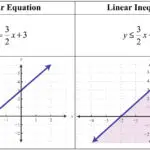
Graphical Representation of Linear Inequalities
Linear inequalities can be represented on a number line to show all possible values that satisfy the inequality.
The following are examples of graphical representations:
- x > 2 → Open circle at 2, shading to the right.
- x ≤ –1 → Closed circle at –1, shading to the left.
- x ≥ 4 → Closed circle at 4, shading to the right.
Word Problems Involving Linear Inequalities
Word problems help to apply inequalities to real-life situations such as age limits, costs, and measurements.
Examples include:
- A pupil must be at least 12 years old to join a club. If x is the age, then:
x ≥ 12 - A book costs ₦500, and a pupil has ₦m. For the pupil to afford the book:
m ≥ 500 - A bottle can hold not more than 2 liters of water. If v is the volume:
v ≤ 2
Teaching Methods/Instructional Techniques:
Discussion, Lecture, Explanation, Demonstration, Group Work, Visualization, Question and Answer
Instructional Procedures
To deliver this lesson, the teacher will adopt the following steps:
Step 1: Introduction
Time: 5 minutes
Teaching Skill: Set Induction
Teacher’s Activity: Reviews previous work on equations and asks pupils to compare equations and inequalities using flash cards.
Pupils’ Activity: Respond to questions and identify inequality symbols.
Learning Point: Pupils recall concepts leading into inequalities.
Step 2: Solving Linear Inequalities
Time: 10 minutes
Teaching Skill: Explanation
Teacher’s Activity: Solves examples of linear inequalities on the board and explains each step clearly.
Pupils’ Activity: Observe and solve similar problems individually.
Learning Point: Pupils understand how to solve basic inequalities.
Step 3: Graphical Representation
Time: 10 minutes
Teaching Skill: Demonstration
Teacher’s Activity: Draws number lines and shows how to represent solutions with open or closed circles.
Pupils’ Activity: Draw number lines in their books following teacher’s demonstration.
Learning Point: Pupils learn to represent solution sets graphically.
Step 4: Word Problems on Inequalities
Time: 10 minutes
Teaching Skill: Discussion
Teacher’s Activity: Presents real-life word problems and guides pupils to translate them into inequalities.
Pupils’ Activity: Work in pairs to solve provided word problems.
Learning Point: Pupils connect inequalities with daily situations.
Step 5: Note-Taking
Time: 5 minutes
Teaching Skill: Reinforcement
Teacher’s Activity: Provides the Board Summary for pupils to copy.
Pupils’ Activity: Write notes neatly in their books.
Learning Point: Pupils maintain accurate records of concepts learned.
Step 6: Evaluation/Review
Time: 3 minutes
Teaching Skill: Questioning
Teacher’s Activity: The teacher evaluates the learning by asking the following questions:
- Solve: 4x – 6 < 10
- Represent x ≥ –3 on a number line
- Form an inequality: “A pupil must have more than ₦200 to buy a snack.”
Pupils’ Activity: Answer questions orally.
Learning Point: Pupils demonstrate mastery of learning objectives.
Step 7: Conclusion
Time: 2 minutes
Teaching Skill: Reinforcement
Teacher’s Activity: Summarizes key points and encourages pupils to practice more inequality problems.
Pupils’ Activity: Listen and ask final questions.
Learning Point: Pupils understand the need for continuous practice.
Lesson Keywords
- Inequality – a mathematical comparison showing greater or lesser values
- Variable – a symbol representing an unknown quantity
- Solution Set – all possible values that satisfy an inequality
- Number Line – a line used to show numerical values and solutions
- Expression – a combination of numbers, variables, and operations
Differentiation
Provide simpler inequality problems for slow learners, while faster learners handle complex multi-step inequalities and additional word problems.
Note for teachers using this lesson plan
Emphasize the difference between open and closed circles. Encourage neat drawing of number lines and ensure pupils follow steps when solving inequalities.


Community Join the conversation Open discussion +