

Class: Junior Secondary School 3 (JSS 3 / JS3)
Term: Third Term
Week: 4
Age: 14 years
Duration: 45 minutes
Subject: Mathematics
Curriculum Theme: Mathematics
Previous Lesson: .
Topic: APPROXIMATION
Subject Matter: Revision of approximation of numbers to, Decimal place, Significant figures: required degree of accuracy
Specific Objectives
By the end of the lesson, pupils should be able to:
Cognitive Domain:
- Define approximation and state the rules for rounding numbers.
- Identify the required decimal place or significant figure in a given number.
- Round numbers to a specified number of decimal places.
- Round numbers to a specified number of significant figures.
Affective Domain:
- Appreciate the importance of approximation in everyday calculations.
- Develop a careful attitude towards accuracy in mathematical problems.
Psychomotor Domain:
- Solve problems involving approximation to decimal places.
- Solve problems involving approximation to significant figures.
Social Domain:
- Participate actively in class discussions on approximation techniques.
- Collaborate with peers to solve approximation problems.
Reference Materials
The following resources were used in planning this lesson:
- 9 Years Basic Education Curriculum
- State Unified Scheme of Work
- New General Mathematics for Junior Secondary Schools 3
- https://www.study.com/academy/lesson/what-is-approximation-in-math-definition-examples.html
- https://www.bbc.co.uk/bitesize/guides/zxd2tv4/revision/1
Instructional Materials
The teacher will teach this lesson with the aid of:
- Whiteboard and markers
- Charts showing examples of approximation
- Calculators (optional, for checking answers)
- Textbooks
Rationale for the Lesson
This lesson helps pupils understand how to simplify numbers for easier use and communication. Approximation is important in real-life situations where exact values are not always necessary or practical, such as estimating costs or measurements.
Prerequisite/Previous Knowledge
Pupils have prior knowledge of place values of numbers, basic arithmetic operations, and introductory concepts of rounding numbers from earlier classes.
Lesson Content/Board Summary
Approximation
Approximation means finding a number that is close enough to the exact value for a particular purpose. It involves rounding numbers to a certain degree of accuracy.
Rules for Rounding Numbers
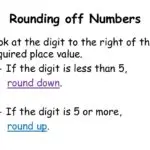
- If the digit to be dropped is 5 or greater, add 1 to the preceding digit (round up).
- If the digit to be dropped is less than 5, leave the preceding digit as it is (round down).
Approximation to Decimal Places
To approximate a number to a given number of decimal places, identify the digit at that decimal place. Then, look at the digit immediately to its right and apply the rounding rules.
Example 1: Round 7.348 to 2 decimal places.
- Step 1: Identify the second decimal place, which is 4.
- Step 2: Look at the digit immediately to its right, which is 8.
- Step 3: Since 8 is 5 or greater, add 1 to the 4.
- Result: 7.35
Example 2: Round 12.621 to 1 decimal place.
- Step 1: Identify the first decimal place, which is 6.
- Step 2: Look at the digit immediately to its right, which is 2.
- Step 3: Since 2 is less than 5, leave the 6 as it is.
- Result: 12.6
Approximation to Significant Figures
Significant figures are the digits in a number that carry meaning and contribute to its precision. The rules for identifying significant figures are:
- All non-zero digits are significant. (e.g., 123 has 3 s.f.)
- Zeros between non-zero digits are significant. (e.g., 105 has 3 s.f.)
- Leading zeros (zeros before non-zero digits) are NOT significant. (e.g., 0.007 has 1 s.f.)
- Trailing zeros (zeros at the end of a number) are significant ONLY if there is a decimal point. (e.g., 1200 has 2 s.f.; 1200. has 4 s.f.; 12.00 has 4 s.f.)
To approximate a number to a given number of significant figures, identify the required significant figure, then look at the digit immediately to its right and apply the rounding rules. Replace any remaining digits to the right of the significant figures with zeros if they are before the decimal point to maintain place value.
Example 1: Round 0.00456 to 1 significant figure.
- Step 1: Identify the first significant figure, which is 4 (the first non-zero digit).
- Step 2: Look at the digit immediately to its right, which is 5.
- Step 3: Since 5 is 5 or greater, add 1 to the 4.
- Result: 0.005
Example 2: Round 23,450 to 2 significant figures.
- Step 1: Identify the first two significant figures, which are 2 and 3.
- Step 2: Look at the digit immediately to the right of the second significant figure (3), which is 4.
- Step 3: Since 4 is less than 5, leave the 3 as it is.
- Step 4: Replace the remaining digits with zeros to maintain place value.
- Result: 23,000
Teaching Methods/Instructional Techniques
Discussion, Lecture, Demonstration, Question and Answer, Visual Aids
Instructional Procedures
Step 1: Introduction
Time: 5 minutes
Teaching Skill: Set Induction
Teacher’s Activity: The teacher greets the pupils and asks them how they would tell someone the population of Nigeria or the cost of a car if they only knew it roughly. This introduces the concept of approximation.
Pupils’ Activity: Pupils respond with examples of rough numbers they use in daily life, like “about 200 million” or “around 5 million Naira”.
Learning Point: Pupils are introduced to the idea that exact numbers are not always needed, and estimation is a useful skill.
Step 2: Revision of Approximation to Decimal Places
Time: 10 minutes
Teaching Skill: Explanation/Demonstration
Teacher’s Activity: The teacher explains what decimal places are and reminds pupils of the general rules for rounding. The teacher then writes numbers on the board and demonstrates how to round them to specific decimal places, emphasizing the digit to the right.
Pupils’ Activity: Pupils listen attentively, ask questions for clarification, and identify the required decimal place and the deciding digit.
Learning Point: Pupils recall and understand the rules for rounding to decimal places.
Step 3: Practice with Decimal Places
Time: 7 minutes
Teaching Skill: Guided Practice
Teacher’s Activity: The teacher provides more examples of numbers to be rounded to different decimal places (e.g., 3.14159 to 3 d.p., 0.998 to 1 d.p.) and guides pupils through the step-by-step process.
Pupils’ Activity: Pupils solve the examples in their notebooks, explaining their steps when called upon by the teacher.
Learning Point: Pupils apply the rules of approximation to decimal places independently.
Step 4: Revision of Approximation to Significant Figures
Time: 10 minutes
Teaching Skill: Explanation/Demonstration
Teacher’s Activity: The teacher explains what significant figures are and the rules for identifying them, especially concerning zeros. The teacher then demonstrates how to round numbers to specific significant figures.
Pupils’ Activity: Pupils listen, take notes on the rules, and identify significant figures in given numbers.
Learning Point: Pupils understand the concept and rules for identifying and rounding to significant figures.
Step 5: Practice with Significant Figures
Time: 6 minutes
Teaching Skill: Guided Practice
Teacher’s Activity: The teacher provides various examples (e.g., 5078 to 2 s.f., 0.00304 to 1 s.f., 12500 to 3 s.f.) and guides pupils to solve them, ensuring they correctly identify significant figures and apply rounding rules.
Pupils’ Activity: Pupils work through the examples, showing their steps and explaining their reasoning.
Learning Point: Pupils confidently apply the rules of approximation to significant figures.
Step 6: Evaluation/Review
Time: 5 minutes
Teaching Skill: Questioning/Assessment
Teacher’s Activity: The teacher evaluates the learning by asking the following questions:
- Define approximation in your own words.
- Round 45.678 to 2 decimal places.
- Round 0.00789 to 1 significant figure.
- Round 1,234,500 to 3 significant figures.
Pupils’ Activity: Pupils answer orally and in writing.
Learning Point: Pupils demonstrate understanding of the lesson.
Step 7: Conclusion
Time: 2 minutes
Teaching Skill: Summarization
Teacher’s Activity: The teacher summarizes the key points of the lesson, reiterating the importance of approximation and the rules for rounding to decimal places and significant figures.
Pupils’ Activity: Pupils listen and ask any final questions.
Learning Point: Pupils consolidate their understanding of the lesson.
Lesson Keywords
- Approximation – Finding a number close to an exact value.
- Decimal place – The position of a digit to the right of the decimal point.
- Significant figures – The digits in a number that are considered reliable or important.
- Rounding – The process of approximating a number to a specified degree of accuracy.
Differentiation
For pupils who grasp the concept quickly, the teacher will provide more complex numbers and word problems involving multiple steps of approximation. For those who need more support, the teacher will provide simpler numbers and guide them through each step more closely, possibly using number lines to visualize rounding.
Note for teachers using this lesson plan
Ensure pupils understand the distinction between rounding to decimal places and significant figures, especially when dealing with zeros. Encourage pupils to practice regularly to build confidence. Provide real-life scenarios where approximation is useful to make the lesson more relatable.


Community Join the conversation Open discussion +