

Class: Senior Secondary School 2 (SS2 / SSS 2)
Term: First Term
Week: 5
Age: 16 years
Duration: 45 minutes
Subject: General Mathematics
Curriculum Theme: Number and Numeration
Previous Lesson: .
Topic: APPROXIMATION
Subject Matter: Rounding up and down of numbers to significant figures, decimal places and nearest whole numbers, application of approximation to everyday life, percentage error.
Specific Objectives
By the end of the lesson, pupils should be able to:
Cognitive Domain:
- Define approximation.
- State the rules for rounding numbers to the nearest whole number, decimal places, and significant figures.
- Calculate percentage error.
Affective Domain:
- Appreciate the importance of approximation in various real-life contexts.
- Demonstrate an accurate approach to numerical calculations.
Psychomotor Domain:
- Apply rounding rules correctly to approximate numbers.
- Solve problems involving percentage error.
- Use logarithm tables and calculators to approximate solutions and compare results.
Social Domain:
- Collaborate with peers to solve approximation problems.
Reference Materials
The following resources were used in planning this lesson:
- Senior Secondary Schools Education Curriculum
- State Unified Scheme of Work
- New General Mathematics for Senior Secondary Schools 2
Instructional Materials
The teacher will teach this lesson with the aid of:
- Financial reports and budget figures
- Population figures
- Logarithm table
- Calculator
- Data from school records, health sector, economy.
Rationale for the Lesson
This lesson helps pupils understand how to simplify numbers for easier use and communication. It enables them to apply mathematical concepts to everyday situations such as managing finances, understanding population data, and making measurements.
Prerequisite/Previous Knowledge
Pupils have a basic understanding of numbers, place values, and basic arithmetic operations.
Lesson Content/Board Summary
APPROXIMATION
What is Approximation?
Approximation is the process of finding a value that is close enough to the correct value for a specific purpose. It involves rounding numbers to a specified degree of accuracy, such as the nearest whole number, decimal place, or significant figure.
Rounding to the Nearest Whole Number
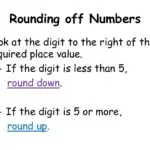
To round a number to the nearest whole number, check the digit in the first decimal place:
- If the digit is 5 or greater (5, 6, 7, 8, 9), round up the whole number by adding 1.
- If the digit is less than 5 (0, 1, 2, 3, 4), keep the whole number as it is.
Examples:
- Round 15.7 to the nearest whole number.
- Step 1: Identify the first decimal digit, which is 7.
- Step 2: Since 7 is greater than or equal to 5, round up the whole number (15).
- Answer: 16
- Round 8.24 to the nearest whole number.
- Step 1: Identify the first decimal digit, which is 2.
- Step 2: Since 2 is less than 5, keep the whole number (8) as it is.
- Answer: 8
Rounding to Decimal Places (d.p.)
To round a number to a specific number of decimal places, look at the digit immediately after the last required decimal place:
- If this digit is 5 or greater, add 1 to the last required decimal digit.
- If this digit is less than 5, keep the last required decimal digit as it is.
Examples:
- Round 7.348 to 2 decimal places.
- Step 1: The second decimal place is 4. The digit after it is 8.
- Step 2: Since 8 is greater than or equal to 5, add 1 to 4.
- Answer: 7.35
- Round 0.913 to 1 decimal place.
- Step 1: The first decimal place is 9. The digit after it is 1.
- Step 2: Since 1 is less than 5, keep 9 as it is.
- Answer: 0.9
Rounding to Significant Figures (s.f.)
Significant figures are the digits in a number that carry meaningful contributions to its measurement resolution.
Rules for identifying significant figures:
- All non-zero digits are significant. (e.g., 123 has 3 s.f.)
- Zeros between non-zero digits are significant. (e.g., 102 has 3 s.f.)
- Leading zeros (zeros before non-zero digits) are not significant. (e.g., 0.00123 has 3 s.f.)
- Trailing zeros (zeros at the end of the number) are significant only if the number contains a decimal point. (e.g., 1200 has 2 s.f.; 1200.0 has 5 s.f.)
To round to significant figures, identify the required number of significant figures, then apply the rounding rule to the next digit.
Examples:
- Round 23,456 to 3 significant figures.
- Step 1: The first three significant figures are 2, 3, 4. The next digit is 5.
- Step 2: Since 5 is greater than or equal to 5, add 1 to 4.
- Step 3: Replace the remaining digits with zeros to maintain place value.
- Answer: 23,500
- Round 0.007821 to 2 significant figures.
- Step 1: The first two significant figures are 7, 8 (leading zeros are not significant). The next digit is 2.
- Step 2: Since 2 is less than 5, keep 8 as it is.
- Answer: 0.0078
Approximation using Logarithm Tables and Calculators
Logarithm tables and calculators are tools used to perform complex calculations. When using these tools, results often need to be approximated due to the limitations of the table (e.g., fixed number of decimal places) or the need for a simpler final answer. While calculators provide more precise answers, log tables often require rounding during intermediate steps, leading to slight differences in final approximated values.
Percentage Error
Percentage error is a measure of the difference between an approximate or measured value and the actual or exact value, expressed as a percentage of the actual value.
Formula:
Percentage Error = |Actual Value – Approximate Value| / Actual Value × 100%
Examples:
- A student measures the length of a desk as 1.5 meters, but its actual length is 1.6 meters. Calculate the percentage error.
- Step 1: Identify Actual Value = 1.6 m, Approximate Value = 1.5 m.
- Step 2: Calculate the difference: |1.6 – 1.5| = 0.1 m.
- Step 3: Apply the formula: (0.1 / 1.6) × 100% = 6.25%.
- A machine is supposed to produce bolts of 20 mm length. Due to a fault, it produces bolts of 20.5 mm length. Find the percentage error.
- Step 1: Identify Actual Value = 20 mm, Approximate Value = 20.5 mm.
- Step 2: Calculate the difference: |20 – 20.5| = |-0.5| = 0.5 mm.
- Step 3: Apply the formula: (0.5 / 20) × 100% = 2.5%.
Application of Approximation in Everyday Life
Approximation is used in various real-life situations:
- Population Figures: Reporting population numbers to the nearest million or thousand.
- Financial Reports and Budgets: Rounding large sums of money in financial statements for clarity.
- Measurements: Estimating distances, weights, or volumes when exact figures are not necessary or difficult to obtain.
- Scientific Calculations: Rounding off results to an appropriate number of significant figures based on instrument precision.
- Time Management: Estimating how long tasks will take.
Teaching Methods/Instructional Techniques
Discussion, Lecture, Demonstration, Question and Answer, Visual Aids
Instructional Procedures
Step 1: Introduction
Time: 5 minutes
Teaching Skill: Set Induction
Teacher’s Activity: The teacher greets the pupils and asks them if they have ever rounded numbers or estimated values in their daily lives, like estimating the cost of groceries or the number of people at an event.
Pupils’ Activity: Pupils share their experiences of estimating or rounding numbers.
Learning Point: Pupils relate approximation to real-life situations.
Step 2: Explanation of Approximation and Rounding to Whole Numbers
Time: 8 minutes
Teaching Skill: Explanation/Demonstration
Teacher’s Activity: The teacher defines approximation and explains the rules for rounding numbers to the nearest whole number, demonstrating with examples on the board.
Pupils’ Activity: Pupils listen, take notes, and practice rounding numbers to the nearest whole number as guided by the teacher.
Learning Point: Pupils understand the concept of approximation and can round numbers to the nearest whole number.
Step 3: Explanation of Rounding to Decimal Places
Time: 8 minutes
Teaching Skill: Explanation/Demonstration
Teacher’s Activity: The teacher explains the rules for rounding numbers to a specified number of decimal places, providing various examples for clarity.
Pupils’ Activity: Pupils actively participate by solving examples and asking questions for clarification.
Learning Point: Pupils can round numbers to a given number of decimal places.
Step 4: Explanation of Rounding to Significant Figures
Time: 8 minutes
Teaching Skill: Explanation/Demonstration
Teacher’s Activity: The teacher explains the concept of significant figures and the rules for rounding numbers to a specified number of significant figures, including examples with leading and trailing zeros.
Pupils’ Activity: Pupils note down the rules and practice rounding numbers to significant figures, including comparing results obtained from logarithm tables and calculators for approximate values.
Learning Point: Pupils understand significant figures and can round numbers accordingly, also acknowledging the use of different tools.
Step 5: Introduction to Percentage Error
Time: 8 minutes
Teaching Skill: Explanation/Problem Solving
Teacher’s Activity: The teacher defines percentage error, introduces its formula, and guides pupils through worked examples, emphasizing the difference between actual and approximate values.
Pupils’ Activity: Pupils copy the formula and worked examples, and attempt to solve similar problems independently or in pairs.
Learning Point: Pupils can calculate the percentage error in given scenarios.
Step 6: Applications of Approximation
Time: 3 minutes
Teaching Skill: Discussion/Application
Teacher’s Activity: The teacher discusses various real-life applications of approximation, such as in financial reports, population figures, and scientific measurements, using the instructional materials.
Pupils’ Activity: Pupils identify and discuss more examples of approximation in daily life and various sectors.
Learning Point: Pupils appreciate the practical importance of approximation.
Step 7: Evaluation/Review
Time: 5 minutes
Teaching Skill: Questioning/Assessment
Teacher’s Activity: The teacher evaluates the learning by asking the following questions:
- Define approximation in your own words.
- Round 345.678 to the nearest whole number, 2 decimal places, and 3 significant figures.
- The actual weight of a bag of rice is 50 kg. A scale measures it as 49.5 kg. Calculate the percentage error.
- Mention two areas in everyday life where approximation is commonly used.
Pupils’ Activity: Pupils answer orally and in writing.
Learning Point: Pupils demonstrate understanding of the lesson.
Step 8: Conclusion
Time: 1 minute
Teaching Skill: Summarization
Teacher’s Activity: The teacher summarizes the key concepts of approximation, rounding techniques, and percentage error, and assigns homework.
Pupils’ Activity: Pupils listen and copy down the homework assignment.
Lesson Keywords
- Approximation – Finding a value that is close to the exact value.
- Rounding – Adjusting a number to a simpler, approximate value.
- Decimal Places – The number of digits after the decimal point.
- Significant Figures – Digits in a number that contribute to its precision.
- Percentage Error – The relative error expressed as a percentage.
Differentiation
For pupils who grasp concepts quickly, provide more complex numbers for rounding or multi-step problems involving percentage error. For those needing more support, offer additional guided practice with simpler numbers and visual aids, and allow peer tutoring.
Note for teachers using this lesson plan
Encourage pupils to use both logarithm tables and calculators to solve problems where appropriate, allowing them to compare results and understand the slight differences that may arise due to rounding conventions. Emphasize the practical relevance of approximation to sustain pupil interest.

Community Join the conversation Open discussion +