

Class: Senior Secondary School 1 (SS1, SS 1, SSS1, SSS 1)
Term: 2nd Term
Week: 8
Age: 15 years
Duration: 45 minutes
Subject: Agricultural Science
Curriculum Theme: Agricultural Science
Previous Lesson: Methods of soil conservation.
Topic: Husbandry of Pulses (groundnut, cowpea)
Subject Matter: method of propagation of pulses, climatic and soil requirements for groundnut and cowpea, pre planting and planting operations for pulses, manuring and fertilizer requirements for pulses, harvesting processing and storage of pulses, farm record keeping for pulse production
Specific Objectives
By the end of the lesson, pupils should be able to:
Cognitive Domain:
- Define pulses and state their importance.
- Describe the methods of propagation for groundnut and cowpea.
- State the climatic and soil requirements for groundnut and cowpea.
- Explain the pre-planting and planting operations for pulses.
- List the manuring and fertilizer requirements for pulses.
- Describe the processes of harvesting, processing, and storage of pulses.
- Identify different types of farm records essential for pulse production.
Affective Domain:
- Appreciate the economic importance of pulse production in Nigeria.
- Show interest in adopting good husbandry practices for pulses.
- Value the importance of accurate farm record keeping.
Psychomotor Domain:
- Demonstrate the correct planting depth for pulse seeds.
- Prepare simple farm records for pulse production.
- Outline the steps involved in processing and storing pulses.
Social Domain:
- Work cooperatively in groups to discuss pulse husbandry practices.
- Share ideas on sustainable pulse production techniques.
Reference Materials
The following resources were used in planning this lesson:
- 9 Years Basic Education Curriculum for Senior Secondary Agricultural Science.
- State Unified Scheme of Work for Agricultural Science SSS 1.
- Essential Agricultural Science for Senior Secondary Schools by O.A. Iwena.
- Agricultural Science for Senior Secondary Schools by B.O. Anyaegbu.
Instructional Materials
The teacher will teach this lesson with the aid of:
- Groundnut and cowpea seeds.
- Farm tools (e.g., hoe, cutlass).
- Fertilizer samples (e.g., NPK, SSP).
- Record sheets or sample farm record books.
- Husbandry charts showing stages of pulse growth and operations.
Rationale for the Lesson
This lesson helps pupils understand how to cultivate important food crops like groundnut and cowpea, which are staples in many Nigerian diets. It also teaches them the practical skills of managing a farm and keeping records, which are useful for successful farming and managing resources effectively.
Prerequisite/Previous Knowledge
Pupils should have a basic understanding of general crop production, types of crops, and the importance of agriculture.
Lesson Content/Board Summary
Husbandry of Pulses (Groundnut and Cowpea)
Definition of Pulses
Pulses are leguminous crops harvested solely for the dry grain. They are a type of legume but the term “pulse” refers only to the dry seed. Examples include groundnut, cowpea, beans, lentils, and chickpeas.
Methods of Propagation of Pulses
Pulses are propagated mainly by seeds.
The following are common methods for groundnut and cowpea:
- Groundnut: Seeds are planted directly in the soil.
- Cowpea: Seeds are planted directly in the soil.
Climatic and Soil Requirements for Groundnut and Cowpea
Groundnut
Climate:
- Requires warm temperatures (25-30°C).
- Needs moderate rainfall (500-1000mm) well distributed during the growing season.
- Requires a dry period for harvesting.
Soil:
- Thrives in well-drained, sandy loams or loamy sands.
- Prefers slightly acidic to neutral pH (6.0-7.0).
- Needs good aeration for peg development.
Cowpea
Climate:
- Tolerant to a wide range of temperatures, thrives in warm conditions (25-35°C).
- Requires moderate rainfall (300-800mm).
- Can tolerate drought conditions better than many other crops.
Soil:
- Grows well in a variety of soils, from sandy to clay loams.
- Prefers well-drained soils.
- Tolerates slightly acidic to alkaline pH (5.5-7.5).
Pre-planting and Planting Operations for Pulses
Pre-planting Operations:
- Land Preparation: Clearing, ploughing, harrowing to create a fine tilth.
- Seed Selection: Using healthy, viable, disease-free seeds.
- Seed Treatment: Treating seeds with fungicides or insecticides to protect against pests and diseases.
Planting Operations:
- Time of Planting: Usually at the onset of the rainy season.
- Method of Planting: Direct sowing (drilling or dibbling).
- Spacing: Appropriate spacing (e.g., groundnut 75cm x 25cm; cowpea 75cm x 20cm) to allow for proper growth and aeration.
- Depth of Planting: Seeds are planted at a depth of 3-5 cm.
Manuring and Fertilizer Requirements for Pulses
Pulses, being legumes, fix atmospheric nitrogen through root nodules. Therefore, they generally require less nitrogen fertilizer.
The following are general requirements:
- Organic Manure: Application of farmyard manure or compost before planting improves soil structure and fertility.
- Phosphorus (P): Essential for root development and nodulation. Applied as Single Superphosphate (SSP) or Triple Superphosphate (TSP).
- Potassium (K): Important for overall plant health and disease resistance. Applied as Muriate of Potash (MOP).
- Calcium (Ca): Particularly important for groundnut peg development. Applied as gypsum.
Harvesting, Processing, and Storage of Pulses
Harvesting:
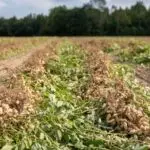
- Groundnut: Harvested when leaves turn yellow and pods are mature (usually 90-120 days after planting). Plants are lifted, dried, and pods removed.
- Cowpea: Harvested when pods are dry and brittle (usually 60-90 days after planting). Pods are picked manually or plants are cut.
Processing:
- Threshing: Separating the seeds from the pods (manual or mechanical).
- Winnowing: Separating lighter chaff from heavier seeds.
- Drying: Reducing moisture content to safe levels (10-12%) to prevent spoilage.
Storage:
- Stored in clean, dry, cool, and well-ventilated places.
- Use of airtight containers, jute bags, or silos.
- Pest control measures (e.g., insecticides, traditional methods like ash) are important.
Farm Record Keeping for Pulse Production
Farm records are written accounts of all activities and transactions on a farm. They help in decision-making and assessing profitability.
The following are important farm records for pulse production:
- Production Record: Date of planting, seed variety, area planted, yield per hectare.
- Input Record: Quantities and costs of seeds, fertilizers, pesticides, labour.
- Labour Record: Dates, type of work, hours worked, wages paid.
- Sales Record: Dates of sale, quantity sold, selling price, total income.
- Financial Record: All income and expenditure.
Teaching Methods/Instructional Techniques
Discussion, Lecture, Demonstration, Question and Answer, Visual Aids
Instructional Procedures
Step 1: Introduction
Time: 5 minutes
Teaching Skill: Set Induction
Teacher’s Activity: The teacher greets the pupils and reviews the previous lesson. The teacher then introduces the new topic by asking pupils to name common leguminous crops grown in their locality and their uses. The teacher writes the topic “Husbandry of Pulses (groundnut, cowpea)” on the board.
Pupils’ Activity: Pupils respond to the teacher’s questions, mentioning crops like beans, groundnut, and cowpea. They listen and copy the topic.
Learning Point: Pupils are prepared for the new lesson and relate it to their prior knowledge.
Step 2: Explanation of Pulses and Propagation
Time: 7 minutes
Teaching Skill: Explanation/Demonstration
Teacher’s Activity: The teacher defines pulses and explains their importance. The teacher then discusses the methods of propagation for groundnut and cowpea, showing actual seeds as examples. The teacher emphasizes that pulses are mainly propagated by seeds.
Pupils’ Activity: Pupils listen attentively, ask questions, and observe the seeds.
Learning Point: Pupils understand what pulses are and how they are propagated.
Step 3: Climatic and Soil Requirements
Time: 7 minutes
Teaching Skill: Explanation/Discussion
Teacher’s Activity: The teacher explains the specific climatic and soil requirements for groundnut and cowpea, highlighting similarities and differences. The teacher may use a chart to illustrate these requirements.
Pupils’ Activity: Pupils listen, take notes, and participate in discussions about suitable conditions for growing these crops.
Learning Point: Pupils learn the ideal environmental conditions for groundnut and cowpea.
Step 4: Pre-planting and Planting Operations
Time: 7 minutes
Teaching Skill: Explanation/Demonstration
Teacher’s Activity: The teacher describes the steps involved in pre-planting operations (land preparation, seed selection, seed treatment) and planting operations (time, method, spacing, depth). The teacher can demonstrate ideal planting depth using a small container of soil or by showing a diagram.
Pupils’ Activity: Pupils observe the demonstration, ask questions for clarification, and take notes.
Learning Point: Pupils understand the practical steps before and during planting pulses.
Step 5: Manuring and Fertilizer Requirements
Time: 5 minutes
Teaching Skill: Explanation/Questioning
Teacher’s Activity: The teacher explains the manuring and fertilizer needs of pulses, emphasizing their nitrogen-fixing ability. The teacher shows samples of fertilizers like NPK or SSP and discusses their application.
Pupils’ Activity: Pupils listen, observe the fertilizer samples, and ask questions about nutrient application.
Learning Point: Pupils learn about the nutritional needs of pulses and appropriate fertilizer use.
Step 6: Harvesting, Processing, and Storage
Time: 6 minutes
Teaching Skill: Explanation/Discussion
Teacher’s Activity: The teacher explains the methods and timing for harvesting groundnut and cowpea. The teacher then discusses the processing steps (threshing, winnowing, drying) and proper storage techniques to prevent spoilage and pest infestation.
Pupils’ Activity: Pupils listen, take notes, and contribute ideas on traditional storage methods.
Learning Point: Pupils understand the post-harvest operations for pulses.
Step 7: Evaluation/Review
Time: 5 minutes
Teaching Skill: Questioning/Assessment
Teacher’s Activity: The teacher evaluates the learning by asking the following questions:
- Define pulses and give two examples.
- State three climatic requirements for groundnut cultivation.
- List three pre-planting operations for pulses.
- Mention two types of farm records important for pulse production.
Pupils’ Activity: Pupils answer orally and in writing.
Learning Point: Pupils demonstrate understanding of the lesson.
Step 8: Conclusion
Time: 3 minutes
Teaching Skill: Summarization/Assignment
Teacher’s Activity: The teacher summarizes the key points of the lesson, reiterating the importance of proper pulse husbandry and record keeping. The teacher gives an assignment: “Draw a simple farm record sheet for pulse production and fill it with hypothetical data for one planting season.”
Pupils’ Activity: Pupils listen to the summary and copy the assignment.
Learning Point: Pupils consolidate their learning and apply it through an assignment.
Lesson Keywords
- Pulses – Leguminous crops harvested solely for their dry grain.
- Husbandry – The care, cultivation, and breeding of crops and animals.
- Propagation – The process of breeding specimens of a plant or animal by natural processes from the parent stock.
- Pre-planting operations – Activities carried out before planting seeds, such as land preparation and seed treatment.
- Threshing – The process of separating edible grain from the husks and stalks.
- Winnowing – A method of separating grain from chaff by means of wind.
- Farm records – Written accounts of all farm activities, income, and expenditure.
Differentiation
The teacher will provide additional support to struggling learners by pairing them with more advanced pupils for peer tutoring during group activities. Advanced pupils will be encouraged to research and present on common pulse diseases and their control measures.
Note for teachers using this lesson plan
Teachers should ensure they have all instructional materials readily available before the lesson. Practical demonstrations, where possible, will enhance pupil understanding. Encourage pupils to share their experiences with pulse cultivation from their homes or communities to make the lesson more relatable.

Community Join the conversation Open discussion +