

Note for teachers using this lesson plan
This lesson introduces Senior Secondary 1 students to simple farm tools. Teachers should prepare by having actual samples of hoes, cutlasses, and rakes available for demonstration, ensuring they are in safe condition. Emphasise safety precautions during any practical demonstration or activity on the school farm. By the end of the lesson, students should be able to define, explain, and identify the uses of these basic tools, understanding their role in soil preparation and crop production.
Class: SS 1
Term: Third Term
Week: 1
Age: 15 years
Duration: 60 minutes
Subject: Agricultural Science
Curriculum Theme: Simple tools and farm Machinery
Focal competence: Using simple farm tools effectively
Key competencies/values: Critical Thinking; Information Literacy
Skills:
- Utilising farm tools
Previous Lesson:
Topic: Simple Farm Tools
Subject Matter: Meaning and example of simple farm tools, Uses of simple farm tools
Specific Objectives
By the end of the lesson, pupils/students should be able to:
Cognitive Domain
- Define simple farm tools.
- Explain what simple farm tools are.
- Identify basic common uses of simple farm tools.
Affective Domain
- Appreciate the importance of simple farm tools in farming operations.
- Observe safety precautions when handling simple farm tools.
Psychomotor Domain
- Demonstrate the correct handling of a hoe for tilling.
- Demonstrate the correct handling of a cutlass for clearing.
Reference Materials
The following resources were used in planning this lesson:
- 2025 New Revised Senior Secondary Education Curriculum (SSEC)
- Relevant State Unified Scheme of Work
- Agricultural Science for Senior Secondary Schools, Book 1
- The HeadTeacher Scheme of work For The New Revised Senior Secondary Education Curriculum (SSEC)
Instructional Materials
The teacher will teach this lesson with the aid of:
- Sample of a Hoe for tilling the soil.
- Sample of a Cutlass for clearing bushes.
- Sample of a Rake for levelling of seed bed.
- Video clips on the use of farm tools (if available).
- Pictures or charts showing various simple farm tools.
- School farm for practical demonstration.
Rationale for the Lesson
This lesson is important as it introduces students to fundamental tools used in agriculture, which are essential for basic farm operations. Understanding these tools and their correct uses helps students develop practical skills for crop production and appreciate the labour involved in farming. It also lays a foundation for understanding more complex farm machinery later on.
Prerequisite/Previous Knowledge
Students should have basic knowledge of farming activities and the need for tools in daily life.
Lesson Content/Board Summary
Simple Farm Tools
Meaning of Simple Farm Tools
Simple farm tools are basic, hand-operated implements used by farmers for various agricultural activities. They are typically non-mechanised and require human effort to operate. These tools are fundamental for small-scale farming and initial land preparation.
Examples of Simple Farm Tools
Common examples of simple farm tools include:
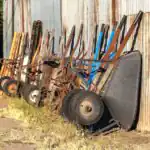
- Hoe: A tool with a long handle and a flat blade, used for digging, tilling, weeding, and making ridges.
- Cutlass: A long, broad-bladed knife, primarily used for clearing bushes, cutting weeds, and harvesting certain crops.
- Rake: A tool with a long handle and a head with tines or teeth, used for gathering leaves, levelling soil, and spreading materials.
- Spade/Shovel: Tools with a handle and a broad, flat blade, used for digging, lifting, and moving loose materials like soil or sand.
- Fork: A tool with a handle and several tines, used for loosening soil, turning compost, or lifting hay.
Uses of Simple Farm Tools
Uses of Cutlass
The cutlass is a versatile tool used for:
- Clearing bushes: Removing dense vegetation and undergrowth from farmland before cultivation.
- Weeding: Cutting down unwanted plants (weeds) that compete with crops for nutrients, water, and sunlight.
- Harvesting: Cutting down certain crops like maize stalks, cassava stems, or sugarcane.
- Pruning: Trimming small branches or unwanted parts of plants.
Uses of Hoe
The hoe is essential for various soil-related tasks:
- Tilling the soil: Breaking up hard soil, which improves soil aeration (allowing air to reach plant roots), enhances water infiltration and retention, and makes nutrients more available to crops. It also prepares a good seedbed for planting.
- Weeding: Removing weeds by cutting them at the root level or overturning them.
- Making ridges and heaps: Creating elevated rows or mounds of soil for planting specific crops like yam, cassava, or groundnuts.
- Moulding: Piling soil around the base of plants for support and to cover tubers, protecting them from sunlight and pests.
Uses of Rake
The rake is used for:
- Levelling seedbeds: Smoothing the surface of the soil after tilling to create an even bed for planting seeds.
- Gathering debris: Collecting leaves, stones, and other unwanted materials from the farm.
- Spreading manure or compost: Distributing organic matter evenly over the soil surface.
Teaching Methods/Instructional Techniques
Discussion, Demonstration, Guided Practice, Question and Answer, Explanation, Observation, Practical Activity
Instructional Procedures
Step 1: Introduction
Time: 5 minutes
Teaching Skill: Questioning/Activating Prior Knowledge
Teacher’s Activity: The teacher greets the students and asks them to mention some activities farmers carry out on their farms. The teacher then asks what tools farmers use for these activities.
Pupils’ Activity: Pupils respond by mentioning activities like planting, weeding, harvesting, and tools like hoe, cutlass, etc.
Learning Point: Farm activities and tools
Step 2: Meaning of Simple Farm Tools
Time: 10 minutes
Teaching Skill: Explanation/Definition
Teacher’s Activity: The teacher explains what simple farm tools are, highlighting that they are basic, hand-operated implements. The teacher guides students to brainstorm on the meaning.
Pupils’ Activity: Pupils listen attentively and contribute to defining simple farm tools.
Learning Point: Definition of simple tools
Step 3: Examples of Simple Farm Tools
Time: 10 minutes
Teaching Skill: Demonstration/Identification
Teacher’s Activity: The teacher displays samples of a hoe, cutlass, and rake. The teacher asks students to identify each tool and state its name.
Pupils’ Activity: Pupils identify the tools and state their names.
Learning Point: Identification of tools
Step 4: Uses of Cutlass
Time: 10 minutes
Teaching Skill: Explanation/Discussion
Teacher’s Activity: The teacher explains the various uses of a cutlass, such as clearing bushes, weeding, and harvesting. The teacher demonstrates safe handling of the cutlass.
Pupils’ Activity: Pupils listen, ask questions, and discuss the uses of the cutlass.
Learning Point: Uses of cutlass
Step 5: Uses of Hoe and Rake
Time: 10 minutes
Teaching Skill: Explanation/Connection
Teacher’s Activity: The teacher explains the uses of the hoe (tilling, weeding, making ridges) and the rake (levelling, gathering). The teacher connects the use of the hoe for tilling to improving soil aeration, water retention, and nutrient availability.
Pupils’ Activity: Pupils listen and understand the uses, relating them to soil properties.
Learning Point: Uses of hoe and rake
Step 6: Practical Application/Demonstration
Time: 10 minutes
Teaching Skill: Guided Practice/Demonstration
Teacher’s Activity: The teacher guides students to the school farm (if available) or uses video clips to demonstrate the correct and safe handling of the hoe for tilling and the cutlass for clearing. Students are guided to carry out simple farming operations.
Pupils’ Activity: Pupils observe the demonstration and practice handling the tools under supervision, appreciating their importance.
Learning Point: Safe tool handling
Step 7: Evaluation/Review
Time: 5 minutes
Teaching Skill: Questioning/Assessment
Teacher’s Activity: The teacher evaluates the learning by asking the following questions:
- What are simple farm tools?
- Mention two examples of simple farm tools.
- State two uses of a cutlass.
- Explain why tilling the soil with a hoe is important.
Pupils’ Activity: Pupils answer orally and in writing.
Learning Point: Understanding farm tools
Step 8: Note-Taking
Time: 10 minutes
Teaching Skill: Guided Writing
Teacher’s Activity: The teacher guides pupils/students to copy the essential Board Summary notes on the meaning, examples, and uses of simple farm tools into their notebooks.
Pupils’ Activity: Pupils/students copy the notes carefully into their notebooks.
Learning Point: Recording lesson notes
Step 9: Conclusion
Time: 5 minutes
Teaching Skill: Consolidation
Teacher’s Activity: The teacher summarises the lesson by reiterating the importance of simple farm tools in agriculture and the need for proper handling and maintenance. The teacher encourages students to practice identifying these tools and their uses.
Pupils’ Activity: Pupils listen and ask any final questions.
Learning Point: Importance of farm tools
Continuous Assessment/Further Study
Type: Homework
Instruction: Answer the following questions in your Agricultural Science notebook.
- List five simple farm tools not discussed in class and state one use for each.
- Describe three safety precautions to observe when using a cutlass or hoe.
- Draw and label a hoe and a cutlass.
Lesson Keywords
- Simple Farm Tools – Basic, hand-operated implements used in agriculture.
- Hoe – A tool for tilling, weeding, and making ridges.
- Cutlass – A long-bladed knife for clearing bushes and cutting.
- Rake – A tool for levelling soil and gathering debris.
- Tilling – Breaking up soil to prepare it for planting.
- Weeding – Removing unwanted plants from a farm.
Differentiation
For students who grasp concepts quickly, encourage them to research the maintenance and storage of simple farm tools. For students needing more support, provide labelled diagrams of the tools and their uses, and offer additional guided practice during the practical session.
Suggested Lesson Videos
Search on YouTube for: simple farm tools and their uses agricultural science ss1
Community Join the conversation Open discussion +