

Class: Primary 6
Term: Third Term
Subject: Basic Science & Technology
Curriculum Theme: Basic Technology
Previous Lesson: Definition and Types Simple Machines
Topic: Simple Machines
content/Learning Area: Simple Machine Classes (Lever, Pulley, Inclined Plane)
Time Allocation: 40 Minutes
Performance Objectives
By the end of the lesson, pupils should be able too:
- Cognitive Domain: Classify simple machines into their respective types.
- Affective Domain: Show interest in learning about the different types of simple machines and their uses.
- psychomotor Domain: Construct simple models of levers, pulleys, or inclined planes.
- Social Domain: Collaborate with peers to identify and discuss the uses of simple machines in everyday life.
Reference Materials
- 9 Years basic Education Curriculum
- Abuja Educational Resource Center Scheme of work
- NAPPS National Unified Scheme of Work
- Basic Science and Technology Textbook for Primary 6
- Evans Basic Science and Technology for Primary Schools, Book 6
Instructional Materials
To deliver this lesson, the teacher will use the following materials: real-life examples of levers (e.g., seesaw, crowbar), pulleys (e.g., window blinds, well pulley), and inclined planes (e.g., ramp, slide), charts illustrating different types of simple machines, and materials for constructing simple models (e.g., cardboard, string, weights).
Rationale for the Lesson
understanding simple machines helps pupils appreciate how technology simplifies tasks. this knowledge is crucial for future technological innovations and problem-solving skills.
Prerequisite/Previous Knowledge
Pupils have a basic understanding of what machines are and their uses in making work easier.
Lesson Content
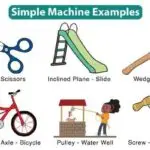
Simple Machines
Lever
A lever is a simple machine that consists of a rigid bar that pivots on a fixed point called a fulcrum. Levers are used to multiply force to lift heavy objects or move things more easily.
- Seesaw – A playground equipment that uses a lever to lift people up and down.
- Crowbar – A tool used to pry objects apart or lift heavy items.
- Pliers – A tool used for gripping or cutting, utilizing the lever principle.
- Scissors – A cutting tool that uses two levers to slice through materials.
- Wheelbarrow – A cart with a single wheel, using a lever to lift and move loads.
- Nutcracker – A device used to crack nuts by applying force through a lever.
- Bottle Opener – A tool used to remove bottle caps, employing the lever principle.
- Fishing Rod – A pole used for fishing, utilizing a lever to cast the line and reel in fish.
Pulley
A pulley is a simple machine that consists of a wheel with a grooved rim around which a rope,cable,or belt passes. Pulleys are used to lift heavy objects by changing the direction of the force or multiplying the force applied.
- Window Blinds – A system of cords and pulleys used to raise and lower blinds.
- Well Pulley – A pulley used to draw water from a well.
- Crane – A machine that uses pulleys to lift and move heavy objects in construction.
- Elevator – A lift that uses pulleys and cables to transport people or goods vertically.
- Flagpole – A pole with a pulley system to raise and lower a flag.
- Clothesline – A line strung between two points with a pulley to hang and dry clothes.
- gym Equipment – Various machines in a gym use pulleys to provide resistance for exercise.
- Theater Curtains – A system of pulleys used to raise and lower curtains on a stage.
Inclined Plane
An inclined plane is a simple machine that is a flat surface set at an angle or incline with no moving parts. Inclined planes are used to make it easier to move objects to a higher or lower level.
- Ramp – A sloping surface used to move objects or people between different levels.
- Slide – A playground equipment that uses an inclined plane for children to slide down.
- Stairs – A series of steps that form an inclined plane for ascending or descending.
- Loading Ramp – A ramp used to load goods onto trucks or ships.
- Mountain Road – A road that winds up a mountain, using an inclined plane to reduce the steepness.
- Wheelchair Ramp – A ramp designed to provide access for wheelchair users.
- Conveyor Belt – A moving inclined plane used to transport items in factories or warehouses.
- Chute – A sloping channel used to slide objects down,such as in mining or agriculture.
Teaching Methods
To deliver this lesson, the teacher will adopt the following methods: Explanation, Exhibition, Visual Aids, Discussion, Group Work.
Instructional Procedures
to deliver this lesson, the teacher will adopt the following steps:
Step 1: Introduction
Time: 5 Minutes
Teaching Skill: Set Induction
teacher’s Activity: The teacher reviews the previous lesson on machines and introduces the topic of simple machines by asking pupils to name some machines they know and how they make work easier.
Pupils’ Activity: Pupils respond by naming machines they know and explaining how they help in daily tasks.
Step 2: Lever Explanation
Time: 10 Minutes
Teaching Skill: Explanation
Teacher’s Activity: The teacher explains what a lever is, its components (fulcrum, load, effort), and provides examples of levers in everyday life, demonstrating how they work.
Pupils’ Activity: Pupils listen attentively, ask questions, and identify examples of levers around them.
Step 3: Pulley Explanation
Time: 10 Minutes
Teaching Skill: Explanation
Teacher’s Activity: The teacher explains what a pulley is, its types (fixed and movable), and demonstrates how pulleys make lifting easier, using real-life examples.
Pupils’ Activity: Pupils observe the demonstration, ask questions, and discuss the uses of pulleys in various applications.
Step 4: Inclined Plane Explanation
Time: 10 Minutes
Teaching Skill: Explanation
Teacher’s Activity: the teacher explains what an inclined plane is and how it reduces the force needed to move objects vertically, providing examples like ramps and slides.
Pupils’ Activity: Pupils listen, ask questions, and relate inclined planes to their experiences with ramps and slides.
Step 5: Note-Taking
Time: 3 Minutes
Teaching Skill: Writing
Teacher’s Activity: The teacher writes a summary of the lesson on the board.
Pupils’ Activity: Pupils copy the notes into their notebooks.
Step 6: Evaluation/Review
Time: 2 Minutes
Teaching Skill: Questioning
Teacher’s Activity: the teacher asks questions to assess pupils’ understanding of the different types of simple machines.
pupils’ Activity: Pupils answer the questions to demonstrate their understanding.
Objective-aligned checks:
- Classify simple machines into their respective types.
- Construct simple models of levers, pulleys, or inclined planes.
- Collaborate with peers to identify and discuss the uses of simple machines in everyday life.
Step 7: Conclusion
Time: 2 Minutes
Teaching Skill: Summarizing
Teacher’s Activity: The teacher summarizes the main points of the lesson and emphasizes the importance of simple machines in everyday life.
Pupils’ Activity: Pupils listen and recap the main points of the lesson.
Lesson Keywords
- Lever – A simple machine using a rigid bar and fulcrum to multiply force.
- Pulley – A simple machine using a wheel and rope to lift objects.
- Inclined Plane – A simple machine using a sloping surface to reduce the force needed to move objects vertically.
- fulcrum – The pivot point of a lever.
- Load – The object being moved or lifted by a machine.
- Effort – The force applied to a machine to move the load.
Lesson Evaluation
To evaluate the learning, the teacher asks pupils to:
- Classify the following machines into levers, pulleys, or inclined planes: seesaw, window blinds, ramp, crowbar, well pulley.
- Explain how an inclined plane makes work easier.
- Give examples of where pulleys are used in their surroundings.
Assignment/Homework
- Draw and label examples of levers, pulleys, and inclined planes found in their homes or surroundings.
- Write a short paragraph explaining which simple machine they find most useful and why.
differentiation
- For slower learners: provide simplified diagrams and hands-on activities with real objects to demonstrate the principles of each simple machine.
- For advanced learners: Challenge them to design and build a complex machine that combines two or more simple machines.
- For visual/auditory/kinesthetic learners: Use visual aids, verbal explanations, and hands-on activities to cater to different learning styles.
Note for Teachers
Ensure to use real-life examples and hands-on activities to make the lesson engaging and relatable for the pupils.Encourage pupils to explore and identify simple machines in their environment.

Community Join the conversation Open discussion +