

Class: Primary Six
Term: First Term
Subject: Basic science and Technology
Curriculum Theme: Basic Technology
Previous Lesson: Production Of Primary Colours
Topic: Production of Secondary Colours
Content/Learning Area: Guidelines for production of Secondary colours
Time Allocation: 40 minutes
Performance Objectives
By the end of the lesson, pupils should be able to:
- Cognitive Domain: Identify the primary colours that combine to form secondary colours.
- Affective Domain: Appreciate the importance of colours in everyday life.
- Psychomotor Domain: Mix primary colours to produce secondary colours accurately.
- Social Domain: Collaborate effectively with classmates during the color-mixing activity.
Reference Materials
- 9 – Years Basic Education Curriculum
- Abuja Educational Resource Center Scheme of Work
- NAPPS National Unified Scheme of Work
- Online Facts from Color Meanings – What Are Secondary Colors and How Are They Created?
- relevant Textbooks
Instructional Materials
To deliver this lesson, the teacher will use the following materials:
- Colour mixing charts
- Red, blue, and yellow paints
- Mixing trays and brushes
- White drawing papers
- Water containers for cleaning brushes
Rationale for the lesson
This lesson is essential as it builds upon the knowledge of primary colours, allowing pupils to understand colour mixing and its applications in art and design. This foundational knowledge will be useful in future art projects and everyday life.
Prerequisite/Previous Knowledge
The teacher will start by asking pupils to recall the primary colours they learned in the previous lesson. A swift review of primary colours will be done,setting the stage for learning about secondary colours.
Lesson Content
Production Of Secondary Colours
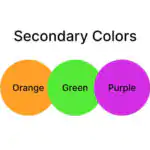
Secondary colours are colours made by mixing two primary colours. These include orange, green, and purple.
How to Produce Secondary Colours:
The following are the steps to produce secondary colours:
- Mix red and yellow to get orange.
- Mix blue and yellow to get green.
- Mix red and blue to get purple.
Producing Clean Secondary Colours
Place small separate amounts of two primary paints on a palette, use a clean brush or mixing stick, combine equal amounts first and record the result. Add one colour gradually to create lighter or darker variations of the mixture.
Dirty tools make muddy colours. Do not return mixed paint to the original container. Protect clothing and the table, avoid tasting art materials and wash hands after the activity.
Producing Secondary Colours
- Place two small primary-colour samples on a clean palette.
- Use a separate brush or clean the brush between colours.
- Mix equal amounts and observe the result.
- Add a little of one colour to create a variation.
- Label the mixture and clean the work area.
Do not pour unused mixed paint back into the original container because it can contaminate the colour.
Teaching Methods
To deliver this lesson, the teacher will adopt the following methods: Discussion, Demonstration, Hands-on Activity, Q&A, Lecture.
Instructional Procedures
To deliver this lesson, the teacher will adopt the following steps:
Step 1: Introduction
Time: 5 min
Teaching Skill: Set Induction
Teacher’s Activity: Review primary colours and ask pupils what happens when two primary colours are mixed.
Pupils’ Activity: Recall and respond about primary colours.
Step 2: Description of Key Concepts
Time: 10 min
Teaching Skill: Demonstration
Teacher’s Activity: Explain secondary colours and demonstrate mixing red and blue to make purple.
Pupils’ Activity: Observe and note the colour change.
Step 3: Guided Practice
Time: 10 min
Teaching Skill: Hands-on Activity
Teacher’s Activity: guide pupils in groups to mix red and yellow (orange), blue and yellow (green).
Pupils’ Activity: Mix colours and observe results.
Step 4: Autonomous Practice
time: 5 min
Teaching skill: Independent Work
Teacher’s Activity: Supervise pupils as they independently practice mixing colours.Pupils’ activity: Independently mix colours based on what they have learned.
Step 5: Note-Taking
Time: 5 min
Teaching Skill: Lecture
Teacher’s activity: Guide pupils to write notes on secondary colours.
Pupils’ Activity: Copy notes into their exercise books.
Step 6: Evaluation/Review
Time: 3 min
Teaching Skill: Oral assessment
Teacher’s activity: Ask questions to assess understanding.
Pupils’ Activity: Answer questions orally.
Step 7: Conclusion
Time: 2 min
Teaching Skill: Wrap-up
Teacher’s Activity: Summarize key points and encourage home practice.
Pupils’ Activity: Listen and reflect.
Lesson Keywords
- Primary Colours – Red, yellow, and blue, which cannot be created by mixing other colours.
- Secondary colours – Colours created by mixing two primary colours.
- Mixing – Combining two or more colours to create a new colour.
- Orange – A secondary colour created by mixing red and yellow.
- Green – A secondary colour created by mixing blue and yellow.
- Purple – A secondary colour created by mixing red and blue.
Lesson Evaluation
To evaluate the learning, the teacher asks pupils to:
- What two primary colours do you mix to make green?
- How do you produce the colour orange?
- Which secondary colour is made by mixing blue and red?
- Why are secondary colours important in our daily lives?
- Describe an activity where you might use secondary colours.
Assignment/Homework
- Mix different amounts of primary colours to create various shades of secondary colours.
- Draw and colour a picture using only secondary colours.
- Write a short paragraph explaining how secondary colours are used in everyday life.
Differentiation
- For slower learners: Provide one-on-one assistance during the colour mixing activity.
- For advanced learners: Challenge them to create additional shades by mixing different amounts of primary colours.
- for visual/auditory/kinesthetic learners: Use colour charts, verbal explanations, and hands-on activities to cater to different learning styles.
Note for Teachers
Ensure that pupils understand the concept of primary colours before introducing secondary colours. Provide clear demonstrations and hands-on activities to reinforce learning. Encourage pupils to explore and experiment with colour mixing to enhance their understanding and creativity.
Community Join the conversation Open discussion +