

Class: Junior Secondary School 1 (JSS1, JSS 1)
Term: 1st Term
Week: 10
Age: 12 years
Duration: 45 minutes
Subject: Basic Science And Technology
Curriculum Theme: Basic Science
Sub Theme: Concept Of Living And Non Living Things
Previous Lesson: Meaning of Drugs, Drug and Substance Abuse, Addiction, Misuse, Examples, Sources, Uses and Side Effects in Family Health
Topic: Reproductive System
Subject Matter: Male Reproductive Organs – Internal and External, Functions and Cares of Male and Female Reproductive Organs
Specific Objectives
By the end of the lesson, pupils should be able to:
- Cognitive Domain:
(a) Identify the internal and external organs of the male reproductive system.
(b) State the functions of male and female reproductive organs. - Affective Domain:
(a) Appreciate the importance of caring for reproductive organs.
(b) Demonstrate respect for discussions on human reproductive health. - Psychomotor Domain:
(a) Draw and label the male reproductive system correctly.
(b) Demonstrate proper hygiene practices for reproductive organs. - Social Domain:
(a) Work in groups to discuss the care of reproductive organs.
(b) Share responsibility in creating awareness on reproductive health among peers.
Reference Materials
The following resources were used in planning this lesson:
- 9 Years Basic Education Curriculum
- Lagos State Unified Scheme of work for Junior Secondary Schools
- Online information from: Wikipedia – Reproductive system
- Relevant Textbooks
Instructional Materials
The teacher will teach this lesson with the aid of:
- A chart of male and female reproductive systems
- Diagrams/drawings on the board
- Multimedia presentation (if available)
- Flash cards with names of reproductive organs
- Real-life hygiene materials like soap, towel, and clean water (for demonstration)
Rationale for the Lesson
Understanding the structure, functions, and care of reproductive organs helps students develop healthy habits and prevents reproductive health problems.
Prerequisite/Previous Knowledge
Pupils are familiar with basic differences between male and female bodies from their everyday experiences and prior lessons on living things.
Lesson Content/Board Summary
The Reproductive System
The reproductive system is the part of the human body made up of special organs that help living things to produce babies. It allows males to make sperm and females to make eggs, and when these come together, new life can begin.
Male Reproductive Organs – Internal and External
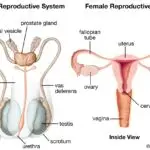
The male reproductive system consists of external and internal organs that work together to produce and deliver sperm. The following are the external organs of the male reproductive system:
- Penis – organ for urination and transfer of sperm.
- Scrotum – sac that holds and protects the testes.
- Testes – produce sperm and male hormone (testosterone).
The following are the internal organs of the male reproductive system:
- Vas deferens – transports sperm.
- Seminal vesicles – produce fluid that mixes with sperm to form semen.
- Prostate gland – adds fluid that nourishes sperm.
- Urethra – passage for urine and semen.
Functions of Male Reproductive Organs
Each part of the male reproductive system has a specific role. The following are the functions of male reproductive organs:
- Testes produce sperm and hormones.
- Penis delivers sperm into the female body.
- Scrotum regulates temperature for sperm production.
- Seminal vesicles and prostate add fluids to nourish sperm.
- Vas deferens and urethra transport sperm.
Female Reproductive Organs – Internal and External
The female reproductive system consists of external and internal organs that work together to produce eggs (ova), support fertilization, and provide a place for the development of a baby.
External Organs of the Female Reproductive System:
- Vulva – the outer part of the female reproductive system that protects the internal organs.
- Labia majora and labia minora – folds of skin that protect the openings of the vagina and urethra.
- Clitoris – a small sensitive organ involved in female sexual response.
- Vaginal opening – the passage through which menstrual flow leaves the body, and through which a baby is born.
Internal Organs of the Female Reproductive System:
- Vagina – a muscular canal that connects the uterus to the outside of the body. It receives the penis during sexual intercourse and serves as the birth canal.
- Uterus (womb) – a hollow, muscular organ where a fertilized egg implants and grows into a baby.
- Fallopian tubes – narrow tubes that carry eggs from the ovaries to the uterus. Fertilization of the egg by sperm usually occurs here.
- Ovaries – small oval-shaped glands that produce eggs (ova) and female hormones (oestrogen and progesterone).
Functions of Female Reproductive Organs
The female reproductive system is designed to produce eggs, receive sperm, and support pregnancy. The following are the functions of female reproductive organs:
- Ovaries produce eggs and hormones.
- Fallopian tubes transport eggs and fertilization occurs here.
- Uterus provides space for development of the baby.
- Vagina receives sperm and serves as the birth canal.
Care of Male and Female Reproductive Organs
Proper care is important for good health and prevention of infections. The following are ways to care for reproductive organs:
- Maintain good personal hygiene by bathing daily.
- Wear clean and loose cotton underwear.
- Avoid sharing personal items like towels and underwear.
- Seek medical help when infections or unusual discharges occur.
- Avoid early sexual activity to protect reproductive health.
Teaching Methods/Instructional Techniques:
Discussion, Lecture, Storytelling, Explanation, Demonstration, Visual Aids, Group Work
Instructional Procedures
To deliver this lesson, the teacher will adopt the following steps:
Step 1: Introduction
Time: 5 minutes
Teaching Skill: Set Induction
Teacher’s Activity: The teacher tells a short story about how different parts of the human body perform important roles, then introduces the topic.
Pupils’ Activity: Pupils listen attentively and respond to questions.
Learning Point: Pupils become interested and prepared for the new topic.
Step 2: Male Reproductive Organs
Time: 10 minutes
Teaching Skill: Explanation
Teacher’s Activity: The teacher presents a chart and explains the external and internal male reproductive organs.
Pupils’ Activity: Pupils observe and identify organs from the chart.
Learning Point: Pupils learn the parts of the male reproductive system.
Step 3: Functions of Reproductive Organs
Time: 10 minutes
Teaching Skill: Discussion
Teacher’s Activity: The teacher explains the functions of male and female reproductive organs using diagrams.
Pupils’ Activity: Pupils discuss and state the functions.
Learning Point: Pupils understand the functions of reproductive organs.
Step 4: Care of Reproductive Organs
Time: 10 minutes
Teaching Skill: Demonstration
Teacher’s Activity: The teacher demonstrates hygiene practices and explains how to care for reproductive organs.
Pupils’ Activity: Pupils demonstrate simple hygiene practices.
Learning Point: Pupils learn proper care of reproductive organs.
Step 5: Note-Taking
Time: 3 minutes
Teaching Skill: Explanation
Teacher’s Activity: The teacher dictates or writes the board summary for pupils to copy.
Pupils’ Activity: Pupils write the notes in their books.
Learning Point: Pupils keep accurate records for revision.
Step 6: Evaluation/Review
Time: 5 minutes
Teaching Skill: Questioning
Teacher’s Activity: The teacher evaluates the learning by asking the following questions:
- Mention three external male reproductive organs.
- State two internal male reproductive organs.
- What is the function of the testes?
- List two functions of the female reproductive system.
- Mention three ways of caring for reproductive organs.
Pupils’ Activity: Pupils answer the teacher’s questions.
Learning Point: Pupils recall and apply what they have learned.
Step 7: Conclusion
Time: 2 minutes
Teaching Skill: Reinforcement
Teacher’s Activity: The teacher summarizes the lesson and emphasizes the importance of caring for reproductive organs.
Pupils’ Activity: Pupils listen and ask questions if necessary.
Learning Point: Pupils understand the summary of the lesson.
Home Task: Record two correct examples of Reproductive System from the lesson or home environment and explain each in your own words.
Lesson Keywords
- Reproductive system – organs responsible for producing offspring
- Testes – male organ that produces sperm and hormones
- Ovaries – female organ that produces eggs and hormones
- Urethra – tube that carries urine and semen out of the body
- Hygiene – practices that keep the body clean and healthy
Differentiation
The teacher will use charts, discussions, and demonstrations to cater for visual, auditory, and kinesthetic learners. Pupils with higher ability will explain functions, while others focus on identification and hygiene practices.
Note for teachers using this lesson plan
Use clear, age-appropriate language when teaching reproductive topics. Encourage respectful behavior during discussions. Avoid embarrassing pupils and emphasize the importance of good hygiene and delayed sexual activity.

Community Join the conversation Open discussion +