

Class: Primary Six
Term: First Term
Subject: Basic Science and Technology
Curriculum Theme: Basic Science
Previous Lesson: Solar System, The Earth’s Gravity
Topic: Earth’s Rotation and Revolution
Content/Learning Area: The Earth and Its Movements
Time Allocation: Not specified
Performance Objectives
By the end of the lesson, pupils should be able to:
- Cognitive Domain:
1. Describe the rotation and revolution of the Earth.
2. Identify the differences between rotation and revolution.
- Affective Domain:
1. Show thankfulness for the earth’s movement and its effects on day and night.
- Psychomotor Domain:
1. Demonstrate the Earth’s rotation and revolution using a globe or a model.
- Social Domain:
1. Collaborate in groups to discuss the effects of the earth’s movement on daily life.
Reference Materials
- 9 – Years basic Education Curriculum
- Abuja Educational Resource Center Scheme of Work
- NAPPS National Unified Scheme of Work
- Online Data from BYJU’S – Earth Rotation and Revolution
- relevant Textbooks
Instructional Materials
To deliver this lesson, the teacher will employ the help of the following materials:
- A globe or a model of the Earth
- A flashlight (to represent the Sun)
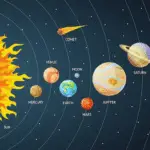
- Diagrams of the solar system
- Whiteboard and markers
Rationale for the Lesson
Understanding Earth’s rotation and revolution is basic to grasping concepts like day and night, seasons, and time zones, crucial for daily life and future science studies.
prerequisite/Previous Knowledge
Pupils are expected to have prior knowledge of the solar system and the position of the Earth within it.
Lesson Content
The Earth and The Movement
The Earth is a planet in our solar system. It’s the third planet from the Sun and supports life.
Rotation
earth’s rotation is the spinning of the earth on its axis.The following are effects of the Earth’s rotation:
- Causes day and night.
- Leads to the deflection of winds and ocean currents.
- Results in the rising and falling of tides.
- Affects the measurement of time and navigation.
- Creates the Coriolis effect, influencing weather patterns.
Revolution
Earth’s revolution is the movement of the Earth around the Sun.
The following are effects of the Earth’s revolution:
- Causes the seasons.
- Affects the length of day and night throughout the year.
- Influences climate patterns and temperature variations.
- Determines the position of constellations in the night sky.
- Impacts agricultural practices and growing seasons.
Differences between Rotation and Revolution
Rotation and revolution are two distinct movements of the earth, each with its own characteristics and effects.
These include:
- Rotation is the Earth spinning on its axis, while revolution is orbiting the Sun.
- Rotation causes day and night, while revolution causes the seasons.
- Rotation takes approximately 24 hours, while revolution takes approximately 365.25 days.
- Rotation affects local time and weather patterns, while revolution affects climate and seasonal changes.
- Rotation is responsible for the Coriolis effect, while revolution is responsible for the changing positions of constellations.
Teaching Methods
To deliver this lesson, the teacher will adopt the following methods: Direct Instruction, Exhibition, discussion, and Question and Answer.
Instructional Procedures
To deliver this lesson,the teacher will adopt the following steps:
Step 1: Introduction
Time: 5 mins
Teaching Skill: Set Induction
Teacher’s Activity: Reviews the solar system,focusing on Earth’s position.
Pupils’ Activity: Listen and respond to questions about the solar system.
Step 2: earth Rotation
Time: 10 mins
Teaching Skill: Demonstration
Teacher’s Activity: Uses a globe and flashlight to demonstrate Earth’s rotation, explaining day and night.
Pupils’ Activity: Observe and ask questions about the demonstration.
Step 3: Earth Revolution
Time: 10 mins
Teaching Skill: Demonstration
Teacher’s Activity: demonstrates earth’s revolution around the Sun, explaining seasons.
Pupils’ Activity: Participate by moving the globe around the “Sun”.
Step 4: Differences Between Rotation and Revolution
Time: 5 mins
Teaching Skill: Discussion
Teacher’s Activity: asks pupils to differentiate between rotation and revolution and their effects.
Pupils’ Activity: Answer questions and engage in discussion.
Step 5: Note-Taking
Time: 5 mins
Teaching Skill: lecture
Teacher’s Activity: Summarizes the lesson and writes key points on the board.
Pupils’ Activity: Copy notes from the board.
Step 6: Evaluation/Review
Time: 3 mins
Teaching Skill: Oral Questioning
Teacher’s Activity: Asks questions to assess understanding.Pupils’ Activity: Answer questions and ask for clarification.
Objective-aligned checks:
- Describe the rotation and revolution of the Earth.
- Identify the differences between rotation and revolution.
- Show thankfulness for the earth’s movement and its effects on day and night.
Step 7: Conclusion
Time: 2 mins
Teaching Skill: Summary
teacher’s Activity: Recaps the lesson and connects it to real-life experiences.
Pupils’ Activity: Listen to the summary and ask final questions.
Lesson Keywords
- Rotation – The spinning of the Earth on its axis.
- revolution – The movement of the Earth around the Sun.
- Axis – An imaginary line around which the Earth rotates.
- orbit – The path the Earth takes around the Sun.
- Seasons – The different periods of the year caused by the Earth’s tilt and revolution.
Lesson Evaluation
To evaluate the learning, the teacher asks pupils to:
- Explain what happens during the Earth’s rotation.
- Describe the Earth’s revolution around the Sun.
- Differentiate between rotation and revolution.
- identify the effects of the Earth’s rotation and revolution on daily life.
Assignment/Homework
- Draw a diagram illustrating the Earth’s rotation and revolution.
- Write a short paragraph explaining how the Earth’s rotation affects daily life in Nigeria.
- Research and list the dates when each of the four seasons begins.
Differentiation
- For slower learners: Provide one-on-one assistance and use simpler explanations with visual aids.
- For advanced learners: Introduce additional data about time zones and the effects of Earth’s tilt on different regions.
- For visual/auditory/kinesthetic learners: Use diagrams, videos, and hands-on activities to demonstrate the concepts of rotation and revolution.
Note for Teachers
Ensure to use real-life examples relevant to the Nigerian context to help pupils understand the concepts better. Encourage active participation and questions to clarify any doubts.



Community Join the conversation Open discussion +