

Note for teachers using this lesson plan
Before the lesson, gather real-life examples of simple machines like a spoon, a small ramp or toy slide, and a toy car or bicycle wheel to make the concepts concrete. The central idea for pupils is that technology and machines help us do things more easily. Observe pupils as they identify machines and participate in the song and activities, which will show their understanding of how these tools assist us in daily life.
Class: Pre-School Level 3
Term: First Term
Week: 6
Age: 4 years
Duration: 30 minutes
Subject: Basic Science and Technology
Curriculum Theme: Not separately stated in the scheme.
Previous Lesson: Pupils have observed and interacted with various objects in their environment.
Topic: TECHNOLOGY: MACHINES
Subject Matter: Meaning of technology and machines with examples of simple machines.
Specific Objectives
By the end of the lesson, pupils should be able to:
Cognitive Domain
- State a simple meaning of technology.
- State a simple meaning of a machine.
- Identify examples of simple machines in their environment.
Affective Domain
- Show enthusiasm while singing a song about machines.
- Appreciate how machines make work easier.
Psychomotor Domain
- Point to and name simple machines shown in pictures or real objects.
- Participate in actions related to the song about machines.
Social Domain
- Take turns sharing examples of machines they know.
- Collaborate with peers during group activities.
Reference Materials
- NAPPS National Unified Teaching Scheme for Pre-School Level 3
- Relevant Early Childhood Care and Education resources
Instructional Materials
- Charts showing different simple machines (e.g., spoon, ramp, bicycle)
- Pictures of people using various machines
- Real objects: a spoon, a small toy car, a toy ramp/slide, a broom
- Video player/screen
Rationale for the Lesson
This lesson introduces 4-year-olds to the basic concepts of technology and machines, which are fundamental to understanding the world around them. By learning how simple tools make tasks easier, pupils develop early problem-solving skills and an appreciation for innovation, connecting classroom learning to their everyday experiences at home and school.
Prerequisite/Previous Knowledge
Pupils can identify common objects in their home and school environment and understand that some objects are used for specific tasks.
Lesson Content/Board Summary
TECHNOLOGY: MACHINES
What is Technology?
Technology is about using tools and ideas to make our lives easier and better. It helps us do things faster or in new ways.
- Examples: Our phones, cars, light bulbs, even a simple broom.
What is a Machine?
A machine is a tool that helps us do work more easily. It helps us push, pull, lift, or cut things with less effort.
- Machines help us save energy.
- Machines help us save time.
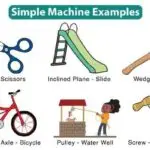
Examples of Simple Machines
Simple machines are basic tools that have few or no moving parts. They are the building blocks of more complex machines.
- Lever: Helps us lift or move things.
- Examples: A spoon (to scoop food), a seesaw (to lift a friend), a bottle opener.
- Inclined Plane: A flat surface tilted at an angle, like a ramp. It helps us move things up or down easily.
- Examples: A ramp (to push a wheelbarrow up), a slide (to slide down).
- Wheel and Axle: A wheel attached to a rod (axle) that helps things move or turn.
- Examples: Bicycle wheels, car wheels, a doorknob.
Machines Help Us Song
Tune: “Twinkle, Twinkle Little Star”
Machines, machines, help us do,
Work so easy, me and you.
Spoon to scoop and broom to sweep,
Secrets of machines we keep.
Ramp to push things up so high,
Machines help us, oh my, oh my!
Actions:
- “Machines, machines, help us do”: Clap hands.
- “Work so easy, me and you”: Point to self and then to others.
- “Spoon to scoop”: Pretend to scoop with a spoon.
- “Broom to sweep”: Pretend to sweep.
- “Ramp to push things up so high”: Make an upward pushing motion with hands.
- “Machines help us, oh my, oh my!”: Nod head and smile.
Watch and Learn About Simple Machines
Key Words
- Technology – Using tools and ideas to make life easier.
- Machine – A tool that helps us do work easily.
- Simple Machine – A basic tool with few or no moving parts.
💡 Teacher Guide for Using This Board Summary
How to teach the content: Explain “Technology” and “Machine” using very simple language and relatable examples. Show the real objects (spoon, toy ramp, toy car) as you introduce each simple machine. Emphasize how each machine helps us do something easier. Encourage pupils to share their own examples.
What to show or demonstrate: Display charts and pictures of various machines. Physically demonstrate how a spoon acts as a lever to scoop, how a toy car rolls easily down a toy ramp, and how a wheel turns. Ask pupils to identify these objects in the classroom.
How to use the rhyme/song: Introduce the “Machines Help Us Song” after explaining the basic concepts. Sing it slowly first, demonstrating the actions. Repeat the song 2-3 times, encouraging pupils to sing along and perform the actions. Use it as a fun way to reinforce the idea that machines make work easier.
How to use the video: Introduce the video as a fun way to see more machines in action. Before playing, tell pupils to watch for how the machines help people. After watching, ask simple questions like, “What machine did you see?” and “How did it help?” Encourage pupils to imitate some of the movements or actions shown in the video.
What to watch for: Observe if pupils can correctly identify the real objects as examples of machines and if they understand the basic idea that these tools make tasks easier. Listen for their participation in the song and their attempts to name machines.
Teaching Methods/Instructional Techniques
- Play-based Learning
- Demonstration
- Guided Practice
- Songs and Rhymes
- Picture Talk
- Question and Answer
- Manipulation of Objects
- Repetition
Instructional Procedures
Step 1: Introduction
Time: 3 minutes
Teaching Skill: Engagement/Recall
Teacher’s Activity: The teacher greets pupils and asks them to name some things they use every day at home or school, like a spoon or a broom. The teacher then introduces the topic by saying, “Today, we will learn about special tools that help us do things easily!”
Pupils’ Activity: Pupils respond by naming familiar objects. They listen attentively to the teacher.
Learning Point: Pupils are engaged and connect to the lesson through familiar objects.
Step 2: Meaning of Technology
Time: 4 minutes
Teaching Skill: Explanation/Concept Building
Teacher’s Activity: The teacher explains “technology” in simple terms: “Technology is about using smart ideas and tools to make our lives better and easier.” The teacher gives examples like phones, cars, and lights. “These are all technology because they help us!”
Pupils’ Activity: Pupils listen and repeat “technology.” They point to examples of technology in the classroom if prompted (e.g., light switch, fan).
Learning Point: Pupils understand that technology makes life easier and better.
Step 3: Meaning of Machines
Time: 5 minutes
Teaching Skill: Explanation/Demonstration
Teacher’s Activity: The teacher introduces “machines”: “A machine is a tool that helps us do work easily.” The teacher picks up a spoon and demonstrates scooping. “See? This spoon is a machine; it helps me scoop food easily!” The teacher shows a broom. “This broom is a machine; it helps us sweep the floor easily.”
Pupils’ Activity: Pupils listen, repeat “machine,” and observe the teacher’s demonstrations. They may try to imitate the actions with imaginary tools.
Learning Point: Pupils grasp that machines are tools that simplify work.
Step 4: Introducing Simple Machines (Lever and Inclined Plane)
Time: 6 minutes
Teaching Skill: Demonstration/Identification
Teacher’s Activity: The teacher introduces “simple machines.” The teacher shows the spoon again and explains it’s a “lever.” Then, the teacher shows a toy ramp or picture of a slide and explains it’s an “inclined plane.” The teacher demonstrates pushing a toy car up a ramp versus lifting it directly. “Which is easier?”
Pupils’ Activity: Pupils watch the demonstrations, identify the spoon and ramp, and say which action is easier.
Learning Point: Pupils identify examples of levers and inclined planes and understand their function.
Step 5: Introducing Simple Machines (Wheel and Axle) and Song Reinforcement
Time: 5 minutes
Teaching Skill: Demonstration/Singing
Teacher’s Activity: The teacher introduces the “wheel and axle” using a toy car or bicycle wheel. “See how the wheel helps the car move quickly?” The teacher then leads pupils in singing the “Machines Help Us Song” with actions to reinforce the lesson concepts.
Pupils’ Activity: Pupils observe the wheel demonstration, then sing the song loudly, performing the actions with enthusiasm.
Learning Point: Pupils identify the wheel and axle and reinforce learning through song and movement.
Step 6: Video and Discussion
Time: 5 minutes
Teaching Skill: Visual Learning/Discussion
Teacher’s Activity: The teacher plays the short video on simple machines. After the video, the teacher asks pupils to name any machine they saw in the video and how it helped. The teacher encourages pupils to share their observations.
Pupils’ Activity: Pupils watch the video attentively. They then respond to the teacher’s questions, naming machines and explaining their uses.
Learning Point: Pupils reinforce their understanding of machines through visual examples and discussion.
Step 7: Evaluation/Review
Time: 4–5 minutes
Teaching Skill: Questioning/Assessment
Teacher’s Activity: The teacher checks pupils’ understanding through short questions and practical tasks.
- “What is a machine?” (Encourage simple answers like “a tool that helps us”).
- “Show me a machine in our classroom.” (e.g., a chair, a door, a broom).
- “Can you name one simple machine we talked about today?” (e.g., spoon, ramp, wheel).
- “Sing a part of our ‘Machines Help Us’ song.”
Pupils’ Activity: Pupils respond orally and demonstrate the required skill where appropriate.
Learning Point: Pupils demonstrate understanding of the lesson.
Step 8: Conclusion
Time: 2 minutes
Teaching Skill: Summarization/Reinforcement
Teacher’s Activity: The teacher praises the pupils for their participation and summarizes: “Today we learned that technology and machines help us do things more easily, like scooping with a spoon, rolling with a wheel, or moving things up a ramp. Machines are everywhere and they make our lives better!” The teacher leads a final round of the “Machines Help Us Song.”
Pupils’ Activity: Pupils listen to the summary and sing the song one last time.
Learning Point: Pupils consolidate their learning and leave with a positive impression of the topic.
Lesson Keywords
- Technology – Using tools and ideas to make life easier.
- Machine – A tool that helps us do work easily.
- Lever – A simple machine like a spoon that helps lift or move.
- Ramp – A simple machine like a slide that helps move things up or down.
- Wheel – A simple machine that helps things roll or turn.
Differentiation
- Support: For pupils who need extra help, provide larger pictures of machines, use hand-over-hand guidance to point to objects, and repeat key terms slowly. Focus on identifying just one or two simple machines.
- Extension: For pupils who grasp the concepts quickly, ask them to identify other machines they see on their way to school or at home. Encourage them to draw a picture of their favorite machine and explain how it helps.

Community Join the conversation Open discussion +