

Note for teachers using this lesson plan
Before the lesson, prepare pictures or flashcards showing sunny and rainy weather, and objects or pictures of activities suitable for each (e.g., umbrella, raincoat, sun hat, ball, warm tea, cold juice). The central idea is for pupils to identify rainy and sunny weather and associate appropriate activities and clothing with each. Observe pupils as they correctly name the weather types and mention suitable activities, showing their understanding.
Class: Pre-School Level 3
Term: Third Term
Week: 6
Age: 4 years
Duration: 30 minutes
Subject: Basic Science and Technology
Curriculum Theme: Basic Science and Technology
Previous Lesson: Observing changes in the environment
Topic: Types of Weather
Subject Matter: Rainy and sunny weather and activities for different weather conditions.
Specific Objectives
By the end of the lesson, pupils should be able to:
Cognitive Domain
- Identify rainy and sunny weather when shown pictures or observing the environment.
- Name activities suitable for rainy weather.
- Name activities suitable for sunny weather.
Affective Domain
- Show appreciation for different types of weather.
- Participate actively in discussions about weather.
Psychomotor Domain
- Demonstrate actions for indoor and outdoor play.
- Point to appropriate clothing or items for each weather type.
Social Domain
- Share ideas about their favourite weather activities with peers.
Reference Materials
- NAPPS National Unified Teaching Scheme for Pre-School Level 3
- Early Childhood Care and Education resources
- Relevant picture books on weather
Instructional Materials
- Pictures/flashcards of rainy weather (rain, clouds, umbrella, raincoat)
- Pictures/flashcards of sunny weather (sun, bright sky, sun hat, sunglasses)
- Pictures of children playing indoor games (e.g., board games, building blocks)
- Pictures of children playing outdoor games (e.g., football, swinging)
- Pictures of warm drinks (e.g., hot tea, cocoa) and cold drinks (e.g., juice, water)
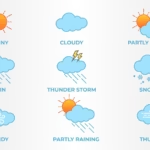
- A chart showing different weather types
- Video player/screen for educational video
- The classroom environment and outside view (if applicable)
Rationale for the Lesson
Understanding different types of weather helps young children make sense of their daily experiences and environment. This lesson enables 4-year-olds to learn about rainy and sunny conditions, promoting their ability to choose appropriate clothing and activities, which is important for their health and safety. It also builds their observational skills and vocabulary related to the natural world.Prerequisite/Previous Knowledge
Pupils can observe their surroundings and have experienced different types of weather in their daily lives. They can identify basic objects and actions.Lesson Content/Board Summary
Rainy and Sunny Weather and Activities
Weather is how the air outside feels and looks each day. Sometimes it is hot, sometimes it is cold, sometimes it is wet.1. Rainy Weather
This is when water falls from the sky as rain. The sky is often grey and cloudy. It feels cool or cold.
- What we do:
- Play indoor games (e.g., building blocks, puzzles, drawing).
- Stay inside to keep warm and dry.
- Wear warm clothes like sweaters or raincoats.
- Drink warm or hot drinks (e.g., warm tea, cocoa).
2. Sunny Weather
This is when the sun shines brightly in the sky. The sky is often blue and clear. It feels warm or hot.
- What we do:
- Play outdoor games (e.g., running, playing with a ball, swinging).
- We can also play indoor games.
- Wear light clothes like t-shirts and shorts.
- Drink cool or cold drinks (e.g., cold juice, water).
Key Words
- Weather – How it feels outside (e.g., hot, cold, wet).
- Rainy – When rain falls from the sky.
- Sunny – When the sun shines brightly.
- Indoor – Inside a building.
- Outdoor – Outside in the open air.
- Warm – A little hot, comfortable.
- Cool – A little cold, refreshing.
Our Weather Song
Tune: “Twinkle, Twinkle Little Star”
Oh, the weather, what will it be?
Sunny, sunny, happy me!
Play outside, run and leap,
Cool juice sips, secrets to keep.
Oh, the weather, what will it be?
Rainy, rainy, stay with me!
Indoor games, warm tea cup,
Pitter-patter, rain drops up!
Actions:
- “Sunny, sunny, happy me!” – Make a big circle with arms for the sun, then smile.
- “Play outside, run and leap,” – Mimic running and jumping.
- “Cool juice sips,” – Pretend to sip a drink.
- “Rainy, rainy, stay with me!” – Wiggle fingers downwards like rain, then hug self.
- “Indoor games, warm tea cup,” – Mimic playing a board game, then holding a cup.
- “Pitter-patter, rain drops up!” – Tap fingers on lap.
Watch and Learn About Weather
💡 Teacher Guide for Using This Board Summary
How to teach the content: Begin by asking pupils to look out the window and describe the current weather. Use pictures to introduce “rainy weather” and “sunny weather,” describing what each looks and feels like. Discuss the activities for each, using simple language and asking pupils to share their own experiences. Emphasize why certain activities are safer or more comfortable in different weather (e.g., staying dry in rain, drinking water in sun).
What to show or demonstrate: Display the pictures of rainy and sunny weather prominently. Show pictures of indoor games for rainy days and outdoor games for sunny days. Hold up pictures of warm and cool drinks. Demonstrate simple actions for playing indoor and outdoor games.
How to use the rhyme/song: Introduce the “Our Weather Song” after discussing both weather types. Sing it slowly with the pupils, demonstrating the actions. Repeat the song 2-3 times to help pupils learn the lyrics and actions, encouraging them to sing along and perform the movements.
How to use the video: Introduce the video as a fun way to learn more about weather. Play the video, asking pupils to pay attention to the parts about sunny and rainy weather. After watching, discuss what they saw and heard, reinforcing the vocabulary and activities for each weather type mentioned in the video.
What to watch for: Observe if pupils can correctly identify the weather types from pictures and link appropriate activities to each. Listen for their use of key words like “rainy,” “sunny,” “indoor,” and “outdoor.” Correct any misconceptions gently and with visual aids.
Teaching Methods/Instructional Techniques
Play-based Learning, Demonstration, Guided Practice, Songs and Rhymes, Picture Talk, Question and Answer, Repetition, Practical Activity, Video Presentation.Instructional Procedures
Step 1: Introduction
Time: 3 minutes
Teaching Skill: Engaging/Activating prior knowledge
Teacher’s Activity: The teacher greets the pupils and asks them to look out the window. “What does the weather look like today? Is it sunny or rainy? How does it feel?”
Pupils’ Activity: Pupils respond by describing the current weather (e.g., “It is sunny!”, “It is bright!”).
Learning Point: Pupils connect to the concept of weather and share observations.
Step 2: Introducing Rainy Weather
Time: 5 minutes
Teaching Skill: Explanation/Visual aid use
Teacher’s Activity: The teacher shows pictures of rainy weather (rain falling, grey clouds, umbrella). “Look at these pictures! This is rainy weather. What do you see?” The teacher explains that during rainy weather, it often feels cold and wet.
Pupils’ Activity: Pupils observe the pictures and describe what they see (e.g., “Rain!”, “Clouds!”). They repeat “rainy weather.”
Learning Point: Pupils identify and understand the characteristics of rainy weather.
Step 3: Activities for Rainy Weather
Time: 4 minutes
Teaching Skill: Discussion/Activity association
Teacher’s Activity: The teacher asks, “When it is rainy, can we play outside?” (Guide to ‘no’). “What games can we play inside?” The teacher shows pictures of indoor games and warm drinks. “We play indoor games and drink warm tea to stay warm.”
Pupils’ Activity: Pupils respond “no” to playing outside. They suggest indoor games or point to pictures of indoor activities and warm drinks.
Learning Point: Pupils associate appropriate indoor activities and warm drinks with rainy weather.
Step 4: Introducing Sunny Weather
Time: 5 minutes
Teaching Skill: Explanation/Visual aid use
Teacher’s Activity: The teacher shows pictures of sunny weather (bright sun, blue sky). “Now look at these! This is sunny weather. What do you see?” The teacher explains that during sunny weather, it feels warm or hot.
Pupils’ Activity: Pupils observe the pictures and describe what they see (e.g., “Sun!”, “Blue sky!”). They repeat “sunny weather.”
Learning Point: Pupils identify and understand the characteristics of sunny weather.
Step 5: Activities for Sunny Weather
Time: 4 minutes
Teaching Skill: Discussion/Activity association
Teacher’s Activity: The teacher asks, “When it is sunny, can we play outside?” (Guide to ‘yes’). “What games can we play outside?” The teacher shows pictures of outdoor games and cool drinks. “We can play outdoor games and drink cool juice to stay cool.”
Pupils’ Activity: Pupils respond “yes” to playing outside. They suggest outdoor games or point to pictures of outdoor activities and cool drinks.
Learning Point: Pupils associate appropriate outdoor activities and cool drinks with sunny weather.
Step 6: Rhyme and Video Reinforcement
Time: 5 minutes
Teaching Skill: Reinforcement/Engagement
Teacher’s Activity: The teacher leads pupils in singing the “Our Weather Song” with actions. Then, the teacher plays the short educational video about weather, focusing on sunny and rainy parts.
Pupils’ Activity: Pupils sing the song with actions and watch the video, pointing out sunny and rainy scenes.
Learning Point: Pupils reinforce their understanding of weather types and associated activities through song and video.
Step 7: Evaluation/Review
Time: 4–5 minutes
Teaching Skill: Questioning/Assessment
Teacher’s Activity: The teacher checks pupils’ understanding through short questions and practical tasks.
- “Show me a picture of rainy weather.”
- “What do we do when it is raining? (e.g., play inside or outside?)”
- “Show me a picture of sunny weather.”
- “What do we drink when it is sunny? (e.g., warm tea or cold juice?)”
- “Mention one game you can play when it is sunny.”
Pupils’ Activity: Pupils respond orally and demonstrate the required skill where appropriate (e.g., pointing to pictures, giving short answers).
Learning Point: Pupils demonstrate understanding of the lesson.
Step 8: Conclusion
Time: 1 minute
Teaching Skill: Summarizing/Encouragement
Teacher’s Activity: The teacher praises the pupils for their participation and reminds them that knowing about weather helps them choose what to wear and what to do each day. “Good job, everyone! Now you know about sunny and rainy weather!”
Pupils’ Activity: Pupils respond with claps or “Thank you, teacher!”
Learning Point: Pupils feel a sense of accomplishment and consolidate learning.
Lesson Keywords
- Weather – How the air outside feels and looks.
- Rainy – When water falls from the sky.
- Sunny – When the sun is shining brightly.
- Indoor – Activities done inside a house or building.
- Outdoor – Activities done outside in the open.
Differentiation
- Support: For pupils who are struggling, provide larger, clearer pictures. Use more repetition of key words and actions. Allow them to simply point to answers rather than speaking. Provide hand-over-hand guidance for actions in the song.
- Extension: For pupils who grasp the concepts quickly, ask them to name more activities for each weather type. Challenge them to draw a picture of themselves doing an activity in sunny or rainy weather. Ask them to describe how they feel in each weather condition.

Community Join the conversation Open discussion +