

Class: Primary Three
Term: Third Term
Subject: Basic Science and Technology
Curriculum Theme: Basic Science
Previous Lesson: Floatation On Water
Topic: The Human Body
Content/Learning Area: What is the Human Body, Parts of the Human Body, Functions of Body Parts
Time allocation: 40 minutes
Performance Objectives
By the end of the lesson, pupils should be able to:
- cognitive Domain:
1. Identify various parts of the human body.
2. Explain the basic functions of different body parts.
- Affective Domain:
1. Show thankfulness for how each body part helps us in daily activities.
- Psychomotor Domain:
1. Point to and label major body parts on themselves and on diagrams.
- Social Domain:
1. Work cooperatively in groups to discuss and share facts about different body parts.
Reference Materials
- 9 – Years Basic education curriculum
- Abuja Educational Resource centre Scheme of Work
- NAPPS National Unified Scheme of Work
- Online Details
- Relevant Textbooks
Instructional Materials
To deliver this lesson, the teacher will employ the help of the following materials:
- Charts showing parts of the human body
- Pictures of the human body
- Whiteboard or chart paper
- Markers
Rationale for the Lesson
Understanding the human body is crucial for personal health and well-being. This lesson provides a foundation for future learning in biology and health education.
Prerequisite/Previous Knowledge
The teacher will start by asking pupils what they know about their bodies. A brief discussion will follow, leading into the lesson’s topic.
lesson Content
What is the Human Body?
The human body is like an amazing machine,made of many parts that work together. These parts help us live, grow, and do everything we do.
Parts of the Human Body
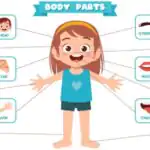
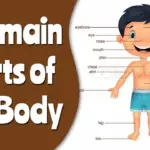
The human body consists of several parts that perform specific functions. These include:
- Head: The top part, including the brain, eyes, ears, nose, and mouth. It helps us think, see, hear, smell, and eat.
- Shoulders: Connect the arms to the body, helping us lift and carry things.
- Arms and Hands: Used for many activities like writing and holding.
- Legs and Feet: help us walk, run, and jump.
- Torso: The middle part, containing the chest, stomach, and back, with vital organs like the heart and lungs.
- Fingers and Toes: Assist with gripping and balance.
- Neck: Supports the head and allows for movement.
Functions of Body Parts
Each part of the human body has a specific role to play in ensuring the body functions properly. They are:
- Brain: Controls our thoughts, feelings, and actions.
- Eyes: Help us see.
- Ears: Help us hear.
- Nose: Helps us smell and breathe.
- Mouth: Helps us eat, speak, and breathe.
- Heart: Pumps blood.
- Lungs: Help us breathe.
- Stomach: Digests food.
- Intestines: Absorb nutrients.
- Muscles: Help us move.
- Bones: Give our bodies support and structure.
- Kidneys: Filter waste from the blood.
- Liver: Processes nutrients and detoxifies harmful substances.
Teaching Methods
To deliver this lesson, the teacher will adopt the following methods: discussion, Question and answer, Group work, Visual aids
Instructional Procedures
to deliver this lesson, the teacher will adopt the following steps:
Step 1: Introduction
Time: 5 minutes
Teaching Skill: Questioning
Teacher’s Activity: Asks pupils what they know about their bodies.
Pupils’ Activity: Respond to the teacher’s questions.
Step 2: Explanation of Key Concepts
Time: 10 minutes
Teaching Skill: Explaining
Teacher’s Activity: Explains the main parts of the human body and their functions using charts and pictures.Pupils’ Activity: Listen attentively and ask questions.
Step 3: Demonstration/Guided Practice
Time: 10 minutes
Teaching Skill: Demonstrating
Teacher’s Activity: Points to and labels major body parts on a diagram, encouraging pupils to do the same.
Pupils’ Activity: Point to and label body parts on themselves and diagrams.
step 4: Autonomous Practice
Time: 5 minutes
Teaching Skill: Monitoring
Teacher’s Activity: Guides pupils in group work, discussing body parts and their functions.
Pupils’ Activity: Work in groups to discuss and share information.
Step 5: Note-Taking
Time: 5 minutes
Teaching Skill: Note-taking
Teacher’s Activity: Guides pupils in taking notes on the main points of the lesson.
Pupils’ activity: Write down key information.
Step 6: Evaluation/Review
Time: 5 minutes
Teaching Skill: Questioning
Teacher’s Activity: Asks evaluation questions to assess understanding.
Pupils’ Activity: Answer the evaluation questions.
Objective-aligned checks:
- Identify various parts of the human body.
- Explain the basic functions of different body parts.
- Show thankfulness for how each body part helps us in daily activities.
Step 7: Conclusion
Time: 2 minutes
Teaching Skill: Summarizing
Teacher’s Activity: Summarizes the main points and encourages pupils to continue learning about their bodies.
Pupils’ Activity: Listen to the summary and ask any remaining questions.
Lesson Keywords
- Human Body – The physical structure of a human being, composed of cells, tissues, organs, and systems.
- Brain – The control center of the body, responsible for thoughts, feelings, and actions.
- Heart – The organ that pumps blood throughout the body.
- Lungs – Organs responsible for breathing and exchanging oxygen and carbon dioxide.
- Stomach – The organ that digests food.
Lesson Evaluation
To evaluate the learning, the teacher asks pupils to:
- What are three critically importent parts of the human body?
- What does the brain do?
- What do our arms and hands help us do?
- Why are our legs and feet important?
- Can you name one function of the heart?
Assignment/Homework
- Draw a picture of the human body and label at least five parts.
- Write a short paragraph explaining the function of one body part.
- Research and list three additional functions of the human body.
Differentiation
- For slower learners: Provide one-on-one assistance and simplified diagrams.
- For advanced learners: Encourage research on additional body parts and their functions.
- For visual/auditory/kinesthetic learners: Use visual aids,verbal explanations,and hands-on activities.
Note for Teachers
Ensure to use clear and simple language to explain the functions of each body part. Encourage pupils to ask questions and participate actively in discussions. Use visual aids to enhance understanding and engagement.


Community 1 comment Open discussion +