

Class: Primary Three
Term: second Term
Subject: Basic Science and Technology
Curriculum Theme: Physical & Health Education
Previous Lesson: Meaning, Examples And Safety Rules In Ball Games
Topic: Football
Content/Learning Area: Brief history of football, Basic skills in football, Materials needed for football, Importance of teamwork in football
Time Allocation: 40 minutes
Performance Objectives
By the end of the lesson, pupils should be able to:
- Cognitive Domain:
1. Recall the brief history of football.
2. Identify five basic skills in football.
3. Name materials needed for football.
- Affective Domain:
1. Appreciate the importance of teamwork in football.
2. Show enthusiasm for participating in football activities.
- Psychomotor Domain:
1. demonstrate basic football skills (dribbling, passing).
- Social Domain:
1. Cooperate with peers during football activities.
Reference Materials
- 9 – Years Basic education Curriculum
- Abuja Educational resource Center Scheme of Work
- NAPPS National Unified Scheme of Work
- Online Details
- Relevant Textbooks
Instructional Materials
To deliver this lesson, the teacher will use the following materials:
- A football
- Cones
- Whiteboard or chart paper
- Markers or pens
Rationale for the Lesson
This lesson introduces pupils to the fundamentals of football, fostering physical activity, teamwork, and an understanding of sports. It builds a foundation for future physical education lessons and promotes healthy habits.
Prerequisite/Previous Knowledge
Pupils have likely seen or heard about football and may have some basic understanding of the game.
lesson Content
Football
Football, also known as soccer, has a long history, with origins in ancient ball games. The modern game developed in medieval England.
What is Football?
Football is a team sport played between two teams of eleven players. The goal is to score by getting the ball into the opponent’s goal. The team with the most goals wins.
Basic Skills In Football
Basic skills are fundamental actions that players use to control the ball, move effectively, and coordinate with teammates. These include:
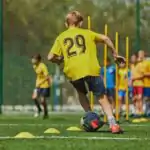
- Dribbling: Controlling the ball with your feet while moving.
- Passing: Kicking the ball to a teammate.
- Shooting: kicking the ball towards the goal to score.
- Heading: Using your head to control or pass the ball.
- Kicking: Using your foot to move the ball.
- Trapping: Stopping the ball with your foot or body.
- Goalkeeping: preventing the other team from scoring.
- Tackling: taking the ball from an opponent.
- Throw-in: Throwing the ball back into play when it goes out of bounds.
Materials Needed For Football
Various materials are essential for playing football, ensuring safety, and facilitating effective gameplay.These include:
- Football: The main equipment.
- Cones: To mark the field and for drills.
- Jerseys: Worn by players to identify teams.
- Goalposts: Mark the goals.
- Playing field: Where the game is played.
- Whistle: Used by the referee to signal fouls and stoppages.
- First aid kit: For treating minor injuries.
- Shin guards: To protect players’ legs.
- Goalkeeper gloves: To help the goalkeeper catch the ball.
Teaching Methods
To deliver this lesson, the teacher will adopt the following methods: Discussion, Exhibition, Practical Activity
Instructional Procedures
To deliver this lesson, the teacher will adopt the following steps:
Step 1: Introduction
Time: 5 minutes
Teaching Skill: Set Induction
Teacher’s Activity: Ask pupils what they know about football. Show a picture of a football game.
pupils’ Activity: Share their knowledge and experiences.
Step 2: Clarification of Key Concepts
Time: 10 minutes
Teaching Skill: Explaining, Illustrating
Teacher’s Activity: Explain the history of football and basic skills.
Pupils’ Activity: Listen attentively and ask questions.
Step 3: Demonstration/Guided Practice
Time: 15 minutes
Teaching Skill: Demonstrating, Guiding
Teacher’s Activity: Demonstrate basic skills (dribbling, passing). Guide pupils in practicing these skills.
Pupils’ Activity: Observe the demonstration and practice the skills.
Step 4: Autonomous Practice
Time: 5 minutes
Teaching Skill: Monitoring, Encouraging
Teacher’s Activity: Supervise pupils as they practice independently.
Pupils’ Activity: Practice the skills independently.
step 5: note-Taking
Time: 2 minutes
Teaching Skill: Summarizing, Guiding
Teacher’s Activity: Guide pupils in taking notes on key concepts.
Pupils’ Activity: Take notes on key concepts.
Step 6: Evaluation/Review
Time: 3 minutes
Teaching Skill: Questioning, Assessing
Teacher’s Activity: Ask evaluation questions.
Pupils’ Activity: Answer the evaluation questions.
Objective-aligned checks:
- Identify five basic skills in football.
- Name materials needed for football.
- Show enthusiasm for participating in football activities.
Step 7: Conclusion
Time: 2 minutes
Teaching Skill: Summarizing, Motivating
Teacher’s Activity: Summarize the key points and encourage pupils to continue practicing football skills.
Pupils’ Activity: Listen to the summary and ask any remaining questions.
Lesson Keywords
- Dribbling – Controlling the ball with your feet while moving.
- Passing – Kicking the ball to a teammate.
- Shooting – Kicking the ball towards the goal to score.
- Heading – Using your head to control or pass the ball.
- Goalkeeping – Preventing the other team from scoring.
Lesson Evaluation
To evaluate the learning, the teacher asks pupils to:
- What is football?
- Name three basic skills in football.
- List two materials needed to play football.
- Why is teamwork crucial in football?
- what are some benefits of playing football?
Assignment/Homework
- draw a picture of a football game.
- Write a short paragraph about your favourite football player.
Differentiation
- For slower learners: Provide one-on-one assistance during practice.
- For advanced learners: Introduce more complex drills and skills.
- For visual/auditory/kinesthetic learners: Use visual aids, verbal instructions, and hands-on activities to cater to different learning styles.
Note for Teachers
Ensure to provide a safe environment for pupils to practice football skills. Encourage teamwork and sportsmanship throughout the lesson. Adjust the activities based on the pupils’ skill levels and abilities.


Community Join the conversation Open discussion +