

Class: Primary 3
Term: 2nd Term
Week: 7
Age: 8 years
Duration: 45 minutes
Subject: Mathematics
Curriculum Theme: Mathematics
Previous Lesson: Measurement, Length and Width.
Topic: Length and Perimeter of Plane Shapes
Subject Matter: PLANE SHAPES, Comparing non-standard measure, Calculating the perimeter of square and rectangle not more than 50 cm. Perimeter of square = 4 × L Perimeter of rectangle = 2(L + B)
Specific Objectives
By the end of the lesson, pupils should be able to:
Cognitive Domain:
- Measure the length of the classroom with their feet and arms and record the results.
- Compare arm-length results and other non-standard measurements with the standard method of measurement such as a tape rule.
- Use a metre rule to measure objects in the classroom.
- Explain the importance of standard units compared to natural units in measurement.
- Calculate the perimeter of squares and rectangles.
Affective Domain:
- Appreciate the need for standard units in society.
- Show interest in measuring objects around them accurately.
Psychomotor Domain:
- Demonstrate the ability to measure length using both non-standard and standard tools.
- Accurately calculate the perimeter of given square and rectangular shapes.
Social Domain:
- Work cooperatively with classmates during group measurement activities.
Reference Materials
The following resources were used in planning this lesson:
- 9 Years Basic Education Curriculum
- State Unified Scheme of Work
- New General Mathematics for Primary 3
Instructional Materials
The teacher will teach this lesson with the aid of:
- Pupils’ feet and arms
- Metre rule
- Tape rule
- Different classroom objects (e.g., desk, book, whiteboard)
- Chart showing various plane shapes (square, rectangle, triangle, circle)
- Chart showing formulas for perimeter of square and rectangle
Rationale for the Lesson
This lesson helps pupils understand how to measure objects around them using different units. It enables them to see why using standard units is better for clear communication and accuracy in daily life, especially when calculating the boundary of shapes like a farm or a room.
Prerequisite/Previous Knowledge
Pupils can identify basic plane shapes and have a general idea of comparing sizes of objects.
Lesson Content/Board Summary
Length and Perimeter of Plane Shapes
Plane Shapes
Plane shapes are flat, two-dimensional shapes that have only length and width. They do not have depth.
The following are examples of plane shapes:
- Square
- Rectangle
- Triangle
- Circle
Non-Standard vs. Standard Measurement of Length
Non-Standard Measurement: This involves using body parts or everyday objects to measure length. Examples include:
- Foot span (measuring with feet)
- Arm length (measuring with arms)
- Hand span (measuring with hands)
- Paces
Standard Measurement: This uses fixed units that are the same everywhere, making measurements consistent and comparable. Examples include:
- Centimetres (cm)
- Metres (m)
- Kilometres (km)
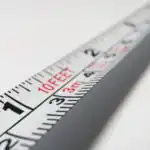
Tools for standard measurement include a metre rule and a tape rule.
Importance of Standard Units: Standard units are important because they ensure that everyone gets the same measurement for an object, no matter who measures it or where it is measured. This avoids confusion and makes communication clear.
Perimeter of Plane Shapes
The perimeter of a plane shape is the total distance around its outer boundary or edge.
Perimeter of a Square
A square has four equal sides. To find its perimeter, you add the lengths of all four sides or multiply the length of one side by 4.
Formula: Perimeter (P) = Side + Side + Side + Side = 4 × Length (L)
Where L = the length of one side of the square.
Example 1: Find the perimeter of a square with a side length of 10 cm.
Step 1: Write the formula: P = 4 × L
Step 2: Substitute the value of L: P = 4 × 10 cm
Step 3: Calculate: P = 40 cm
Example 2: A square mat has a side of 12 cm. What is its perimeter?
Step 1: Formula: P = 4 × L
Step 2: Substitute: P = 4 × 12 cm
Step 3: Calculate: P = 48 cm
Perimeter of a Rectangle
A rectangle has four sides, with opposite sides being equal in length. It has a length (L) and a breadth (B) or width.
Formula: Perimeter (P) = Length + Breadth + Length + Breadth = 2 × (Length + Breadth) = 2(L + B)
Where L = Length and B = Breadth (or Width).
Example 1: Calculate the perimeter of a rectangle with a length of 15 cm and a breadth of 5 cm.
Step 1: Write the formula: P = 2(L + B)
Step 2: Substitute the values of L and B: P = 2(15 cm + 5 cm)
Step 3: Add the values in the bracket: P = 2(20 cm)
Step 4: Multiply: P = 40 cm
Example 2: A rectangular table top is 20 cm long and 10 cm wide. Find its perimeter.
Step 1: Formula: P = 2(L + B)
Step 2: Substitute: P = 2(20 cm + 10 cm)
Step 3: Add: P = 2(30 cm)
Step 4: Multiply: P = 60 cm
Teaching Methods/Instructional Techniques
Discussion, Lecture, Demonstration, Question and Answer, Visual Aids
Instructional Procedures
Length and Perimeter of Plane Shapes
Step 1: Introduction
Time: 5 minutes
Teaching Skill: Set Induction
Teacher’s Activity: The teacher asks pupils to name some objects in the classroom and asks how they would measure the length of their desk or the classroom.
Pupils’ Activity: Pupils name objects and suggest different ways to measure, such as using their hands or feet.
Learning Point: Pupils recall prior knowledge about shapes and measurement and are introduced to the lesson topic.
Step 2: Introduction to Plane Shapes
Time: 5 minutes
Teaching Skill: Explanation/Demonstration
Teacher’s Activity: The teacher displays a chart of plane shapes (square, rectangle, triangle, circle) and explains what plane shapes are, pointing out examples in the classroom.
Pupils’ Activity: Pupils identify the shapes and point to similar shapes in the classroom.
Learning Point: Pupils understand what plane shapes are and can identify common examples.
Step 3: Non-Standard Measurement
Time: 7 minutes
Teaching Skill: Practical Activity/Observation
Teacher’s Activity: The teacher instructs pupils to measure the length of the classroom using their feet (foot span) and then their arms (arm length) and record their individual results.
Pupils’ Activity: Pupils actively participate in measuring the classroom using their feet and arms and write down their measurements.
Learning Point: Pupils experience non-standard units of measurement.
Step 4: Standard Measurement and Comparison
Time: 7 minutes
Teaching Skill: Demonstration/Discussion
Teacher’s Activity: The teacher demonstrates how to use a metre rule to measure objects like a desk or book. The teacher then guides pupils to compare their non-standard measurements with standard measurements and discusses why standard units are more reliable.
Pupils’ Activity: Pupils observe the demonstration, discuss the differences in measurements, and understand the importance of standard units.
Learning Point: Pupils learn about standard units (cm, m) and tools (metre rule) and understand their importance for accuracy.
Step 5: Introduction to Perimeter
Time: 5 minutes
Teaching Skill: Explanation/Questioning
Teacher’s Activity: The teacher draws a rectangle on the board and asks pupils how they would find the total distance around its edges. The teacher then defines perimeter.
Pupils’ Activity: Pupils suggest ideas for finding the distance around the shape and listen to the definition of perimeter.
Learning Point: Pupils understand the concept of perimeter as the distance around a shape.
Step 6: Calculating Perimeter of Square and Rectangle
Time: 8 minutes
Teaching Skill: Explanation/Problem Solving
Teacher’s Activity: The teacher writes the formulas for the perimeter of a square (P = 4 × L) and a rectangle (P = 2(L + B)) on the board. The teacher works through the examples from the board summary, explaining each step clearly.
Pupils’ Activity: Pupils copy the formulas and worked examples into their notebooks, asking questions for clarification.
Learning Point: Pupils learn the formulas for calculating the perimeter of squares and rectangles and practice applying them.
Step 7: Evaluation/Review
Time: 5 minutes
Teaching Skill: Questioning/Assessment
Teacher’s Activity: The teacher evaluates the learning by asking the following questions:
- What is a plane shape?
- Mention two examples of non-standard units of measurement.
- Why is it important to use standard units for measurement?
- State the formula for calculating the perimeter of a square.
- A rectangle has a length of 18 cm and a breadth of 7 cm. Calculate its perimeter.
Pupils’ Activity: Pupils answer orally and in writing.
Learning Point: Pupils demonstrate understanding of the lesson.
Step 8: Conclusion
Time: 3 minutes
Teaching Skill: Summarization/Assignment
Teacher’s Activity: The teacher summarizes the key points of the lesson, emphasizing the difference between non-standard and standard units and how to calculate perimeter. The teacher assigns homework.
Pupils’ Activity: Pupils listen to the summary and copy down the homework.
Learning Point: Pupils consolidate their understanding and are given practice tasks.
Home Task: Solve three new exercises on Length and Perimeter of Plane Shapes. Show each step and check each answer.
Lesson Keywords
- Length – How long something is from one end to the other.
- Perimeter – The total distance around the outside edge of a shape.
- Plane shapes – Flat, two-dimensional shapes like squares and rectangles.
- Square – A plane shape with four equal sides and four right angles.
- Rectangle – A plane shape with four sides where opposite sides are equal and all angles are right angles.
- Standard unit – A fixed unit of measurement that is the same everywhere, e.g., centimetre, metre.
- Non-standard unit – A unit of measurement that is not fixed and can vary, e.g., arm length, foot span.
- Metre rule – A tool used for measuring length in standard units.
Differentiation
For pupils who are struggling, the teacher will provide simpler shapes with smaller numbers for perimeter calculations and offer more one-on-one guidance during practical measurement activities. For advanced learners, the teacher can challenge them to find the perimeter of more complex shapes or to convert units (e.g., cm to m) before calculating perimeter (though keeping within the 50 cm limit for P3). Group activities will allow peer support and collaborative learning.
Note for teachers using this lesson plan
Encourage active participation in all measurement activities. Ensure pupils understand the practical difference between non-standard and standard units by having them compare their individual measurements. Emphasize that the perimeter is always measured in units of length (cm, m). Provide plenty of practice examples for perimeter calculations within the specified range (not more than 50 cm).
Community Join the conversation Open discussion +