

Class: Primary 3
Term: First Term
Week: 4
Age: 8 years
Duration: 45 minutes
Subject: Mathematics
Curriculum Theme: Numbers
Previous Lesson: Fraction, Division of Concrete Objects Into, 1 1.
Topic: Equivalent Fractions
Subject Matter: Dividing sets of objects into halves, showing equivalent fractions (e.g., 1/2 = 2/4), dividing whole units into equal parts using fraction boards, ordering fractions using symbols.
Specific Objectives
By the end of the lesson, pupils should be able to:
Cognitive Domain:
- Divide different sets of objects into two to understand halves.
- Discover equivalent fractions such as 1/2 = 2/4 = 3/6.
- Discover equivalent fractions such as 1/3 = 2/6 = 4/12.
- Identify which fraction is less than, greater than, or equal to another using symbols.
Affective Domain:
- Appreciate the concept of equal parts in fractions.
- Show interest in learning about equivalent fractions.
- Participate actively in classroom activities involving fractions.
Psychomotor Domain:
- Accurately divide objects into equal parts.
- Draw simple diagrams to represent equivalent fractions.
- Use fraction boards to demonstrate fraction equivalence.
Social Domain:
- Work cooperatively with peers during group activities to explore fractions.
Reference Materials
The following resources were used in planning this lesson:
- 9 Years Basic Education Curriculum for Primary 3 Mathematics
- State Unified Scheme of Work
- New General Mathematics for Primary Schools, Book 3
Instructional Materials
The teacher will teach this lesson with the aid of:
- Fraction boards or fraction circles
- Cut-out shapes (e.g., circles, rectangles)
- Real-life objects (e.g., oranges, biscuits, paper)
- Chalk and chalkboard
Rationale for the Lesson
This lesson helps pupils understand that fractions can look different but represent the same amount. This knowledge is important for comparing fractions, performing operations with them, and applying fractions in daily life situations like sharing items or following recipes.
Prerequisite/Previous Knowledge
Pupils have prior knowledge of basic fractions such as halves and quarters, and can divide objects into equal parts.
Lesson Content/Board Summary
Equivalent Fractions
What is a Fraction?
A fraction represents a part of a whole. It shows how many parts we have out of the total number of equal parts that make up the whole.
- The top number is called the numerator (the number of parts we have).
- The bottom number is called the denominator (the total number of equal parts in the whole).
Dividing Objects into Halves
To divide an object into halves, we split it into two equal parts. Each part is called one half (1/2).
Example: If you cut an orange into two equal pieces, each piece is 1/2 of the orange.
Understanding Equivalent Fractions
Equivalent fractions are fractions that represent the same value, even though they have different numerators and denominators.
To find equivalent fractions, you can multiply or divide both the numerator and the denominator by the same non-zero number.
Example 1: Showing 1/2 = 2/4 = 3/6
Imagine a whole pizza cut into 2 equal slices. One slice is 1/2.
If you cut the same pizza into 4 equal slices, two slices represent the same amount as 1/2. So, 1/2 = 2/4.
If you cut the same pizza into 6 equal slices, three slices represent the same amount as 1/2. So, 1/2 = 3/6.
Therefore, 1/2, 2/4, and 3/6 are equivalent fractions.
Example 2: Showing 1/3 = 2/6 = 4/12
Consider a chocolate bar divided into 3 equal pieces. One piece is 1/3.
If you divide each of those 3 pieces into 2 smaller pieces, you now have 6 pieces in total. Two of these smaller pieces make up the same amount as 1/3. So, 1/3 = 2/6.
If you divide each of the 6 pieces into 2 smaller pieces again, you have 12 pieces in total. Four of these smaller pieces make up the same amount as 1/3. So, 1/3 = 4/12.
Therefore, 1/3, 2/6, and 4/12 are equivalent fractions.
Ordering Fractions using Symbols
We use symbols to compare fractions and show which one is greater, less, or equal.
- > means “greater than”
- < means “less than”
- = means “equal to”
Examples:
- 1/2 = 2/4 (Because they are equivalent)
- 1/2 > 1/4 (Half is bigger than a quarter)
- 1/3 < 1/2 (A third is smaller than a half)
- 2/4 = 3/6 (Because both are equivalent to 1/2)
Teaching Methods/Instructional Techniques
Discussion, Lecture, Demonstration, Question and Answer, Visual Aids
Instructional Procedures
Step 1: Introduction
Time: 5 minutes
Teaching Skill: Set Induction
Teacher’s Activity: The teacher greets the pupils, checks attendance, and reviews the previous lesson on basic fractions by asking pupils to state examples of fractions they know.
Pupils’ Activity: Pupils respond to greetings, answer attendance, and recall basic fractions like 1/2, 1/4, 3/4.
Learning Point: Pupils recall prior knowledge of fractions.
Step 2: Introducing Halves with Objects
Time: 7 minutes
Teaching Skill: Demonstration
Teacher’s Activity: The teacher uses real-life objects (e.g., an orange or a piece of paper) and divides them into two equal parts to demonstrate “halves” (1/2). The teacher asks pupils to identify each part.
Pupils’ Activity: Pupils observe the demonstration and identify each part as one half (1/2).
Learning Point: Pupils understand how to divide objects into halves and represent them as 1/2.
Step 3: Discovering Equivalent Fractions (Halves)
Time: 8 minutes
Teaching Skill: Guided Discovery
Teacher’s Activity: The teacher takes a whole cut-out shape (e.g., a circle) and shows 1/2. Then, the teacher takes an identical shape and divides it into 4 equal parts, showing that two of these parts (2/4) cover the same area as 1/2. The teacher writes 1/2 = 2/4 on the board. The teacher repeats this by dividing another identical shape into 6 parts, showing 3/6 is equal to 1/2.
Pupils’ Activity: Pupils observe the demonstrations, compare the parts, and understand that 1/2, 2/4, and 3/6 are the same amount.
Learning Point: Pupils discover that different fractions can represent the same value.
Step 4: Discovering Equivalent Fractions (Thirds)
Time: 7 minutes
Teaching Skill: Explanation/Demonstration
Teacher’s Activity: The teacher takes another whole cut-out shape and divides it into 3 equal parts, showing 1/3. The teacher then takes an identical shape, divides it into 6 equal parts, and shows that 2/6 covers the same area as 1/3. The teacher writes 1/3 = 2/6 on the board and explains how to get equivalent fractions by multiplying the numerator and denominator by the same number.
Pupils’ Activity: Pupils follow the demonstration and understand how to find equivalent fractions for 1/3.
Learning Point: Pupils learn to identify and create equivalent fractions for other unit fractions like 1/3.
Step 5: Using Fraction Boards to Confirm Equivalence
Time: 5 minutes
Teaching Skill: Practical Application
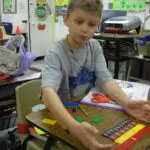
Teacher’s Activity: The teacher uses a fraction board or fraction circles to show various equivalent fractions (e.g., 1/2 = 2/4, 1/3 = 2/6, 1/4 = 2/8). The teacher encourages pupils to manipulate the fraction pieces.
Pupils’ Activity: Pupils observe and manipulate the fraction board pieces to confirm the equivalence of different fractions.
Learning Point: Pupils gain a hands-on understanding of equivalent fractions.
Step 6: Ordering Fractions Using Symbols
Time: 5 minutes
Teaching Skill: Explaining/Questioning
Teacher’s Activity: The teacher explains the symbols >, <, and =. The teacher then gives examples of fractions and asks pupils to use the correct symbol to compare them (e.g., 1/2 and 1/4; 1/3 and 1/2; 2/4 and 3/6).
Pupils’ Activity: Pupils listen to the explanation and practice comparing fractions using the symbols.
Learning Point: Pupils learn to compare fractions using appropriate mathematical symbols.
Step 7: Evaluation/Review
Time: 5 minutes
Teaching Skill: Questioning/Assessment
Teacher’s Activity: The teacher evaluates the learning by asking the following questions:
- What are equivalent fractions?
- Give two fractions that are equivalent to 1/2.
- Give two fractions that are equivalent to 1/3.
- Fill in the blank with >, <, or =: 1/2 _____ 1/4.
Pupils’ Activity: Pupils answer orally and in writing.
Learning Point: Pupils demonstrate understanding of the lesson.
Step 8: Conclusion
Time: 3 minutes
Teaching Skill: Summarization
Teacher’s Activity: The teacher summarizes the key points of the lesson, emphasizing that equivalent fractions represent the same amount. The teacher assigns homework: Draw diagrams to show that 1/4 = 2/8.
Pupils’ Activity: Pupils listen to the summary and copy the homework assignment.
Learning Point: Pupils consolidate their understanding and apply their knowledge.
Home Task: Solve three new exercises on Equivalent Fractions. Show each step and check each answer.
Lesson Keywords
- Fraction – A part of a whole.
- Numerator – The top number in a fraction, showing how many parts are taken.
- Denominator – The bottom number in a fraction, showing the total number of equal parts.
- Half (1/2) – One of two equal parts of a whole.
- Equivalent Fractions – Fractions that have different numerators and denominators but represent the same value.
- Greater than (>) – A symbol used to show that one number or fraction is larger than another.
- Less than (<) – A symbol used to show that one number or fraction is smaller than another.
- Equal to (=) – A symbol used to show that two numbers or fractions have the same value.
Differentiation
For struggling learners, the teacher will provide more one-on-one guidance and use more physical objects for division. Advanced learners will be challenged with more complex equivalent fraction problems or asked to find multiple equivalent fractions for a given fraction.
Note for teachers using this lesson plan
Ensure a variety of visual aids are available to demonstrate fractions clearly. Encourage pupils to participate actively through hands-on activities with fraction manipulatives. Emphasize the concept that the size of the whole remains constant when finding equivalent fractions.

Community Join the conversation Open discussion +