

Class: Primary 6
Term: 2nd Term
Week: 7
Age: 11 years
Duration: 45 minutes
Subject: General Mathematics
Curriculum Theme: Measurement
Previous Lesson: Length, Pythagoras Rule and Right, Angled Triangles.
Topic: WEIGHT
Subject Matter: Meaning of weight and units, measuring weight using weighing scale, converting between grammes and kilogrammes, expressing weight in different units, word problems and quantitative aptitude on weight
Specific Objectives
By the end of the lesson, pupils should be able to:
Cognitive Domain:
- Define weight and state its basic units.
- Convert between grammes and kilogrammes.
- Solve word problems involving weight.
- Solve quantitative aptitude problems related to weight.
Affective Domain:
- Appreciate the importance of accurate weight measurement in daily life.
- Participate actively in class discussions and problem-solving activities.
Psychomotor Domain:
- Demonstrate how to measure weight using a weighing scale.
- Accurately perform conversions between different units of weight.
Social Domain:
- Collaborate with peers to solve weight-related problems.
Reference Materials
The following resources were used in planning this lesson:
- 9 Years Basic Education Curriculum for Primary Schools
- State Unified Scheme of Work for Primary 6 Mathematics
- New General Mathematics for Primary Schools, Book 6
- Textbook, workbook, formula book
Instructional Materials
The teacher will teach this lesson with the aid of:
- Weighing scale (bathroom scale, kitchen scale)
- Various objects of different weights (e.g., books, bags of rice, stones)
- Textbook, workbook, formula book
- Charts showing units of weight and conversion factors
Rationale for the Lesson
Understanding weight is important for pupils as it is a fundamental concept used in everyday life, from cooking and shopping to understanding health and fitness. This lesson helps pupils to accurately measure and compare the mass of objects, making them more aware of quantities in their environment.
Prerequisite/Previous Knowledge
Pupils should have a basic understanding of measurement, numbers, and simple arithmetic operations (addition, subtraction, multiplication, division).
Lesson Content/Board Summary
WEIGHT
Meaning of Weight
Weight is a measure of how heavy an object is. It tells us the amount of matter in an object and the force of gravity acting on it. The heavier an object, the more it weighs.
Units of Weight
The standard units used to measure weight are:
- Gramme (g): Used for measuring lighter objects, like a pencil or a small sachet of sugar.
- Kilogramme (kg): Used for measuring heavier objects, like a bag of rice or a person’s body weight.
- Tonne (t): Used for measuring very heavy objects, like a vehicle or a large amount of goods. (1 tonne = 1000 kg)
Measuring Weight Using a Weighing Scale
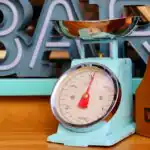
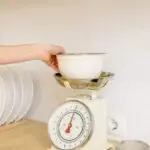
A weighing scale is an instrument used to measure weight. Different types of scales are used for different purposes, such as kitchen scales for food, bathroom scales for body weight, and industrial scales for heavy loads.
To measure weight:
- Place the object carefully on the weighing scale.
- Read the measurement indicated by the pointer or digital display.
- Ensure the scale is calibrated to zero before placing the object.
Conversion Between Grammes and Kilogrammes
The relationship between grammes and kilogrammes is:
1 kilogramme (kg) = 1000 grammes (g)
To convert kilogrammes to grammes:
Multiply the number of kilogrammes by 1000.
Example 1: Convert 5 kg to grammes.
Solution:
- Step 1: Identify the conversion factor. (1 kg = 1000 g)
- Step 2: Multiply the given kilogrammes by 1000. (5 kg × 1000 g/kg)
- Step 3: Perform the multiplication. (5000 g)
Therefore, 5 kg = 5000 g.
To convert grammes to kilogrammes:
Divide the number of grammes by 1000.
Example 2: Convert 3500 g to kilogrammes.
Solution:
- Step 1: Identify the conversion factor. (1000 g = 1 kg)
- Step 2: Divide the given grammes by 1000. (3500 g ÷ 1000 g/kg)
- Step 3: Perform the division. (3.5 kg)
Therefore, 3500 g = 3.5 kg.
How to solve for different values:
If you are given a weight in one unit and need to find its equivalent in another, always use the conversion factor (1 kg = 1000 g). To find grammes from kilogrammes, multiply. To find kilogrammes from grammes, divide.
Expressing Weight in Different Units
Weight can be expressed in mixed units (e.g., 2 kg 500 g) or as a single unit (e.g., 2.5 kg or 2500 g).
Example: Express 3 kg 250 g in grammes.
Solution:
- Step 1: Convert the kilogramme part to grammes. (3 kg = 3 × 1000 g = 3000 g)
- Step 2: Add the remaining grammes. (3000 g + 250 g)
- Step 3: State the total in grammes. (3250 g)
Therefore, 3 kg 250 g = 3250 g.
Word Problems on Weight
Word problems require careful reading to identify the given information and what needs to be found. They often involve addition, subtraction, multiplication, or division of weights, sometimes requiring unit conversion.
Example: A bag of rice weighs 5 kg 200 g, and another bag weighs 3 kg 900 g. What is their total weight in kilogrammes?
Solution:
- Step 1: Convert all weights to a common unit (grammes or kilogrammes). Let’s convert to grammes.
Bag 1: 5 kg 200 g = (5 × 1000) g + 200 g = 5000 g + 200 g = 5200 g
Bag 2: 3 kg 900 g = (3 × 1000) g + 900 g = 3000 g + 900 g = 3900 g - Step 2: Add the weights. (5200 g + 3900 g = 9100 g)
- Step 3: Convert the total weight back to the required unit (kilogrammes).
9100 g = 9100 ÷ 1000 kg = 9.1 kg
The total weight is 9.1 kg.
Quantitative Aptitude on Weight
Quantitative aptitude problems test problem-solving skills and understanding of relationships between quantities. They might involve patterns, missing values, or logical reasoning related to weight.
Example: If 3 apples weigh 450 g, how much would 5 similar apples weigh?
Solution:
- Step 1: Find the weight of one apple. (450 g ÷ 3 apples = 150 g/apple)
- Step 2: Multiply the weight of one apple by the number of apples. (150 g/apple × 5 apples = 750 g)
Therefore, 5 similar apples would weigh 750 g.
Teaching Methods/Instructional Techniques
Discussion, Lecture, Demonstration, Question and Answer, Visual Aids
Instructional Procedures
Step 1: Introduction
Time: 5 minutes
Teaching Skill: Set Induction
Teacher’s Activity: The teacher greets the pupils and asks them to identify objects in the classroom that are heavy or light. The teacher then asks what we use to find out how heavy an object is.
Pupils’ Activity: Pupils respond by naming heavy and light objects and suggest using a weighing scale.
Learning Point: Pupils recall prior knowledge related to weight and are introduced to the lesson topic.
Step 2: Meaning of Weight and Units
Time: 5 minutes
Teaching Skill: Explanation/Definition
Teacher’s Activity: The teacher explains the meaning of weight and introduces the common units of weight (gramme, kilogramme, tonne), explaining when each is used. The teacher writes key points on the board.
Pupils’ Activity: Pupils listen attentively, take notes, and state the meaning of weight and its basic units.
Learning Point: Pupils understand what weight is and identify its standard units.
Step 3: Measuring Weight Using a Weighing Scale
Time: 7 minutes
Teaching Skill: Demonstration/Practical Application
Teacher’s Activity: The teacher demonstrates how to use a weighing scale with various objects, showing how to read the measurements. The teacher asks pupils to come forward and practice.
Pupils’ Activity: Pupils observe the demonstration and then take turns to measure the weight of different objects using the weighing scale.
Learning Point: Pupils gain practical experience in measuring weight.
Step 4: Conversion Between Grammes and Kilogrammes
Time: 8 minutes
Teaching Skill: Explanation/Problem Solving
Teacher’s Activity: The teacher explains the relationship between grammes and kilogrammes (1 kg = 1000 g). The teacher demonstrates how to convert kilogrammes to grammes and grammes to kilogrammes with examples on the board.
Pupils’ Activity: Pupils follow the examples, ask questions for clarification, and attempt simple conversion exercises.
Learning Point: Pupils learn the conversion factor and how to convert between grammes and kilogrammes.
Step 5: Expressing Weight in Different Units
Time: 5 minutes
Teaching Skill: Guided Practice
Teacher’s Activity: The teacher guides pupils on how to express weight in mixed units or as a single unit, providing examples such as converting 3 kg 250 g to grammes.
Pupils’ Activity: Pupils practice expressing weights in different units as guided by the teacher.
Learning Point: Pupils can express weight in various forms.
Step 6: Word Problems and Quantitative Aptitude
Time: 8 minutes
Teaching Skill: Problem Solving/Application
Teacher’s Activity: The teacher presents several word problems and quantitative aptitude questions on weight. The teacher guides pupils through the steps to solve these problems, emphasizing careful reading and unit consistency.
Pupils’ Activity: Pupils actively participate in solving the problems, asking questions, and explaining their reasoning.
Learning Point: Pupils apply their knowledge of weight to solve practical problems.
Step 7: Evaluation/Review
Time: 5 minutes
Teaching Skill: Questioning/Assessment
Teacher’s Activity: The teacher evaluates the learning by asking the following questions:
- Define weight in your own words.
- Mention two common units used for measuring weight.
- Convert 7 kg to grammes.
- Convert 4500 g to kilogrammes.
- If a bag of sugar weighs 2 kg 500 g, what is its weight in grammes?
Pupils’ Activity: Pupils answer orally and in writing.
Learning Point: Pupils demonstrate understanding of the lesson.
Step 8: Conclusion
Time: 2 minutes
Teaching Skill: Summarization
Teacher’s Activity: The teacher summarizes the key points of the lesson, reiterating the meaning of weight, its units, and how to convert between them and solve related problems. The teacher assigns homework from the textbook.
Pupils’ Activity: Pupils listen to the summary and copy down the homework.
Learning Point: Pupils consolidate their learning and identify areas for further practice.
Home Task: Solve three new exercises on WEIGHT. Show each step and check each answer.
Lesson Keywords
- Weight – A measure of how heavy an object is.
- Gramme (g) – A unit of weight for lighter objects.
- Kilogramme (kg) – A unit of weight for heavier objects; 1 kg = 1000 g.
- Weighing Scale – An instrument used to measure weight.
- Conversion – Changing a quantity from one unit to another.
Differentiation
For pupils who grasp concepts quickly, the teacher can provide more complex word problems or introduce the concept of tonnes. For pupils needing extra support, the teacher will provide additional guided practice with simpler conversions and direct measurement activities using the weighing scale. Peer tutoring can also be encouraged.
Note for teachers using this lesson plan
Ensure that actual weighing scales are available and functional for practical demonstrations. Encourage active pupil participation in measuring and problem-solving. Emphasize the real-life applications of weight measurement to make the lesson relatable and engaging.

Community Join the conversation Open discussion +