

Class: Primary 3
Term: Second Term
Week: 4
Age: 8 years
Duration: 45 minutes
Subject: Mathematics
Curriculum Theme: Numbers
Previous Lesson: Division, Find the Missing Factor in a Given Number.
Topic: Factors and Multiples of Numbers
Subject Matter: NUMBERS
Specific Objectives
By the end of the lesson, pupils should be able to:
Cognitive Domain:
- Define factors and multiples of numbers.
- Identify multiples of given numbers (e.g., 2, 3, 4, 5, 6).
- State factors of given numbers.
- Distinguish between factors and multiples.
Affective Domain:
- Appreciate the importance of accuracy in mathematical operations, especially division.
- Show interest in finding factors and multiples of numbers.
Psychomotor Domain:
- Correctly list the first few multiples of simple numbers.
- Accurately identify and list factors of numbers up to 20.
Social Domain:
- Work cooperatively in groups to solve problems involving factors and multiples.
Reference Materials
The following resources were used in planning this lesson:
- 9 Years Basic Education Curriculum
- State Unified Scheme of Work
- New General Mathematics for Primary 3
Instructional Materials
The teacher will teach this lesson with the aid of:
- Number charts
- Multiplication tables
- Flashcards with numbers
- Real-life objects for grouping (e.g., counters, stones)
Rationale for the Lesson
This lesson helps pupils understand how numbers relate to each other through multiplication and division. Learning factors and multiples is important for solving problems involving sharing, grouping, and understanding number patterns, which are useful in everyday activities.
Prerequisite/Previous Knowledge
Pupils can perform basic multiplication and division operations and have an understanding of number sequences.
Lesson Content/Board Summary
Factors and Multiples of Numbers
What are Multiples?
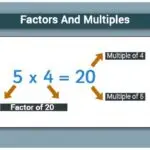
Multiples are the results you get when you multiply a number by other whole numbers (1, 2, 3, 4, etc.). They are like the products in a multiplication table for a specific number.
To find the multiples of a number, multiply the number by 1, 2, 3, 4, and so on.
Examples of Multiples:
- Multiples of 2: 2 x 1 = 2, 2 x 2 = 4, 2 x 3 = 6, 2 x 4 = 8, … (2, 4, 6, 8, 10, 12, …)
- Multiples of 3: 3 x 1 = 3, 3 x 2 = 6, 3 x 3 = 9, 3 x 4 = 12, … (3, 6, 9, 12, 15, 18, …)
- Multiples of 4: 4 x 1 = 4, 4 x 2 = 8, 4 x 3 = 12, 4 x 4 = 16, … (4, 8, 12, 16, 20, 24, …)
- Multiples of 5: 5 x 1 = 5, 5 x 2 = 10, 5 x 3 = 15, 5 x 4 = 20, … (5, 10, 15, 20, 25, 30, …)
What are Factors?
Factors are numbers that divide another number exactly without leaving a remainder. When you multiply two factors, you get the original number.
To find the factors of a number, think of all the pairs of numbers that multiply together to give that number.
Examples of Factors:
- Factors of 6:
- 1 x 6 = 6
- 2 x 3 = 6
So, the factors of 6 are 1, 2, 3, and 6.
- Factors of 12:
- 1 x 12 = 12
- 2 x 6 = 12
- 3 x 4 = 12
So, the factors of 12 are 1, 2, 3, 4, 6, and 12.
- Factors of 10:
- 1 x 10 = 10
- 2 x 5 = 10
So, the factors of 10 are 1, 2, 5, and 10.
Distinction between Factors and Multiples
- Factors are numbers that divide into another number exactly. Factors are usually smaller than or equal to the number itself. (e.g., Factors of 10 are 1, 2, 5, 10)
- Multiples are numbers you get when you multiply a number by an integer. Multiples are usually larger than or equal to the number itself. (e.g., Multiples of 10 are 10, 20, 30, 40, …)
Everyday Activities Requiring Division and Accuracy
Correct division is important in many daily activities:
- Sharing: Dividing sweets among friends equally.
- Grouping: Arranging chairs into equal rows.
- Cooking: Measuring ingredients accurately for a recipe.
- Money: Calculating how much change you should get or splitting a bill.
NOTE: Accuracy in division is very important to ensure fairness and correctness in results. A small error can lead to big mistakes.
Teaching Methods/Instructional Techniques
Discussion, Lecture, Demonstration, Question and Answer, Visual Aids
Instructional Procedures
Factors and Multiples of Numbers
Step 1: Introduction
Time: 5 minutes
Teaching Skill: Set Induction
Teacher’s Activity: The teacher greets the pupils, reviews the previous lesson on multiplication and division, and then asks them to recite multiplication tables (e.g., 2 times table, 3 times table).
Pupils’ Activity: Pupils greet the teacher and actively participate in reciting multiplication tables.
Learning Point: Pupils recall previous knowledge relevant to the new topic.
Step 2: Explanation of Multiples
Time: 10 minutes
Teaching Skill: Explanation/Demonstration
Teacher’s Activity: The teacher explains what multiples are using the multiplication table as a guide. The teacher gives examples like multiples of 2 (2, 4, 6, 8, …) and multiples of 3 (3, 6, 9, 12, …), writing them on the board.
Pupils’ Activity: Pupils listen attentively, observe the examples on the board, and ask questions for clarification.
Learning Point: Pupils understand the concept of multiples.
Step 3: Finding Multiples
Time: 5 minutes
Teaching Skill: Guided Practice
Teacher’s Activity: The teacher guides pupils to find the first few multiples of other numbers like 4, 5, and 6, by asking them to multiply the number by 1, 2, 3, etc.
Pupils’ Activity: Pupils actively participate by suggesting the multiples and writing them down in their notebooks.
Learning Point: Pupils can correctly list multiples of given numbers.
Step 4: Explanation of Factors
Time: 10 minutes
Teaching Skill: Explanation/Demonstration
Teacher’s Activity: The teacher explains what factors are by using division. The teacher shows how to find factors by asking: “What numbers can divide 6 exactly?” (1, 2, 3, 6). The teacher writes examples on the board.
Pupils’ Activity: Pupils listen, observe the examples, and try to identify factors for simple numbers.
Learning Point: Pupils understand the concept of factors.
Step 5: Finding Factors
Time: 5 minutes
Teaching Skill: Guided Practice
Teacher’s Activity: The teacher guides pupils to find factors of numbers like 10, 12, and 18, encouraging them to think of pairs of numbers that multiply to give the target number.
Pupils’ Activity: Pupils work individually or in pairs to find and list the factors of the given numbers.
Learning Point: Pupils can accurately find factors of given numbers.
Step 6: Distinguishing Factors and Multiples
Time: 5 minutes
Teaching Skill: Comparison/Discussion
Teacher’s Activity: The teacher leads a discussion comparing factors and multiples, emphasizing that factors divide a number, while multiples are products of a number. The teacher also highlights the importance of accuracy in division for everyday activities.
Pupils’ Activity: Pupils contribute to the discussion, state the differences, and give examples of real-life situations where division is needed.
Learning Point: Pupils can distinguish between factors and multiples and appreciate accuracy in calculations.
Step 7: Evaluation/Review
Time: 5 minutes
Teaching Skill: Questioning/Assessment
Teacher’s Activity: The teacher evaluates the learning by asking the following questions:
- What are multiples? Give the first five multiples of 4.
- What are factors? List all the factors of 15.
- State one difference between a factor and a multiple.
- Mention two everyday activities where correct division is important.
Pupils’ Activity: Pupils answer orally and in writing.
Learning Point: Pupils demonstrate understanding of the lesson.
Step 8: Conclusion
Time: 5 minutes
Teaching Skill: Summarization/Assignment
Teacher’s Activity: The teacher summarizes the key points of the lesson on factors and multiples. The teacher gives homework: “List the factors of 20 and the first five multiples of 7.”
Pupils’ Activity: Pupils listen to the summary and copy the homework assignment.
Learning Point: Pupils consolidate their understanding and apply learned concepts.
Home Task: Solve three new exercises on Factors and Multiples of Numbers. Show each step and check each answer.
Lesson Keywords
- Factors – Numbers that divide another number exactly without a remainder.
- Multiples – The results of multiplying a number by other whole numbers.
- Division – The process of splitting a number into equal parts.
- Multiplication – The process of adding a number to itself a certain number of times.
- Product – The result of multiplying two or more numbers.
Differentiation
For struggling learners, the teacher will provide extra examples and use concrete objects to demonstrate factors and multiples. Advanced learners will be challenged to find factors and multiples of larger numbers or explore common factors and multiples.
Note for teachers using this lesson plan
Teachers should ensure that pupils have a strong grasp of basic multiplication and division before introducing factors and multiples. Encourage pupils to use multiplication tables as a tool. Emphasize practical examples to make the concepts relatable to daily life.


Community Join the conversation Open discussion +