

Class: Primary 5
Term: 2nd Term
Subject: Cultural and Creative Arts
Curriculum Theme: Cultural and Creative Arts
Previous Lesson: Importance Of Motif In Dance in Materials For Mosaic
Topic: Reasons For The Production of Mosaic: Musical Notes And Their Values
Content/Learning Area: to reflect one ill in the society, e.g., cultism, HIV, smoking, etc. Musical notes and their values.
Time Allocation: 40 minutes
Performance Objectives
By the end of the lesson, pupils should be able to:
- Cognitive Domain: List five reasons for producing mosaics and identify five musical notes with their values.
- Affective Domain: Appreciate how mosaics can reflect societal issues.
- Psychomotor Domain: Draw five musical notes and label their values.
- Social Domain: Discuss the relevance of mosaics in addressing societal ills with peers.
Reference Materials
The following resources were used in planning this lesson:
- 9–Years Basic Education Curriculum, Abuja Educational Resource Center.
- Scheme of Work, NAPPS National Unified Scheme of Work.
- Online Information from: Britannica – Musical notation | Description, Systems, & Note Symbols
Instructional Materials
To deliver this lesson, the teacher will use the following materials:
- A sample mosaic reflecting societal ills.
- A whiteboard and markers.
- Printed charts showing musical notes and their values.
- A drawing of a completed mosaic.
Rationale for the Lesson
Understanding mosaics and musical notes helps pupils recognize how art and music can convey messages, educate society, and promote awareness of pressing societal issues.
Prerequisite/Previous Knowledge
Pupils have learned about the importance of motifs in dance and are familiar with using patterns to communicate cultural ideas.
Lesson Content
Reasons for The Production Of Mosaic: Musical Notes And Their Values
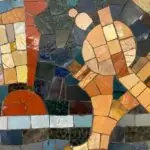
Music uses symbols called notes to represent sound duration and pitch. Mosaics are artworks made by arranging small pieces to form patterns.
Reasons for the Production of Mosaic:
Mosaics serve various purposes, from reflecting societal issues to preserving past events.
The following are:
- To reflect societal issues, e.g., cultism, HIV, smoking.
- To promote cultural awareness.
- To beautify environments.
- To pass moral lessons.
- To preserve historical events.
- to commemorate vital figures or events.
- To educate the public on specific topics.
Musical Notes and Their Values:
Musical notes represent the duration of sounds in music, each having a specific beat value.
They are:
- Semibreve – 4 beats (whole note).
- Minim – 2 beats (half note).
- Crotchet – 1 beat (quarter note).
- Quaver – 1/2 beat (eighth note).
- Semiquaver – 1/4 beat (sixteenth note).
- Demisemiquaver – 1/8 beat (thirty-second note).
- Hemi-demisemiquaver – 1/16 beat (sixty-fourth note).
Teaching Methods
To deliver this lesson, the teacher will adopt the following methods: Question and answer, Clarification, Exhibition, Guided writing, Group activity, Verbal reinforcement, Interaction.
Instructional Procedures
To deliver this lesson, the teacher will adopt the following steps:
Step 1: Introduction
Time: 5 mins
Teaching skill: Set Induction
Teacher’s Activity: Asks pupils to describe what they know about mosaics and musical notes.
Pupils’ Activity: Respond to the questions.
Step 2: Explanation
Time: 10 mins
Teaching Skill: Direct instruction
Teacher’s Activity: Explains reasons for producing mosaics and shows examples of musical notes.
Pupils’ Activity: Observe,listen,and ask questions.
Step 3: Demonstration
Time: 10 mins
Teaching skill: Practical demonstration
Teacher’s Activity: Demonstrates how to draw a mosaic and musical notes with their values.
Pupils’ Activity: Follow the demonstration.
Step 4: Note-Taking
Time: 5 mins
Teaching Skill: Guided writing
Teacher’s Activity: Guides pupils in writing short notes on the topic.
pupils’ Activity: Copy the note.
Step 5: evaluation/Review
Time: 5 mins
Teaching Skill: Assessment
Teacher’s Activity: Asks evaluation questions to check understanding.
Pupils’ Activity: Answer the questions.
Objective-aligned checks:
- List five reasons for producing mosaics and identify five musical notes with their values.
- Draw five musical notes and label their values.
Step 6: Conclusion
Time: 3 mins
Teaching Skill: Summary
Teacher’s Activity: Recaps the key points of the lesson.
Pupils’ Activity: Listen and ask clarifying questions.
Lesson Keywords
- Mosaic – An artwork made by arranging small pieces to form patterns.
- Musical Note – A symbol representing the duration and pitch of a sound.
- Semibreve – A musical note with 4 beats.
- Crotchet – A musical note with 1 beat.
- Societal Issues – Problems affecting a community or society.
Lesson Evaluation
To evaluate the learning, the teacher asks pupils to:
- list two reasons for producing mosaics.
- Mention and draw two musical notes with their values.
- Explain how mosaics can address societal issues.
- Name two societal ills that can be depicted in mosaics.
- State the beat value of a crotchet.
assignment/homework
- Create a simple mosaic design that reflects a societal issue in your community.
- Draw and label five different musical notes with their corresponding beat values.
- write a short paragraph explaining how music can be used to promote positive change in society.
Differentiation
- For slower learners: provide simplified diagrams of musical notes and pre-cut mosaic pieces for easier assembly.
- For advanced learners: Encourage them to research and present on complex mosaic designs or musical compositions.
- For visual/auditory/kinesthetic learners: Use visual aids, play musical examples, and allow hands-on creation of mosaics and musical notation.
Note for Teachers
This lesson provides an opportunity to blend art and music, showing their relevance in addressing real-world issues. Ensure pupils actively participate in discussions and practice. Happy teaching!


Community Join the conversation Open discussion +