

Class: primary 5
Term: 2nd Term
Subject: Cultural Adn Creative Arts
Curriculum Theme: Cultural And Creative Arts
Previous Lesson: Meaning And Functions Of Role Play in Method Of Wood Carving
Topic: Materials For Wood Carving: Writing Melody With Text
Content/Learning Area: Writing melody with text e.g. “Twinkle twinkle little star”……
Time Allocation: 40 minutes
Performance Objectives
By the end of the lesson, pupils should be able to:
- Cognitive Domain: Identify and name materials used in wood carving and explain how they are used.
- Affective Domain: Appreciate the importance of melody in music and express enthusiasm when writing their own melodies.
- Psychomotor Domain: Write simple melodies using sofa notation and compose a melody with lyrics.
- Social domain: Collaborate with peers to share melodies and provide feedback during group activities.
reference Materials
The following resources were used in planning this lesson:
- 9 – Years Basic Education Curriculum
- Abuja Educational Resource Center Scheme of Work
- NAPPS National Unified Scheme of Work
- Online Information from: Dsource – Tools and Raw Materials – Wood Carving
- Relevant Textbooks
Instructional Materials
To deliver this lesson, the teacher will employ the help of the following materials:
- Whiteboard
- Markers
- Piano or xylophone for melody examples
- visual aids depicting wood carving tools
- notation charts for sofa notation
Rationale for the Lesson
Understanding how to write melodies with text is an essential skill in music creation. It allows pupils to express themselves creatively, and it is also tied to cultural heritage through songs passed down across generations. Knowing materials for wood carving further connects students to the cultural arts,helping them to appreciate the process and creativity involved in the craft.
Prerequisite/Previous Knowledge
Pupils are expected to have basic knowledge of music and how melodies are created. They should be familiar with simple songs and understand the general concept of wood carving from the previous lesson.
Lesson Content
Materials For Wood Carving: Writing Melody With Text
Wood carving is a traditional craft that involves shaping wood to create art.
For wood carving, various materials are used. These include:
- Wood (e.g., mahogany, oak, iroko)
- Carving knives
- Chisels
- Sandpaper
- Mallets
- Gouges
- Rasps
A melody is a sequence of musical notes that is catchy and easy to follow. To write melodies,we use sofa notation,where each syllable corresponds to a note.For example, in the song “Twinkle Twinkle Little Star”:
“Twin-kle, twin-kle, lit-tle star”
the syllables “Twin-kle” represent specific musical notes.
Wood-carving Materials and Writing a Melody to Text
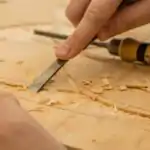
Wood carving uses suitable wood and correctly maintained tools to remove material and create a form. Pupils should identify tools through demonstration; sharp carving tools must be handled only under close responsible supervision.
When a melody is written for words, the rhythm should fit the syllables and natural stress of the text. Begin with a short phrase, sing it, adjust difficult jumps and write the note or sol-fa pattern clearly.
Teaching methods
To deliver this lesson, the teacher will adopt the following methods: Discussion, Explanation, Exhibition, Guided Practice, Group Activity, Questioning, Summary.
Instructional Procedures
To deliver this lesson, the teacher will adopt the following steps:
Step 1: Introduction (Set Induction)
Time: 5 minutes
Teaching Skill: Set Induction
Teacher’s Activity: Ask pupils if they remember what they learned in the previous lesson. Discuss the importance of melody in music and wood carving.
Pupils’ Activity: Pupils will respond by recalling the previous lesson on wood carving.
Step 2: Materials Used for Wood Carving
Time: 7 minutes
Teaching Skill: Discussion
Teacher’s Activity: Display images of wood carving tools, explain their uses, and list five materials used.
Pupils’ Activity: Pupils will take notes and ask questions.
Step 3: Writing Melody with Text
Time: 10 minutes
Teaching Skill: Explanation
Teacher’s Activity: Explain what melody writing is, and show how to write “Twinkle, Twinkle” using sofa notation.
Pupils’ Activity: Pupils will copy the melody and notation.
Step 4: Demonstrating Melody
Time: 8 minutes
Teaching skill: Guided Practice
Teacher’s Activity: Play a melody on the piano or xylophone and have pupils write it down in notation form.
Pupils’ Activity: Pupils will write down the melody as the teacher plays.
Step 5: Group Work
Time: 5 minutes
Teaching Skill: Group Activity
Teacher’s Activity: In groups, pupils create their own simple melody with text using sofa notation.
Pupils’ Activity: Pupils will work in groups to create melodies.
Step 6: Note-Taking
Time: –
Teaching Skill: –
Teacher’s activity: The teacher writes the lesson content on the board.
Pupils’ Activity: The pupils copy the note from the board.
Step 7: Evaluation/Review
Time: 3 minutes
Teaching Skill: Questioning
Teacher’s Activity: Ask pupils questions to review what they’ve learned about wood carving materials and melody writing.
Pupils’ Activity: Pupils will respond to the questions.
Objective-aligned checks:
- Identify and name materials used in wood carving and explain how they are used.
- Write simple melodies using sofa notation and compose a melody with lyrics.
Step 8: Conclusion
Time: 2 minutes
Teaching Skill: Summary
Teacher’s Activity: Summarize the lesson by revisiting the materials and melody writing. Give feedback.
Pupils’ Activity: Pupils will summarize what they have learned.
Lesson keywords
- Wood Carving – The art of shaping wood to create decorative or functional objects.
- Melody – A sequence of musical notes that form a recognizable tune.
- Sofa Notation – A system of representing musical notes using syllables like do,re,mi,fa,so,la,ti.
- Chisels – Hand tools used for shaping wood by removing small pieces.
- Mallets – Hammers made of wood or rubber, used to drive chisels.
Lesson Evaluation
To evaluate the learning, the teacher asks pupils to:
- Name two materials used for wood carving.
- Write the melody for “Twinkle Twinkle Little Star” using sofa notation.
- Explain how they would create their own melody using text.
- Identify the steps involved in writing a melody.
- Discuss why melody writing is important in music.
Assignment/Homework
- List five materials used in wood carving and their uses.
- Compose a short melody using sofa notation and write lyrics for it.
- Research and write about a famous wood carving artist from Nigeria.
Differentiation
- For slower learners: Provide simplified notation charts and one-on-one assistance during melody writing.
- for advanced learners: Encourage them to explore more complex melodies and harmonies in their compositions.
- For visual/auditory/kinesthetic learners: Use visual aids, play melodies on instruments, and allow hands-on practice with wood carving tools (under supervision).
Note for Teachers
Ensure that pupils understand the concept of melody writing by breaking down each step and allowing time for practice. it might be helpful to have a melody ready for demonstration before the lesson. For group activities, encourage students to collaborate and share their ideas.Happy teaching!

Community Join the conversation Open discussion +