

Class: Senior Secondary School 2 (SS2 / SSS2)
Term: Second Term
Week: 5 & 6
Age: 16 years
Duration: 45 minutes
Subject: Building Construction
Curriculum Theme: Building Elements
Previous Lesson: Concrete: Types of concrete test.
Topic: FOUNDATION
Subject Matter: Meaning of FOUNDATION, Types of foundation (raft, pile, strip, pad), identification and drawings.
Specific Objectives
By the end of the lesson, pupils should be able to:
Cognitive Domain:
- Define foundation.
- List different types of foundation.
- Explain the purpose of various foundation types.
Affective Domain:
- Appreciate the importance of a strong foundation in building construction.
- Develop interest in identifying different foundation types.
Psychomotor Domain:
- Identify different foundation types from diagrams or actual construction sites.
- Sketch simple diagrams of common foundation types.
Social Domain:
- Participate actively in discussions about foundation types.
- Collaborate in identifying foundation types during site visits or from images.
Reference Materials
The following resources were used in planning this lesson:
- Senior Secondary Schools Education Curriculum
- State Unified Scheme of Work
- Building Construction for Senior Secondary Schools by E.A. Olaitan
- https://www.theconstructor.org/building/types-of-foundations-shallow-deep-foundations-details/
- https://www.youtube.com/watch?v=Fj-yL-kKk08
Instructional Materials
The teacher will teach this lesson with the aid of:
- Charts showing different types of foundations.
- Pictures or drawings of various foundation types (e.g., strip, pad, raft, pile).
- Video clips demonstrating foundation construction.
- Access to a construction site (for practical observation, if feasible).
Rationale for the Lesson
Understanding foundations is important because they are the base of any building and transfer the building’s load safely to the ground. This knowledge helps pupils appreciate how buildings stand firm and avoid structural failures.
Prerequisite/Previous Knowledge
Pupils have a basic understanding of what a building is and some of its basic components, such as walls and roofs.
Lesson Content/Board Summary
FOUNDATION
Meaning of Foundation
A foundation is the lowest part of a structure that transfers the building’s load to the soil or rock beneath. It is the part of the building that is usually below ground level and provides stability.
Purpose of Foundation
The following are the main purposes of a foundation:
- To support the entire weight (load) of the building.
- To distribute the building’s load evenly over a larger area of soil, reducing pressure.
- To provide a level and stable base for the construction of the superstructure.
- To prevent settlement and movement of the building, which could lead to cracks or structural failure.
- To resist external forces such as wind, earthquakes, and lateral soil pressure.
Types of Foundation
Foundations are broadly classified into two main categories: Shallow Foundations and Deep Foundations.
A. Shallow Foundations
Shallow foundations are used when the soil directly beneath the structure has sufficient bearing capacity at a shallow depth (typically less than 3 meters). They are generally more economical.
The following are common types of shallow foundations:
- Strip Foundation: This is a continuous strip of concrete, wider than the wall it supports, running along the line of load-bearing walls. It is suitable for most residential buildings with good bearing soil.
- Pad Foundation (Isolated Footing): This is a square or rectangular concrete pad that supports individual columns. Each column has its own pad foundation to transfer its load to the soil.
- Raft Foundation (Mat Foundation): This is a large concrete slab extending over the entire area of the building, supporting all the walls and columns. It is used when soil bearing capacity is low or when individual footings would cover more than 50% of the area. It helps to distribute the load over a very large area.
B. Deep Foundations
Deep foundations are used when the soil near the surface does not have sufficient bearing capacity to support the building’s load, or when the loads are very heavy. They transfer the load to deeper, stronger soil or rock layers.
The following is a common type of deep foundation:
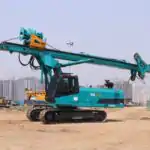
- Pile Foundation: Piles are long, slender members driven or cast into the ground to transfer the load through weak soil layers to a stronger bearing stratum or to resist uplift forces. Piles can be made of concrete, steel, or timber.
- Pile Strip Foundation: While not a standard primary classification, “pile strip” can refer to a continuous strip of piles, often used under a load-bearing wall where a strip footing alone is insufficient, or it might be a misunderstanding of continuous pile cap over a line of piles. The main deep foundation type is the Pile Foundation.
Identification and Drawings
Pupils should be able to identify these foundations from architectural and structural drawings. Key features to look for include:
- Strip Foundation: A continuous line of concrete under walls.
- Pad Foundation: Isolated square or rectangular blocks under columns.
- Raft Foundation: A single, large slab covering the entire building footprint.
- Pile Foundation: Long, slender elements extending deep into the ground, often topped with a pile cap.
Teaching Methods/Instructional Techniques
Discussion, Lecture, Demonstration, Question and Answer, Visual Aids
Instructional Procedures
Step 1: Introduction
Time: 5 minutes
Teaching Skill: Set Induction
Teacher’s Activity: The teacher asks pupils what makes a building stand firm and what part of a building is usually hidden underground.
Pupils’ Activity: Pupils respond, mentioning the base or bottom part.
Learning Point: Pupils are introduced to the concept of a building’s support system.
Step 2: Meaning of Foundation
Time: 7 minutes
Teaching Skill: Explanation/Definition
Teacher’s Activity: The teacher defines foundation as the lowest part of a structure that transfers the building’s load to the soil or rock beneath, using simple language and examples.
Pupils’ Activity: Pupils listen attentively and copy the definition into their notes.
Learning Point: Pupils learn the definition of a foundation.
Step 3: Purpose of Foundation
Time: 7 minutes
Teaching Skill: Elaboration/Discussion
Teacher’s Activity: The teacher explains the various purposes of a foundation, such as supporting the load, distributing pressure, and preventing settlement, encouraging pupils to share their ideas.
Pupils’ Activity: Pupils contribute ideas and note down the key purposes discussed.
Learning Point: Pupils understand why foundations are important for building stability.
Step 4: Introduction to Types of Foundation
Time: 7 minutes
Teaching Skill: Categorization/Visualisation
Teacher’s Activity: The teacher introduces the two main categories of foundations: shallow and deep, explaining when each is generally used. The teacher uses charts or diagrams to illustrate.
Pupils’ Activity: Pupils observe the charts and listen to the explanations, identifying the general differences.
Learning Point: Pupils learn the broad classifications of foundations.
Step 5: Shallow Foundations
Time: 7 minutes
Teaching Skill: Description/Illustration
Teacher’s Activity: The teacher describes and shows diagrams of strip, pad, and raft foundations, explaining their characteristics and typical applications.
Pupils’ Activity: Pupils observe the diagrams, ask questions for clarification, and make simple sketches in their notebooks.
Learning Point: Pupils understand and can identify different types of shallow foundations.
Step 6: Deep Foundations
Time: 7 minutes
Teaching Skill: Description/Illustration
Teacher’s Activity: The teacher describes and shows diagrams of pile foundations, explaining their purpose and where they are used, including the concept of pile strip if applicable.
Pupils’ Activity: Pupils observe the diagrams, ask questions, and make simple sketches.
Learning Point: Pupils understand and can identify deep foundations.
Step 7: Evaluation/Review
Time: 5 minutes
Teaching Skill: Questioning/Assessment
Teacher’s Activity: The teacher evaluates the learning by asking the following questions:
- Define foundation.
- State three purposes of a building foundation.
- List two types of shallow foundations and one type of deep foundation.
- When would a raft foundation be preferred over strip foundations?
Pupils’ Activity: Pupils answer orally and in writing.
Learning Point: Pupils demonstrate understanding of the lesson.
Step 8: Conclusion
Time: 2 minutes
Teaching Skill: Summarization
Teacher’s Activity: The teacher summarizes the key points of the lesson, reiterating the importance of foundations in building construction.
Pupils’ Activity: Pupils listen and ask any final questions.
Learning Point: Key concepts of foundations are reinforced.
Lesson Keywords
- Foundation – The lowest part of a structure that transfers its load to the ground.
- Strip Foundation – A continuous concrete strip under load-bearing walls.
- Pad Foundation – An isolated concrete pad supporting a single column.
- Raft Foundation – A large concrete slab covering the entire building area.
- Pile Foundation – Long, slender members driven deep into the ground to transfer loads.
- Shallow Foundation – Foundations placed near the ground surface.
- Deep Foundation – Foundations extending deep into the ground to reach stronger soil.
Differentiation
For pupils who are struggling, the teacher will provide simplified diagrams and additional verbal explanations. Advanced pupils will be encouraged to research specific examples of foundation failures due to poor design or construction, and to identify the appropriate foundation type for different soil conditions.
Note for teachers using this lesson plan
It is highly recommended to arrange a visit to a nearby construction site where foundation work is in progress or completed, to give pupils a practical understanding. If a site visit is not feasible, use detailed video clips or 3D models to demonstrate the various foundation types and their construction processes. Encourage pupils to bring pictures of different foundations they might see in their communities.

Community Join the conversation Open discussion +