

Class: Senior Secondary School 2 (SS2 / SSS2)
Term: Second Term
Week: 3
Age: 16 years
Duration: 45 minutes
Subject: Building Construction
Curriculum Theme: Building Materials and Construction Techniques
Previous Lesson: Excavation Problems: Safety rules during excavation.
Topic: CONCRETE
Subject Matter: Meaning, Definition, Properties, Characteristics, Production Process, Types of Concrete.
Specific Objectives
By the end of the lesson, pupils should be able to:
Cognitive Domain:
- Define concrete.
- State at least three properties and characteristics of concrete.
- Explain the process of concrete production.
- List at least three different types of concrete.
Affective Domain:
- Appreciate the importance of concrete in building construction.
- Show interest in the correct mixing and application of concrete.
Psychomotor Domain:
- Identify the main materials used in concrete production.
- Describe the basic steps involved in mixing concrete.
Social Domain:
- Participate in discussions about the uses of concrete in their environment.
Reference Materials
The following resources were used in planning this lesson:
- Senior Secondary Schools Education Curriculum
- State Unified Scheme of Work
- Building Construction for Senior Secondary Schools, Book 2
Instructional Materials
The teacher will teach this lesson with the aid of:
- Sand
- Cement
- Gravel (coarse aggregate)
- Water
- Reinforcement bars (as an example for reinforced concrete)
- Mixing tools (e.g., shovel, head pan)
- Charts showing different types of concrete structures.
Rationale for the Lesson
This lesson helps pupils understand concrete, a fundamental material in building construction. Knowing its composition, properties, and how it is produced enables them to appreciate its wide application and importance in constructing durable structures around them.
Prerequisite/Previous Knowledge
Pupils are expected to have prior knowledge of basic building materials like sand, cement, and gravel, and their uses in construction.
Lesson Content/Board Summary
CONCRETE
Meaning and Definition of Concrete
Concrete is a composite construction material composed of fine aggregate (sand), coarse aggregate (gravel or crushed stone), and a fluid cement (usually Portland cement) that hardens over time. Water is mixed with the cement and aggregates, which react chemically to form a durable, stone-like material.
Properties and Characteristics of Concrete
The following are important properties and characteristics of concrete:
- High Compressive Strength: Concrete can withstand large compressive loads.
- Durability: It is resistant to weathering, abrasion, and chemical attack.
- Workability: Fresh concrete can be easily molded and compacted.
- Impermeability: When properly mixed and cured, concrete is resistant to water penetration.
- Fire Resistance: Concrete has good fire-resistant properties.
- Economical: It is relatively cheap and readily available.
Process of Concrete Production (Mixing)
The main ingredients for concrete are cement, sand, gravel (or crushed stone), and water. The production process involves:
- Batching: Measuring the correct proportions of cement, sand, gravel, and water.
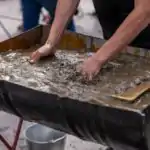
- Mixing: Thoroughly combining the materials to form a uniform mixture. This can be done manually (hand mixing) or mechanically (using a concrete mixer).
- Transporting: Moving the freshly mixed concrete to the place of use.
- Placing: Depositing the concrete into forms or molds.
- Compacting: Removing trapped air from the concrete to increase its density and strength.
- Curing: Maintaining adequate moisture and temperature conditions for a period after placing to allow the concrete to gain strength.
Types of Concrete
The following are different types of concrete:
- Plain Concrete: Concrete without reinforcement, used for mass concrete structures where tensile strength is not critical.
- Reinforced Concrete: Concrete in which steel bars (reinforcement) are embedded to resist tensile forces.
- Pre-stressed Concrete: Concrete where internal stresses are introduced to counteract the stresses that will occur during service, improving its strength and performance.
- Lightweight Concrete: Concrete made with lightweight aggregates to reduce its density, often used for non-load-bearing walls and insulation.
- High-Strength Concrete: Concrete designed to achieve significantly higher compressive strengths than conventional concrete.
Teaching Methods/Instructional Techniques
Discussion, Lecture, Demonstration, Question and Answer, Visual Aids
Instructional Procedures
Step 1: Introduction
Time: 5 minutes
Teaching Skill: Set Induction
Teacher’s Activity: The teacher greets the pupils and reviews the previous lesson. The teacher then asks pupils to name some materials used in building houses and introduces the topic “Concrete” by mentioning its common use.
Pupils’ Activity: Pupils respond to greetings, answer questions about previous lesson, and name building materials.
Learning Point: Pupils recall previous knowledge and are introduced to the new topic.
Step 2: Meaning and Definition of Concrete
Time: 7 minutes
Teaching Skill: Explanation/Definition
Teacher’s Activity: The teacher defines concrete as a mixture of cement, sand, gravel, and water, and explains its hardening process. The teacher writes the definition on the board.
Pupils’ Activity: Pupils listen attentively, ask questions for clarification, and copy the definition into their notes.
Learning Point: Pupils understand the basic meaning and definition of concrete.
Step 3: Properties and Characteristics of Concrete
Time: 7 minutes
Teaching Skill: Elucidation/Listing
Teacher’s Activity: The teacher explains the key properties of concrete such as high compressive strength, durability, workability, and fire resistance, using simple examples.
Pupils’ Activity: Pupils listen, identify these properties, and discuss their importance in construction.
Learning Point: Pupils learn about the essential characteristics that make concrete a valuable building material.
Step 4: Process of Concrete Production (Mixing)
Time: 7 minutes
Teaching Skill: Demonstration/Explanation
Teacher’s Activity: The teacher lists the main ingredients of concrete and describes the step-by-step process of concrete production, from batching to curing, using the available instructional materials or charts.
Pupils’ Activity: Pupils observe the materials, listen to the explanation, and ask questions about the mixing process.
Learning Point: Pupils understand how concrete is prepared and handled.
Step 5: Types of Concrete
Time: 7 minutes
Teaching Skill: Classification/Explanation
Teacher’s Activity: The teacher explains and lists different types of concrete, such as plain concrete, reinforced concrete, pre-stressed concrete, and lightweight concrete, highlighting their distinguishing features.
Pupils’ Activity: Pupils listen, identify the different types, and note them down.
Learning Point: Pupils gain knowledge of various types of concrete and their specific applications.
Step 6: Class Discussion/Activity
Time: 5 minutes
Teaching Skill: Collaborative Learning
Teacher’s Activity: The teacher facilitates a brief discussion on where pupils have seen concrete used in their daily lives and encourages them to share observations.
Pupils’ Activity: Pupils contribute to the discussion by sharing examples of concrete structures and uses.
Learning Point: Pupils connect classroom learning to real-world applications of concrete.
Step 7: Evaluation/Review
Time: 5 minutes
Teaching Skill: Questioning/Assessment
Teacher’s Activity: The teacher evaluates the learning by asking the following questions:
- Define concrete in your own words.
- Mention three properties of concrete.
- Briefly explain the process of concrete production.
- List three types of concrete.
Pupils’ Activity: Pupils answer orally and in writing.
Learning Point: Pupils demonstrate understanding of the lesson.
Step 8: Conclusion
Time: 2 minutes
Teaching Skill: Summarization
Teacher’s Activity: The teacher summarizes the key points of the lesson, emphasizing the importance of concrete in building construction. The teacher then gives pupils homework to research other uses of concrete.
Pupils’ Activity: Pupils listen to the summary and note down the homework.
Learning Point: Pupils consolidate their understanding and are given an assignment for further learning.
Lesson Keywords
- Concrete – A composite material made of cement, aggregates, and water.
- Aggregate – Granular material like sand and gravel used in concrete.
- Cement – A binder that sets and hardens to form a strong adhesive.
- Compressive Strength – The ability of a material to resist forces that try to compress it.
- Reinforced Concrete – Concrete with steel bars embedded to improve tensile strength.
Differentiation
For pupils who grasp concepts quickly, the teacher can encourage them to research the different types of cement used in concrete. For those who need more support, the teacher can provide simplified diagrams of the concrete mixing process and offer one-on-one explanations.
Note for teachers using this lesson plan
Teachers should ensure they have adequate visual aids or actual samples of concrete materials to enhance understanding. Practical demonstration of mixing (even on a small scale) can significantly improve pupil engagement. Emphasize safety if any practical activity is involved.

Community Join the conversation Open discussion +