

Class: Senior Secondary School 2 (SS2 / SSS2)
Term: 2nd Term
Week: 2
Age: 16 years
Duration: 45 minutes
Subject: Building Construction
Curriculum Theme: Construction Technology: Site Operations and Safety
Previous Lesson: Excavation Problems: Solution to excavation problems.
Topic: EXCAVATION PROBLEMS
Subject Matter: Safety rules during excavation (safe digging practices, preventing collapse, site protection) (working in wet ground, loose soil, water logged areas)
Specific Objectives
By the end of the lesson, pupils should be able to:
Cognitive Domain:
- Define excavation problems.
- Identify problems associated with excavation in wet ground, loose soil, and waterlogged areas.
- List safety rules for excavation.
Affective Domain:
- Appreciate the importance of safety during excavation.
- Develop a cautious attitude towards construction site hazards.
Psychomotor Domain:
- Suggest appropriate safety measures for different excavation conditions.
- Draw simple sketches illustrating safe excavation practices (e.g., shoring).
Social Domain:
- Collaborate with peers to discuss and identify potential excavation problems on a site.
Reference Materials
The following resources were used in planning this lesson:
- Senior Secondary Schools Education Curriculum
- State Unified Scheme of Work
- Building Construction for Senior Secondary Schools by J.S. Olaitan
- https://www.buildsafe.org/safety-topics/excavation-trenching-safety
- https://www.osha.gov/trenching-excavation
Instructional Materials
The teacher will teach this lesson with the aid of:
- Pictures or diagrams of various excavation sites.
- Pictures showing different ground conditions (wet, loose, waterlogged).
- Examples of shoring and bracing systems.
- Safety posters related to excavation.
Rationale for the Lesson
This lesson helps pupils understand the dangers involved in excavation work. It enables them to identify common problems and apply essential safety rules, preparing them for safer practices in the construction industry.
Prerequisite/Previous Knowledge
Pupils should have basic knowledge of site preparation, different types of foundations, and general construction tools.
Lesson Content/Board Summary
EXCAVATION PROBLEMS
Introduction to Excavation Problems
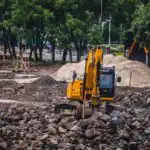
Excavation involves digging or removing earth to create trenches, foundations, or basements. While essential for construction, it presents various hazards, especially when dealing with challenging ground conditions. Understanding these problems is important for ensuring safety and structural stability.
Problems Associated with Excavation in Specific Ground Conditions
Different ground conditions pose unique challenges and risks during excavation:
- Wet Ground:
- Reduces soil stability, making it prone to collapse.
- Increases the weight of the soil, exerting more pressure on trench walls.
- Makes working conditions slippery and hazardous.
- Can lead to water accumulation in the trench, requiring dewatering.
- Loose Soil:
- Has poor cohesion and high void content, making it unstable.
- Prone to caving in, especially when disturbed by excavation.
- Requires extensive shoring and sloping to prevent collapse.
- Difficult to compact effectively after excavation.
- Waterlogged Areas:
- Ground is saturated with water, leading to very low bearing capacity.
- High risk of trench collapse due to hydrostatic pressure.
- Constant inflow of water into the excavation, requiring continuous pumping (dewatering).
- Increases the risk of equipment sinking and worker entrapment.
Safety Rules During Excavation
Adhering to strict safety rules is critical to prevent accidents, injuries, and fatalities during excavation work. Key safety practices include:
- Safe Digging Practices:
- Always identify and mark underground utilities (pipes, cables) before digging.
- Use appropriate excavation equipment for the soil type and depth.
- Ensure proper access and egress points are available in trenches deeper than 1.2m.
- Keep excavated soil (spoil piles) at least 0.6m away from the edge of the trench to prevent it from falling back in.
- Preventing Collapse:
- Sloping: Cut back the sides of the excavation at a safe angle to prevent soil from caving in. The angle depends on soil type.
- Shoring: Install supports (timber, steel, hydraulic) to prevent trench walls from collapsing. This includes sheeting, bracing, and walers.
- Benching: Excavate the sides in a series of horizontal steps or benches, creating a stepped slope.
- Inspect trenches daily and after rain or other events that could affect stability.
- Site Protection:
- Erect physical barriers or fences around the excavation area to prevent unauthorized access.
- Place warning signs (e.g., “Danger: Excavation,” “Keep Out”) prominently.
- Provide adequate lighting for excavations, especially during night work or in low-light conditions.
- Ensure a competent person is on site to oversee excavation work and identify hazards.
- Provide personal protective equipment (PPE) such as hard hats, safety boots, high-visibility vests for all workers.
Teaching Methods/Instructional Techniques
Discussion, Lecture, Demonstration, Question and Answer, Visual Aids
Instructional Procedures
Step 1: Introduction
Time: 5 minutes
Teaching Skill: Set Induction
Teacher’s Activity: The teacher reviews the previous lesson on site preparation and asks pupils to mention some activities done on a construction site before building commences. The teacher then introduces the topic “Excavation Problems.”
Pupils’ Activity: Pupils respond to the teacher’s questions and listen attentively to the new topic.
Learning Point: Pupils are reminded of previous knowledge and introduced to the new lesson.
Step 2: Explanation of Excavation Problems
Time: 10 minutes
Teaching Skill: Explanation/Illustration
Teacher’s Activity: The teacher explains the problems associated with excavation in wet ground, loose soil, and waterlogged areas, using pictures or diagrams to illustrate points.
Pupils’ Activity: Pupils listen, observe the pictures, and ask questions for clarification.
Learning Point: Pupils understand the challenges posed by different ground conditions during excavation.
Step 3: Discussion on Safety Rules
Time: 10 minutes
Teaching Skill: Discussion/Questioning
Teacher’s Activity: The teacher introduces and discusses various safety rules during excavation, focusing on safe digging practices, methods to prevent collapse (sloping, shoring, benching), and site protection.
Pupils’ Activity: Pupils participate in the discussion, contributing ideas and asking questions about safety measures.
Learning Point: Pupils learn essential safety protocols to prevent accidents during excavation.
Step 4: Practical Application/Site Discussion
Time: 10 minutes
Teaching Skill: Demonstration/Application
Teacher’s Activity: The teacher discusses how the safety rules apply to the specific problems identified in Step 2, possibly referencing a hypothetical construction site visit or by showing more detailed pictures of shoring systems.
Pupils’ Activity: Pupils relate the safety rules to practical scenarios and identify appropriate solutions for various excavation problems.
Learning Point: Pupils connect theoretical knowledge of safety rules to practical application on a construction site.
Step 5: Board Summary
Time: 5 minutes
Teaching Skill: Summarization/Writing
Teacher’s Activity: The teacher writes the key points of the lesson on the board, ensuring the content is clear and concise for pupils to copy into their notes.
Pupils’ Activity: Pupils copy the board summary into their notebooks.
Learning Point: Pupils consolidate their notes for future reference and revision.
Step 6: Class Activity
Time: 5 minutes
Teaching Skill: Group Work/Problem Solving
Teacher’s Activity: The teacher divides pupils into small groups and asks each group to identify one common excavation hazard and suggest a practical safety measure for it.
Pupils’ Activity: Pupils work in groups to discuss and provide solutions to the assigned hazards.
Learning Point: Pupils apply their understanding to solve practical problems and work collaboratively.
Step 7: Evaluation/Review
Time: 5 minutes
Teaching Skill: Questioning/Assessment
Teacher’s Activity: The teacher evaluates the learning by asking the following questions:
- Define excavation.
- Mention three problems associated with excavation in wet ground.
- List three safety rules for preventing trench collapse.
- Explain two ways to protect an excavation site.
Pupils’ Activity: Pupils answer orally and in writing.
Learning Point: Pupils demonstrate understanding of the lesson.
Step 8: Conclusion
Time: 1 minute
Teaching Skill: Recap
Teacher’s Activity: The teacher summarizes the main points of the lesson, emphasizing the importance of safety in excavation work.
Pupils’ Activity: Pupils listen and note the summary.
Learning Point: Pupils recall the key aspects of the lesson.
Lesson Keywords
- Excavation – The process of digging or removing earth.
- Shoring – A system used to support the sides of an excavation to prevent collapse.
- Sloping – Cutting back the sides of an excavation to a safe angle to prevent cave-ins.
- Benching – Creating a series of horizontal steps or benches along the sides of an excavation.
- Dewatering – The process of removing water from an excavation or construction site.
- Spoil pile – Excavated material temporarily stored near the edge of a trench or excavation.
- Competent person – An individual capable of identifying existing and predictable hazards in the surroundings or working conditions.
Differentiation
For pupils who grasp concepts quickly, the teacher can assign additional research on different types of shoring systems or case studies of excavation accidents. For pupils needing more support, the teacher will provide simplified diagrams and allow for peer-to-peer explanations and guided practice.
Note for teachers using this lesson plan
Teachers should ensure they have adequate visual aids, such as pictures or short video clips, to illustrate the various excavation problems and safety measures. If a site visit is not feasible, a virtual tour or detailed photographic presentation can be used effectively. Emphasize the real-world implications of unsafe practices.

Community Join the conversation Open discussion +