

Class: Junior Secondary School 1 (JSS1, JSS 1)
Term: 1st Term
Week: 7
Age: 12 years
Duration: 45 minutes
Subject: Pre-Vocational Studies
Curriculum Theme: Agricultural Science
Sub Theme: Concept And Medium Of Agricultural Production
Previous Lesson: Fishery and Heliculture as Forms of Agriculture
Topic: Crop Plant Forms
Subject Matter: The Different Parts of Plants, Diagram of a Plant, Functions of the Shoot, Leaves, Roots, Flowers.
Specific Objectives
By the end of the lesson, pupils should be able to:
- Cognitive Domain:
(a) Identify the different parts of a plant.
(b) State the functions of the shoot, leaves, roots, and flowers. - Affective Domain:
(a) Demonstrate interest in studying plants around them.
(b) Appreciate the importance of plants to human and animal life. - Psychomotor Domain:
(a) Draw and label a simple diagram of a plant showing its major parts.
(b) Handle real plant samples to identify different parts. - Social Domain:
(a) Work in groups to discuss plant parts and their functions.
(b) Share observations with peers during class activities.
Reference Materials
The following resources were used in planning this lesson:
- 9 Years Basic Education Curriculum
- Lagos State Unified Scheme of work for Junior Secondary Schools
- Online information from: Biology LibreTexts – Plant Form and Function
- Relevant Textbooks
Instructional Materials
The teacher will teach this lesson with the aid of:
- Real plant samples with roots, stems, leaves, and flowers
- Charts and posters of plant diagrams
- Marker and chalkboard
- Drawing materials (ruler, pencils, eraser)
- Flashcards with names of plant parts
Rationale for the Lesson
Understanding the parts of plants and their functions helps pupils appreciate how crops grow and supports further learning in agriculture and food production.
Prerequisite/Previous Knowledge
Pupils have seen different plants around their homes, farms, and school environment and can mention simple features such as leaves, stems, and flowers.
Lesson Content/Board Summary
Crop Plant Forms
Different Parts of a Plant
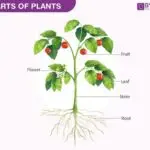
A plant is made up of different parts that work together to support its growth and survival. These parts can be seen above and below the soil.
The following are the main parts of a plant:
- Root
- Stem (shoot)
- Leaves
- Flowers
- Fruits and Seeds
Functions of the Shoot
The shoot includes the stem, branches, leaves, flowers, and fruits. It grows upward and supports the plant.
The following are the functions of the shoot:
- It supports leaves, flowers, and fruits.
- It transports water and nutrients from the roots to other parts of the plant.
- It transports manufactured food from leaves to other parts of the plant.
- It helps in reproduction through flowers and fruits.
Functions of the Leaves
Leaves are usually green and flat parts of the plant that grow on the stem or branches.
The following are the functions of the leaves:
- They manufacture food for the plant through photosynthesis.
- They allow exchange of gases (oxygen and carbon dioxide).
- They help to regulate water loss through transpiration.
Functions of the Roots
Roots grow downward into the soil and help to anchor the plant.
The following are the functions of the roots:
- They anchor the plant firmly in the soil.
- They absorb water and mineral salts from the soil.
- Some roots store food for the plant (e.g. carrot, cassava).
Functions of the Flowers
Flowers are the reproductive organs of the plant, usually colorful and attractive.
The following are the functions of the flowers:
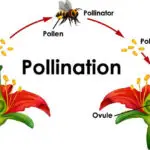
- They produce pollen and ovules for reproduction.
- They attract insects for pollination.
- They develop into fruits and seeds after fertilization.
Teaching Methods/Instructional Techniques:
Discussion, Lecture, Explanation, Storytelling, Group Work, Questioning, Use of Visual Aids
Instructional Procedures
To deliver this lesson, the teacher will adopt the following steps:
Step 1: Introduction
Time: 5 minutes
Teaching Skill: Set Induction
Teacher’s Activity: The teacher asks pupils to name plants they see at home or school and guides them to identify parts they can observe.
Pupils’ Activity: Pupils mention names of plants and identify parts like leaves and flowers.
Learning Point: Pupils become interested and connect prior knowledge to the lesson.
Step 2: Explanation of Plant Parts
Time: 8 minutes
Teaching Skill: Explanation
Teacher’s Activity: The teacher uses a real plant sample and chart to explain the different parts of a plant.
Pupils’ Activity: Pupils observe and point to the parts mentioned.
Learning Point: Pupils understand that a plant has roots, stem, leaves, and flowers.
Step 3: Functions of Plant Parts
Time: 12 minutes
Teaching Skill: Discussion
Teacher’s Activity: The teacher explains the functions of the shoot, leaves, roots, and flowers using examples.
Pupils’ Activity: Pupils listen, ask questions, and repeat the functions.
Learning Point: Pupils learn the importance of each plant part.
Step 4: Drawing of a Plant Diagram
Time: 10 minutes
Teaching Skill: Demonstration
Teacher’s Activity: The teacher draws and labels a diagram of a plant on the board.
Pupils’ Activity: Pupils draw and label the diagram in their notebooks.
Learning Point: Pupils acquire drawing and labeling skills in plant structure.
Step 5: Note-Taking
Time: 5 minutes
Teaching Skill: Explanation
Teacher’s Activity: The teacher dictates or writes key points of the board summary for pupils to copy.
Pupils’ Activity: Pupils copy the notes.
Learning Point: Pupils have a record of the lesson for revision.
Step 6: Evaluation/Review
Time: 5 minutes
Teaching Skill: Questioning
Teacher’s Activity: The teacher evaluates the learning by asking the following questions:
- Mention four main parts of a plant.
- State three functions of the shoot.
- What are two functions of the leaves?
- Explain one function of the roots.
- What is the main function of flowers?
Pupils’ Activity: Pupils answer the questions orally.
Learning Point: Pupils recall and apply knowledge of plant parts and functions.
Step 7: Conclusion
Time: 2 minutes
Teaching Skill: Reinforcement
Teacher’s Activity: The teacher summarizes the lesson and encourages pupils to observe plants around them.
Pupils’ Activity: Pupils listen attentively.
Learning Point: Pupils appreciate the importance of plant parts.
Home Task: List four lesson examples connected with Crop Plant Forms and add one correct use, step or safety rule.
Lesson Keywords
- Root – Part of the plant that grows in soil and absorbs water and nutrients.
- Stem – The shoot that supports the plant and transports substances.
- Leaf – The green part that makes food through photosynthesis.
- Flower – The reproductive organ of the plant.
- Photosynthesis – The process by which plants make food using sunlight.
Differentiation
The teacher will support slower learners with charts and real plant samples, while faster learners will be tasked with drawing and labeling additional details on plant parts.
Note for teachers using this lesson plan
Ensure real plant samples are used to make the lesson practical. Encourage group discussions to keep pupils engaged and allow them to relate the topic to their environment.

Community Join the conversation Open discussion +