

Class: Primary One
Term: Second Term
Subject: Pre-vocational Studies
Curriculum Theme: Agricultural Science
Previous Lesson:
Topic: Meaning of Plants
Content/Learning Area: Meaning and Types of Plants
Time Allocation: 40 minutes
performance Objectives
By the end of the lesson, pupils should be able to:
- Cognitive Domain:
1. Define plants.
2. List five types of plants.
- Affective Domain:
1. Appreciate the importance of plants in their surroundings.
- Psychomotor Domain:
1.Draw and label a simple diagram of a plant.
- Social Domain:
1. Collaborate in groups to discuss different types of plants.
Reference Materials
- 9 – Years Basic Education Curriculum
- Abuja Educational resource Center Scheme of Work
- NAPPS National Unified Scheme of Work
- Online Data from: The Spruce – Types of Plants
- Relevant Textbooks
Instructional Materials
To deliver this lesson, the teacher will employ the help of the following materials:
- Chart showing pictures of different types of plants.
- A real potted plant.
- Drawing tools (board, markers, and pencils).
- Flashcards with names of plants.
Rationale for the Lesson
Understanding plants is crucial for appreciating nature and the environment.This lesson lays the foundation for future learning in agriculture and environmental science.
Prerequisite/Previous Knowledge
Pupils have likely seen plants in their homes, school, or environment.
Lesson Content
Meaning of Plants
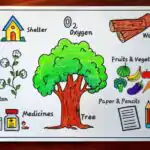
Plants are living organisms that typically grow in soil,water,or air,playing a vital role in our ecosystem. They provide us with essential resources and contribute to the beauty of our surroundings.Examples are: trees, flowers, and grasses.
Types of Plants
Plants come in various forms, each with unique characteristics and functions.
the following are examples:
- Trees – Tall plants with strong stems, like mango and orange trees.
- Shrubs – Medium-sized plants like hibiscus and rose.
- Flowers – Colorful plants like sunflower and marigold.
- Grasses – Short plants like lawn grass, guinea grass and elephant grass.
- Herbs – Small plants used in cooking or medicine, like mint and basil.
- Climbers – Plants that climb up walls or other plants, like bougainvillea and climbing roses.
- Aquatic Plants – plants that grow in water, like water lilies and lotus.
Teaching Methods
To deliver this lesson, the teacher will adopt the following methods: Set induction,Explanation,Discussion,Cooperative learning,Guided writing,Questioning.
Instructional Procedures
To deliver this lesson, the teacher will adopt the following steps:
Step 1: Introduction
Time: 5 mins
Teaching Skill: set Induction
Teacher’s activity: Shows a real plant and asks pupils what they know about plants.Pupils’ Activity: Respond to teacher’s questions.
Learning Point: Plants exist in the environment and are vital.
Step 2: Definition of Plants
Time: 10 mins
Teaching Skill: Explanation
Teacher’s Activity: Defines plants and explains their characteristics using examples.Pupils’ Activity: Listen, observe, and ask questions.
Learning Point: Plants are living things that grow and provide benefits.
Step 3: Types of Plants
Time: 10 mins
Teaching skill: Discussion
Teacher’s Activity: Lists five types of plants and explains each briefly using charts.
pupils’ Activity: Identify and discuss examples.
Learning Point: Plants can be trees, shrubs, flowers, grasses, or herbs.
Step 4: Group Activity
Time: 5 mins
Teaching Skill: Cooperative learning
Teacher’s Activity: Organizes pupils into groups to discuss and identify plants in their locality.
Pupils’ Activity: Discuss and share examples in groups.Learning Point: Collaboration helps pupils learn about local plants.
Step 5: Note Taking
Time: 5 mins
Teaching Skill: Guided writing
Teacher’s Activity: Guides pupils to copy the short note from the board.
Pupils’ Activity: Copy the note neatly.
Learning Point: Writing reinforces the definition and types of plants.
Step 6: Evaluation/Review
Time: 3 mins
Teaching Skill: Questioning
Teacher’s Activity: Asks pupils to answer questions about plants.
Pupils’ Activity: Answer questions orally.
Learning Point: Evaluation checks pupils’ understanding of the topic.
Objective-aligned checks:
- List five types of plants.
- Draw and label a simple diagram of a plant.
Step 7: Conclusion
Time: 2 mins
Teaching Skill: Recap
Teacher’s Activity: Summarizes the lesson and encourages pupils to observe plants around them.
Pupils’ Activity: Listen and reflect on the summary.
learning Point: Revisiting the topic ensures understanding.
Lesson Keywords
- Plants – Living things that grow in soil, water, or air.
- trees – Tall plants with strong stems.
- Shrubs – Medium-sized plants.
- Flowers – Colorful plants.
- Grasses – Short plants.
- herbs – Small plants used in cooking or medicine.
Lesson Evaluation
To evaluate the learning, the teacher asks pupils to:
- What is a plant?
- Name three types of plants.
- Draw a simple plant and label its parts.
- Why are plants significant?
Assignment/Homework
- List five plants you can find in your compound.
- Draw and label any plant you know.
Differentiation
- For slower learners: Provide one-on-one assistance and use simpler language.
- For advanced learners: Encourage them to research and present additional types of plants.
- for visual/auditory/kinesthetic learners: Use visual aids, verbal explanations, and hands-on activities.
Note for Teachers
Ensure to use real plants and visual aids to make the lesson more engaging and understandable for the pupils. Encourage active participation and group discussions to enhance learning.
Community Join the conversation Open discussion +