

Class: Primary 1
Term: 2nd Term
Subject: Agricultural science
Previous Lesson: Uses Of Plants
Topic: Meaning And Types Of Land
Content/Learning Area: Meaning And Types Of Land
Time Allocation: 40 minutes
Performance Objectives
By the end of the lesson, pupils should be able to:
- Cognitive Domain: Identify and define land.
- Affective Domain: Appreciate the different types of land and their uses.
- Psychomotor Domain: Point out examples of different types of land around their environment.
- Social Domain: Work together in pairs or groups to identify types of land.
Reference materials
The following resources were used in planning this lesson:
- 9 – Years Basic Education Curriculum
- Abuja Educational Resource Center Scheme of Work
- NAPPS National Unified Scheme of Work
- Online Data from: Wikipedia – Land
- Relevant Textbooks
Instructional Materials
To deliver this lesson, the teacher will employ the help of the following materials:
- Flashcards showing different types of land.
- A world map showing different land types.
- A whiteboard and markers.
- Samples of soil and stones from different lands.
Rationale for the Lesson
Understanding the meaning and types of land is critically important as it helps children recognize the different areas around them, whether for building, farming, or recreation.It also builds their awareness of the natural world and its uses.
Prerequisite/Previous Knowledge
Pupils already know that plants grow on land and they have some basic knowledge of the environment.
Lesson Content
Meaning And Types Of Land
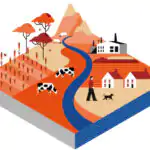
Land is the solid part of the earth where plants and animals live. It is also where people build houses, grow crops, and keep animals.
Types of Land:
Land can be categorized based on its characteristics and uses. These include:
- Farm Land: This is land used for growing crops like maize, rice, and vegetables. Examples include rice paddies in Benue State, maize farms in Kaduna, and vegetable gardens in Lagos.
- Forest Land: This land is covered with trees and bushes. It is where many animals live. Examples include the rainforests of Cross River state, the woodlands of Taraba, and the mangrove forests of the Niger Delta.
- Desert Land: A dry,sandy land where not many plants or animals can survive. Examples include parts of the Sahara Desert bordering northern Nigeria, and arid regions in Borno State.
- Grassland: A large area covered mostly by grass. Some animals like cows and goats live here. examples include the savannah regions of the Middle Belt, and grazing lands in Adamawa state.
- Mountain Land: High,rocky land with steep slopes. It’s hard to build on, but some animals live there.Examples include the hills of Jos Plateau, the mountains of Enugu, and the peaks of the Mandara mountains.
- Wet Land: Land areas that are saturated or flooded with water either permanently or seasonally.Examples include the Niger Delta, the coastal areas of Lagos, and the floodplains of the Benue River.
- Urban Land: Land developed for residential, commercial, and industrial purposes. Examples include the city centers of Lagos, Abuja, and Kano, with buildings, roads, and infrastructure.
Teaching Methods
To deliver this lesson, the teacher will adopt the following methods: Discussion, Clarification, Demonstration, Group Work, Questioning, Note-Taking.
Instructional Procedures
To deliver this lesson, the teacher will adopt the following steps:
Step 1: Introduction
Time: 5 mins
Teaching Skill: Set Induction
Teacher’s Activity: Ask pupils: “Where do plants grow?” Discuss with them about land.
Pupils’ Activity: Pupils respond and share their thoughts on land.
Step 2: Define Land
Time: 7 mins
Teaching Skill: Explanation
Teacher’s Activity: Define land: “Land is the solid part of the earth where plants and animals live.”
Pupils’ Activity: pupils listen and repeat after teacher.
Step 3: Types of Land
time: 8 mins
teaching Skill: Demonstration
Teacher’s Activity: Show pictures of different types of land (e.g.,farm,forest,desert,etc.).
pupils’ Activity: Pupils observe and name types of land shown.
Step 4: Discussion
Time: 7 mins
Teaching Skill: Group Work
Teacher’s Activity: ask pupils to work in pairs and discuss where different types of land are found.
Pupils’ Activity: Pupils discuss and share their answers with the class.
Step 5: Note-Taking
Time: 5 mins
Teaching Skill: Writing
Teacher’s Activity: Guide pupils as they write the definition and types of land in their books.
Pupils’ Activity: Pupils write down the information in their books.
Step 6: Evaluation/Review
Time: 5 mins
Teaching Skill: Questioning
Teacher’s Activity: Ask pupils, “What is land? Can you name some types of land?”
Pupils’ Activity: Pupils answer the questions orally.
Objective-aligned checks:
- Identify and define land.
- Work together in pairs or groups to identify types of land.
Step 7: Conclusion
Time: 3 mins
Teaching Skill: Summarizing
Teacher’s Activity: Summarize the lesson: “Land is where we live and grow plants, and it comes in different types.”
Pupils’ Activity: Pupils listen to the summary and nod in agreement.
Lesson Keywords
- Land – The solid part of the earth where plants and animals live.
- Farm Land – Land used for growing crops.
- Forest Land – Land covered with trees and bushes.
- Desert Land – Dry, sandy land with few plants or animals.
- Grassland – Land covered mostly by grass.
Lesson evaluation
To evaluate the learning, the teacher asks pupils to:
- Define what land is.
- Name at least two types of land.
- Identify the types of land they have seen in their surroundings.
- Describe where plants grow.
- Explain why forest land is important.
Assignment/homework
- Draw pictures of different types of land.
- Write a short paragraph about your favorite type of land and why you like it.
- List three things that people use land for.
Differentiation
- for slower learners: Provide simplified definitions and focus on identifying only the most common types of land (farm, forest, desert).
- For advanced learners: Encourage them to research and present on less common types of land (wetlands, mountains) and their specific uses.
- For visual/auditory/kinesthetic learners: use flashcards, videos, and a mini-walk around the school to observe different types of land.
Note for Teachers
Remember to actively involve the pupils by asking questions and showing examples of land types that they can relate to. You can even take them on a mini-walk around the school to spot different types of land if possible. Happy teaching!



Community Join the conversation Open discussion +