

Class: Primary Three
Term: First Term
Subject: Basic Science and Technology
Curriculum Theme: Physical & Health Education
Previous Lesson: Meaning, Types and Examples of Athletics
Topic: Sprints
Content/Learning Area: Defining sprint, Listing examples of short distance races, demonstrating a sprint on the field
Time Allocation: 40 minutes
Performance Objectives
By the end of the lesson, pupils should be able to:
- Cognitive Domain:
1.Define sprint.
2. List two examples of short distance races.
- affective Domain:
1. Show interest in participating in sprint activities.
- Psychomotor Domain:
1. Demonstrate a sprint on the field.
- social Domain:
1. Work cooperatively with peers during sprint activities.
Reference Materials
- 9 – Years Basic Education Curriculum
- Abuja Educational Resource Center scheme of Work
- NAPPS National Unified Scheme of work
- Relevant Textbooks
Instructional Materials
To deliver this lesson, the teacher will use the following materials:
- Whiteboard or chart
- Markers or chalk
- Open field space
Rationale for the Lesson
Understanding sprints introduces pupils to basic concepts in physical activity and sports. It promotes physical fitness and teamwork, skills applicable throughout life.
Prerequisite/Previous Knowledge
Pupils are familiar with running and races.
Lesson Content
Sprints
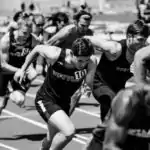
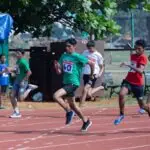
A sprint is a short and fast race where you run as fast as you can for a short distance. it requires speed, power, and endurance.
What is a Sprint?
A sprint is a short-distance race where the goal is to run as fast as possible. Common sprint distances are 100 meters, 200 meters, and 400 meters.
Short Distance Races
Short distance races are races that cover a relatively short distance at maximum speed. These include:
- 100m race: This is the shortest sprint race, often called the “dash.”
- 200m race: This is a longer sprint race requiring more endurance than the 100m race.
- 400m race: This is the longest sprint race,often called the “quarter mile.”
- 800m race: While longer than typical sprints,it still requires a high level of speed and endurance.
- Relay races (4x100m, 4x400m): team races where each member sprints a portion of the total distance.
Sprint Demonstration
Here are the steps in a sprint demonstration:
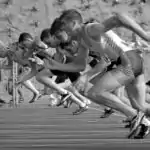
- Start: begin in a crouched position, feet shoulder-width apart, hands on the ground. push off when the starting signal is given.
- Running: Run with arms swinging and legs pumping quickly. Keep your head up and eyes focused on the finish line.
- Finishing: Cross the finish line with your chest.
- Maintaining Form: Keep your body aligned and avoid needless movements that can slow you down.
- breathing: Coordinate your breathing with your strides to maintain a steady rhythm and avoid getting out of breath.
Teaching Methods
To deliver this lesson, the teacher will adopt the following methods: discussion, Presentation, Practical Activity
Instructional Procedures
To deliver this lesson, the teacher will adopt the following steps:
Step 1: Introduction
Time: 5 minutes
Teaching Skill: Set Induction
Teacher’s Activity: Briefly review previous lesson and introduce the topic of sprints.
Pupils’ Activity: Participate in discussion and listen attentively.
step 2: Explanation of Key Concepts
Time: 10 minutes
Teaching Skill: Explanation, Definition
Teacher’s Activity: Define sprints and explain different sprint distances (100m, 200m, 400m).
Pupils’ Activity: Listen attentively and take notes.
Step 3: Demonstration/Guided Practice
Time: 15 minutes
Teaching Skill: Demonstration, Modeling
Teacher’s Activity: Demonstrate proper sprinting technique (start, running, finishing).
Pupils’ Activity: Observe the demonstration and practice sprinting with guidance.
Step 4: self-Reliant Practice
Time: 5 minutes
teaching Skill: Monitoring, Feedback
Teacher’s Activity: Supervise pupils as they practice sprinting independently.
Pupils’ Activity: Practice sprinting, focusing on technique.
Step 5: Note-Taking
Time: 2 minutes
Teaching Skill: Note-taking guidance
Teacher’s Activity: Guide pupils in summarizing key points.
Pupils’ Activity: Write down key points and definitions.
Step 6: Evaluation/Review
Time: 3 minutes
Teaching Skill: Questioning, Feedback
Teacher’s Activity: Ask review questions to assess understanding.
Pupils’ Activity: Answer review questions.
Objective-aligned checks:
- List two examples of short distance races.
- Show interest in participating in sprint activities.
- Demonstrate a sprint on the field.
Step 7: Conclusion
Time: 2 minutes
Teaching Skill: Summarizing
teacher’s Activity: Summarize the key concepts of sprints and encourage pupils to continue practicing their sprinting technique.
Pupils’ Activity: Listen to the summary and ask any remaining questions.
Lesson Keywords
- Sprint – A short-distance race run at maximum speed.
- Dash – A short,quick race,often referring to the 100m sprint.
- Technique – the specific way of performing a sprint, including start, running form, and finish.
- Endurance – The ability to sustain physical effort over a period.
- Speed – The rate at which someone or something moves or operates.
Lesson Evaluation
To evaluate the learning, the teacher asks pupils to:
- What is a sprint?
- Name two short-distance races.
- What are crucial things to remember when sprinting?
- Why is proper form critically important in sprinting?
- What are some benefits of sprinting?
Assignment/Homework
- Research and write a short paragraph about a famous Nigerian sprinter.
- Practice sprinting for 15 minutes each day for the next week, focusing on proper technique.
- Write down three benefits of regular sprinting exercise.
Differentiation
- For slower learners: Provide one-on-one guidance during practice.
- For advanced learners: Challenge them to focus on improving their speed and technique.
- For visual/auditory/kinesthetic learners: Use visual aids, verbal instructions, and hands-on practice to cater to different learning styles.
Note for Teachers
Ensure adequate space for sprinting activities and prioritize safety. Provide clear demonstrations and individual feedback to pupils. Encourage participation and teamwork.

Community Join the conversation Open discussion +