

Class: Primary 5
Term: 2nd Term
Subject: pre-Vocational studies
Curriculum Theme: Home Economics
Previous Lesson: Terms In Knitting And Crocheting
Topic: Simple Basic Stitches
Content/Learning Area: Temporary Stitches and Permanent Stitches
Time Allocation: 40 minutes
Performance Objectives
By the end of the lesson, pupils should be able to:
- Cognitive Domain: Define temporary stitches and permanent stitches.
- Affective Domain: Appreciate the importance of neat stitching in daily life.
- Psychomotor Domain: Demonstrate the basic techniques of making temporary and permanent stitches.
- Social Domain: Work collaboratively to identify examples of stitches in practical items.
Reference Materials
The following resources were used in planning this lesson:
- 9 – Years Basic Education Curriculum abuja.
- Educational resource Center Scheme of Work.
- NAPPS National Unified Scheme of Work.
- Online details from: The Inspired Sewist – 10 Basic Stitches You Should Know.
- Relevant Textbooks.
Instructional Materials
To deliver this lesson, the teacher will use the following materials:
- Needle and thread.
- Pieces of fabric.
- A sewing kit.
- Charts illustrating temporary and permanent stitches.
Rationale for the Lesson
Understanding the types of stitches helps pupils develop sewing skills, which are useful for repairing clothes, creating new designs, and building a foundation for entrepreneurship.
Prerequisite/Previous Knowledge
Pupils are familiar with basic terms in knitting and crocheting and can identify sewing tools.
Lesson Content
Simple Basic Stitches
Temporary Stitches
Temporary stitches are made to hold fabric pieces together temporarily and are usually removed after the final stitches are made.
Examples are:
- running stitch
- Basting stitch
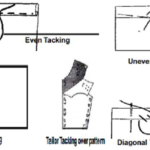
- Tailor’s tack
- Loop stitch
- Temporary hemming
- Gathering stitch
- Darning stitch
Permanent Stitches
Permanent stitches are made to join fabric pieces securely and remain in place permanently.
Examples are:
- Backstitch
- Overcast stitch
- Chain stitch
- Blanket stitch
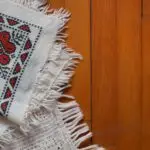
- Cross-stitch
- Slip stitch
- Satin stitch
Simple Basic Stitches
Running stitch passes the needle in and out at regular intervals. Tacking is a loose temporary stitch used to hold work before permanent sewing. Backstitch forms a stronger continuous line, while hemming stitch secures a folded edge.
Begin with a knot or approved fastening, keep stitch length even and avoid pulling the thread so tightly that the fabric gathers. Needles and pins must be stored immediately after use.
Teaching Methods
To deliver this lesson, the teacher will adopt the following methods: Questioning, Explanation, Demonstration, Guided practice, Collaborative learning, Direct teaching.
Instructional Procedures
To deliver this lesson, the teacher will adopt the following steps:
Step 1: Introduction
Time: 5 mins
Teaching Skill: Set Induction
Teacher’s Activity: Asks pupils to name tools used for sewing and their functions.
Pupils’ Activity: Respond and share their knowledge of sewing tools.
Step 2: Explanation of Stitches
Time: 10 mins
Teaching Skill: Explanation
Teacher’s activity: Explains the meaning of temporary and permanent stitches with examples.Pupils’ Activity: Listen attentively and ask questions.
Step 3: Demonstration of Stitches
Time: 10 mins
Teaching Skill: Demonstration
Teacher’s Activity: Demonstrates making a temporary and a permanent stitch.
pupils’ Activity: Observe and try to replicate the stitches.
Step 4: Practice Stitching
Time: 7 mins
teaching Skill: guided Practice
Teacher’s Activity: Guides pupils in stitching small fabric samples in groups.
pupils’ Activity: Work in groups to practice stitches.
Step 5: Note-Taking
Time: 5 mins
Teaching Skill: Note-writng
Teacher’s Activity: Dictates and writes concise notes on the board.
Pupils’ Activity: Copy the notes into their notebooks.
Step 6: Evaluation/Review
Time: 2 mins
Teaching Skill: Oral Questioning
Teacher’s Activity: Asks questions to assess understanding.
Pupils’ Activity: Answer the questions based on the lesson.
Objective-aligned checks:
- Define temporary stitches and permanent stitches.
- Demonstrate the basic techniques of making temporary and permanent stitches.
- Work collaboratively to identify examples of stitches in practical items.
Step 7: Conclusion
Time: 1 min
Teaching Skill: Summarization
Teacher’s Activity: Summarizes the key points and highlights practical use of stitches.
Pupils’ Activity: Listen to the summary.
Lesson Keywords
- Temporary Stitches – Stitches used to hold fabric temporarily.
- Permanent Stitches – Stitches used to join fabric permanently.
- Running Stitch – A simple, temporary stitch made by passing the needle in and out of the fabric.
- Backstitch – A strong, permanent stitch that resembles machine stitching.
- Overcast Stitch – A stitch used to prevent fabric edges from fraying.
Lesson Evaluation
To evaluate the learning, the teacher asks pupils to:
- Define temporary and permanent stitches.
- List five examples of temporary stitches.
- List five examples of permanent stitches.
- State one difference between temporary and permanent stitches.
- Demonstrate a simple running stitch on fabric.
Assignment/Homework
- Collect samples of fabric with different types of stitches.
- Practice making running stitches and backstitches at home.
- Write a short paragraph on why neat stitching is crucial.
Differentiation
- For slower learners: provide pre-threaded needles and larger fabric pieces for easier handling.
- For advanced learners: Encourage them to experiment with different types of stitches and create a small stitched design.
- For visual/auditory/kinesthetic learners: Use visual aids, verbal instructions, and hands-on activities to cater to different learning styles.
Note for Teachers
Ensure to prepare enough materials for hands-on activities so all pupils are actively involved. Allow pupils to showcase their stitched fabric samples to encourage participation. Reinforce the importance of neatness in stitching throughout the lesson.
Community Join the conversation Open discussion +