

Class: Junior Secondary School 1 (JSS 1 / JS1)
Term: 3rd Term
Week: 1
Age: 12 years
Duration: 45 minutes
Subject: National Values Education
Curriculum Theme: Security Education
Previous Lesson: Causes of Contemporary Social Problems, Poverty.
Topic: Security Agents
Subject Matter: Meaning and definition of security agents, roles of security agents, prevention and control of crime in the society
Specific Objectives
By the end of the lesson, pupils should be able to:
Cognitive Domain:
- Define what security agents are.
- Identify various security agencies in Nigeria.
- State the roles of security agents in society.
- Explain how security agents prevent and control crime.
Affective Domain:
- Appreciate the importance of security agents in maintaining peace and order.
- Show respect for security agents and their work.
- Demonstrate a sense of responsibility towards community safety.
Psychomotor Domain:
- Participate actively in discussions about security agents.
- Identify security agents in their local community when seen.
- List measures taken by security agents to ensure safety.
Social Domain:
- Cooperate with security agents to ensure a safe environment.
- Promote peace and order in their communities.
- Understand their role as citizens in supporting security efforts.
Reference Materials
The following resources were used in planning this lesson:
- 9 Years Basic Education Curriculum (JSS 1)
- State Unified Scheme of Work
- National Values Education for Junior Secondary Schools 1 by A.O. Alabi et al.
Instructional Materials
The teacher will teach this lesson with the aid of:
- Illustrative charts showing different security agents (e.g., Police, Army, Civil Defence).
- Pictures and posters depicting security agents performing their duties.
- Video clips (if available) showing security agents in action.
Rationale for the Lesson
This lesson helps pupils understand who security agents are and their important functions in society. It enables pupils to appreciate efforts made to maintain law and order, and encourages them to cooperate with these agents for their safety and the well-being of their community.
Prerequisite/Previous Knowledge
Pupils should have a basic understanding of rules and regulations in society and the concept of safety and protection.
Lesson Content/Board Summary
Security Agents
Meaning of Security Agents
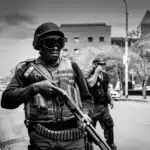
Security agents are individuals or organisations legally empowered and trained to protect lives and property, maintain law and order, and ensure peace and safety in society. They work to prevent crime and enforce laws.
Examples of security agencies in Nigeria include:
- Nigeria Police Force (NPF)
- Nigerian Army
- Nigerian Navy
- Nigerian Air Force
- Nigeria Security and Civil Defence Corps (NSCDC)
- Department of State Services (DSS)
- Federal Road Safety Corps (FRSC)
- National Drug Law Enforcement Agency (NDLEA)
Roles of Security Agents
Security agents perform several important roles in society. These include:
- Maintaining law and order.
- Protecting lives and property of citizens.
- Investigating crimes and gathering evidence.
- Arresting and prosecuting criminals.
- Enforcing laws and regulations.
- Providing emergency response during crises or disasters.
- Gathering intelligence to prevent criminal activities.
- Controlling traffic and ensuring road safety (e.g., FRSC).
- Protecting national borders and territorial integrity.
Prevention and Control of Crime in the Society
Security agents prevent and control crime through various methods. These methods help to reduce criminal activities and ensure that offenders are brought to justice:
- Regular Patrols: They conduct regular patrols in communities, on roads, and in public places to deter criminals and respond quickly to incidents.
- Intelligence Gathering: They collect information about potential threats and criminal plans to prevent them before they occur.
- Public Awareness Campaigns: They educate the public on safety tips and how to report suspicious activities.
- Rapid Response: They respond quickly to distress calls and reports of crime to apprehend criminals and assist victims.
- Investigation and Prosecution: They investigate crimes thoroughly to identify culprits and ensure they face legal consequences, which serves as a deterrent to others.
- Border Security: They monitor and control entry points to prevent illegal activities and the entry of criminals.
Teaching Methods/Instructional Techniques
Discussion, Lecture, Demonstration, Question and Answer, Visual Aids
Instructional Procedures
Security Agents
Step 1: Introduction
Time: 5 minutes
Teaching Skill: Set Induction
Teacher’s Activity: The teacher greets the pupils and reviews the previous lesson by asking a few questions related to safety in the community. The teacher then introduces the new topic, “Security Agents,” by asking pupils who they think keeps law and order in their communities.
Pupils’ Activity: Pupils respond to the teacher’s questions and listen attentively to the introduction of the new topic.
Learning Point: Pupils recall previous knowledge and are prepared for the new lesson.
Step 2: Meaning of Security Agents
Time: 7 minutes
Teaching Skill: Explanation/Definition
Teacher’s Activity: The teacher explains the meaning of security agents, defining them as individuals or organisations responsible for maintaining law and order, and protecting lives and property. The teacher uses charts and pictures to show examples of various security agencies in Nigeria.
Pupils’ Activity: Pupils listen, observe the charts and pictures, and contribute by naming security agents they know.
Learning Point: Pupils understand the definition of security agents and can identify different agencies.
Step 3: Roles of Security Agents
Time: 10 minutes
Teaching Skill: Elucidation/Discussion
Teacher’s Activity: The teacher leads a discussion on the various roles of security agents in society, such as maintaining law and order, protecting lives and property, investigating crimes, and arresting criminals. The teacher encourages pupils to share their experiences or observations.
Pupils’ Activity: Pupils participate in the discussion, ask questions, and list the roles of security agents as discussed.
Learning Point: Pupils learn about the diverse responsibilities and functions of security agents.
Step 4: Prevention and Control of Crime
Time: 10 minutes
Teaching Skill: Explanation/Illustration
Teacher’s Activity: The teacher explains how security agents prevent and control crime in society, detailing methods like regular patrols, intelligence gathering, public awareness campaigns, and rapid response. The teacher uses simple examples to illustrate each point.
Pupils’ Activity: Pupils listen carefully, take notes, and ask clarifying questions about the methods of crime prevention and control.
Learning Point: Pupils understand the practical ways security agents ensure community safety.
Step 5: Teacher summarises and clarifies
Time: 6 minutes
Teaching Skill: Summarisation/Clarification
Teacher’s Activity: The teacher summarises the key points of the lesson, reinforcing the meaning, roles, and crime prevention strategies of security agents. The teacher addresses any lingering questions or misconceptions from the pupils.
Pupils’ Activity: Pupils listen to the summary, ask final questions, and prepare for evaluation.
Learning Point: Pupils consolidate their understanding of the lesson content.
Step 6: Evaluation/Review
Time: 5 minutes
Teaching Skill: Questioning/Assessment
Teacher’s Activity: The teacher evaluates the learning by asking the following questions:
- Who are security agents?
- Mention two security agencies in Nigeria.
- State three roles of security agents.
- How do security agents prevent crime in the society?
Pupils’ Activity: Pupils answer orally and in writing.
Learning Point: Pupils demonstrate understanding of the lesson.
Step 7: Conclusion
Time: 2 minutes
Teaching Skill: Closure
Teacher’s Activity: The teacher commends the pupils for their participation and reminds them of the importance of cooperating with security agents for their safety and the peace of the community. The teacher gives an assignment: “List five ways you can cooperate with security agents in your area.”
Pupils’ Activity: Pupils write down the assignment and prepare for the next subject.
Learning Point: Pupils understand the practical application of the lesson and are given a task to reinforce learning.
Home Task: Give three correct examples of Security Agents and explain what each example shows.
Lesson Keywords
- Security – The state of being free from danger or threat.
- Agent – A person who acts on behalf of another person or group.
- Crime – An action or omission that constitutes an offense that may be prosecuted by the state and is punishable by law.
- Law – The system of rules that a particular country or community recognizes as regulating the actions of its members and may enforce by the imposition of penalties.
- Order – The state of things being arranged in a particular way or sequence.
- Police – The civil force of a state, responsible for the prevention and detection of crime and the maintenance of public order.
- Army – An organised military force equipped for fighting on land.
- Civil Defence – An organisation of civilians trained to act in an emergency or disaster.
Differentiation
For visual learners, the teacher will use charts, pictures, and video clips extensively. Auditory learners will benefit from discussions and verbal explanations. Kinesthetic learners can be encouraged to participate in identifying security agents in their environment or in simple role-playing scenarios.
Note for teachers using this lesson plan
Teachers should use local examples of security agents and their activities to make the lesson more relatable to pupils. Emphasize the importance of respecting and cooperating with security agents. Encourage pupils to ask questions and share their observations about security in their communities.



Community Join the conversation Open discussion +