

Class: Primary 3
Term: 1st Term
Week: 6
Age: 8 years
Duration: 40 minutes
Subject: Pre Vocational Studies
Curriculum Theme: Agricultural Science
Previous Lesson: Distribution Of Animals, Forest Animals
Topic: Meaning And Types Of Savannah Animals
Content/Learning Area: Savannah animals e.g. Cattle, goats, sheep, camels, horses, donkeys, poultry, etc..
Performance Objectives
By the end of the lesson, pupils should be able to:
- Cognitive Domain: Explain the meaning of savannah animals.
- Affective Domain: Show interest in learning about animals that live in the savannah.
- Psychomotor Domain: List and write down examples of savannah animals.
- Social Domain: Work together in groups to identify and discuss savannah animals.
Reference Materials
The following resources were used in planning this lesson:
- 9 Years Basic Education Curriculum
- Abuja Educational Resource Centre Scheme of work
- NAPPS National Unified Scheme of Work
- Online information from: Wikipedia – Savanna
- Relevant Textbooks
Instructional Materials
The teacher will teach this lesson with the aid of:
- Flashcards and charts showing pictures of savannah animals
- Real objects such as feathers, cow horn, or goat skin
- Videos or slides of animals in the savannah
- Drawing of a savannah grassland on the board
- Textbooks and story illustrations
Rationale for the Lesson
To help pupils understand the animals that live in the savannah and their importance to people and the environment.
Prerequisite/Previous Knowledge
Pupils have seen common domestic animals like goats, cows, and chickens in their environment and can describe them.
Lesson Content
Meaning and Types of Savannah Animals
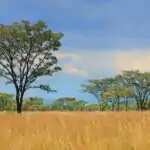
Savannah animals are animals that live in the wide grassland called the savannah. They survive well in the hot sun and open land. They can be small or big and are very useful to humans.
Types of Savannah Animals
The following are examples of savannah animals:
- Cattle
- Goats
- Sheep
- Camels
- Horses
- Donkeys
- Poultry
Savannah Habitat and Animal Adaptations
The savannah is mainly grassland with scattered trees and distinct wet and dry seasons. Animals commonly associated with savannah environments include antelopes, giraffes, elephants, lions, zebras and some grazing cattle. The exact animals found in an area depend on climate, vegetation and human activity.
Grazing animals use grasses as food, while predators feed on other animals. Features such as strong legs, protective colour, herd behaviour and the ability to travel in search of water help different animals survive. Pupils should distinguish wild animals from domesticated animals kept by people.
Teaching Methods
Discussion, Lecture, Storytelling, Explanation, Visual Aids, Group Work
Instructional Procedures
To deliver this lesson, the teacher will adopt the following steps:
Step 1: Introduction
Time: 5 mins
Teaching Skill: Set Induction
Teacher’s Activity: Teacher shows pictures of goats, cows, and chickens, then asks pupils where they think these animals live.
Pupils’ Activity: Pupils observe and respond by naming the animals and places they have seen them.
Learning Point: Pupils are prepared and motivated for the lesson.
Step 2: Meaning of Savannah Animals
Time: 7 mins
Teaching Skill: Explanation
Teacher’s Activity: Teacher explains that savannah animals are animals that live in the wide grassland called the savannah.
Pupils’ Activity: Pupils listen and repeat after the teacher.
Learning Point: Pupils understand the meaning of savannah animals.
Step 3: Examples of Savannah Animals
Time: 10 mins
Teaching Skill: Demonstration and Explanation
Teacher’s Activity: Teacher shows charts and names examples of savannah animals like cattle, goats, sheep, camels, horses, donkeys, and poultry.
Pupils’ Activity: Pupils mention, write, and repeat the examples after the teacher.
Learning Point: Pupils know examples of savannah animals.
Step 4: Group Activity
Time: 8 mins
Teaching Skill: Group Work
Teacher’s Activity: Teacher divides pupils into groups to list savannah animals they know and share with the class.
Pupils’ Activity: Pupils work in groups and present their lists.
Learning Point: Pupils develop teamwork and recall examples of savannah animals.
Step 5: Note Taking
Time: 3 mins
Teaching Skill: Writing
Teacher’s Activity: Teacher dictates short notes on meaning and examples of savannah animals.
Pupils’ Activity: Pupils copy the notes into their books.
Learning Point: Pupils record lesson notes for reference.
Step 6: Evaluation
Time: 5 mins
Teaching Skill: Questioning
Teacher’s Activity: Teacher asks pupils questions on meaning and types of savannah animals.
Pupils’ Activity: Pupils respond to questions individually and in groups.
Learning Point: Teacher checks pupils’ understanding.
Objective-aligned checks:
- Explain the meaning of savannah animals.
- List and write down examples of savannah animals.
- Work together in groups to identify and discuss savannah animals.
Step 7: Conclusion
Time: 2 mins
Teaching Skill: Instructional and Cognitive Closure
Teacher’s Activity: Teacher summarizes the lesson and praises pupils for their participation.
Pupils’ Activity: Pupils clap and repeat key points of the lesson.
Learning Point: Pupils consolidate learning and end the class positively.
Home Task: List four lesson examples connected with Meaning And Types Of Savannah Animals and add one correct use, step or safety rule.
Lesson Keywords
- Savannah: A large open grassland with few trees.
- Animals: Living things that can move, eat, and grow.
- Cattle: Large animals like cows that give milk and meat.
- Poultry: Birds kept for meat and eggs such as chickens.
- Camel: An animal that can live in hot, dry places and carry loads.
Lesson Evaluation
To evaluate the learning, the teacher asks pupils to:
- Explain what savannah animals are.
- Mention two examples of savannah animals.
- Write four types of savannah animals.
- Identify one animal in the savannah that gives us milk.
- Work in pairs to draw one savannah animal.
Differentiation
The teacher will support slower learners with pictures and repetition, while advanced learners can explain the uses of savannah animals.
Note for teachers using this lesson plan
Use real-life examples pupils can relate to, such as animals they see in their villages or towns. Make lessons interactive by asking questions and encouraging group participation.
Community Join the conversation Open discussion +