

Class: Junior Secondary School 1 (JSS 1 / JS1)
Term: Third Term
Week: 1
Age: 12 years
Duration: 45 minutes
Subject: Mathematics
Curriculum Theme: Measurement and Geometry
Previous Lesson: .
Topic: PERIMETER OF IRREGULAR AND REGULAR SHAPES
Subject Matter: Definition of perimeter: How to determine the perimeter of a given plane figures by measuring or calculating
Specific Objectives
By the end of the lesson, pupils should be able to:
Cognitive Domain:
- Define perimeter correctly.
- Identify regular and irregular plane shapes.
- State the formulas for calculating the perimeter of squares, rectangles, and triangles.
- Calculate the perimeter of given regular and irregular shapes.
Affective Domain:
- Appreciate the importance of perimeter in real-life situations.
- Participate actively in classroom discussions and activities.
- Develop an interest in solving problems involving perimeter.
Psychomotor Domain:
- Measure the sides of various plane figures using a ruler or tape measure.
- Draw regular and irregular shapes and label their sides.
- Accurately apply perimeter formulas to solve problems.
Social Domain:
- Collaborate with peers to solve perimeter problems.
- Communicate their understanding of perimeter clearly.
Reference Materials
The following resources were used in planning this lesson:
- 9 Years Basic Education Curriculum
- State Unified Scheme of Work
- New General Mathematics for Junior Secondary Schools 1
Instructional Materials
The teacher will teach this lesson with the aid of:
- Ruler
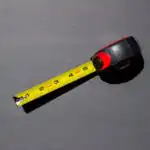
- Measuring tape
- Cut-out shapes (square, rectangle, triangle, and an irregular polygon)
- Whiteboard/Chalkboard
Rationale for the Lesson
This lesson helps pupils understand how to measure the boundary of different shapes. Knowledge of perimeter is important for practical tasks like fencing a compound, framing a picture, or measuring the length of a cloth needed to trim an object.
Prerequisite/Previous Knowledge
Pupils have a basic understanding of plane shapes such as squares, rectangles, and triangles, and can perform simple addition and measurement.
Lesson Content/Board Summary
PERIMETER OF IRREGULAR AND REGULAR SHAPES
Definition of Perimeter
The perimeter of a plane shape is the total distance around its boundary or outer edge. It is found by adding the lengths of all its sides.
Perimeter of Regular Shapes
Regular shapes have all sides equal in length and all angles equal in measure.
1. Perimeter of a Square
A square has four equal sides. If ‘l’ represents the length of one side:
Formula: Perimeter (P) = l + l + l + l = 4l
Example 1: Find the perimeter of a square with a side length of 7 cm.
Step 1: Identify the given side length.
l = 7 cm
Step 2: Apply the formula for the perimeter of a square.
P = 4l
P = 4 × 7 cm
P = 28 cm
Example 2: A square garden has sides of 12 meters. What is its perimeter?
Step 1: Identify the given side length.
l = 12 m
Step 2: Apply the formula.
P = 4l
P = 4 × 12 m
P = 48 m
2. Perimeter of a Rectangle
A rectangle has two pairs of equal sides (length and width). If ‘l’ represents the length and ‘w’ represents the width:
Formula: Perimeter (P) = l + w + l + w = 2l + 2w = 2(l + w)
Example 1: Calculate the perimeter of a rectangle with a length of 10 cm and a width of 5 cm.
Step 1: Identify the given length and width.
l = 10 cm
w = 5 cm
Step 2: Apply the formula for the perimeter of a rectangle.
P = 2(l + w)
P = 2(10 cm + 5 cm)
P = 2(15 cm)
P = 30 cm
Example 2: A rectangular field is 25 meters long and 15 meters wide. Find its perimeter.
Step 1: Identify the given length and width.
l = 25 m
w = 15 m
Step 2: Apply the formula.
P = 2(l + w)
P = 2(25 m + 15 m)
P = 2(40 m)
P = 80 m
3. Perimeter of a Triangle
A triangle has three sides. If ‘a’, ‘b’, and ‘c’ represent the lengths of its three sides:
Formula: Perimeter (P) = a + b + c
Example 1: Find the perimeter of a triangle with sides measuring 6 cm, 8 cm, and 10 cm.
Step 1: Identify the lengths of the sides.
a = 6 cm, b = 8 cm, c = 10 cm
Step 2: Apply the formula.
P = a + b + c
P = 6 cm + 8 cm + 10 cm
P = 24 cm
Perimeter of Irregular Shapes
Irregular shapes do not have all sides equal in length or all angles equal in measure. To find the perimeter of an irregular shape, you must add the lengths of all its individual sides.
Formula: Perimeter (P) = Sum of all side lengths
Example 1: A polygon has sides measuring 4 m, 3 m, 6 m, 2 m, and 5 m. Find its perimeter.
Step 1: Identify all side lengths.
Sides = 4 m, 3 m, 6 m, 2 m, 5 m
Step 2: Add all the side lengths.
P = 4 m + 3 m + 6 m + 2 m + 5 m
P = 20 m
Example 2: An irregular shape has sides of 5 cm, 7 cm, 3 cm, 4 cm, and 6 cm. Calculate its perimeter.
Step 1: Identify all side lengths.
Sides = 5 cm, 7 cm, 3 cm, 4 cm, 6 cm
Step 2: Add all the side lengths.
P = 5 cm + 7 cm + 3 cm + 4 cm + 6 cm
P = 25 cm
NOTE: Ensure all measurements are in the same unit before calculating the perimeter. If units are different, convert them to a common unit first.
Teaching Methods/Instructional Techniques
Discussion, Lecture, Demonstration, Question and Answer, Visual Aids
Instructional Procedures
Step 1: Introduction
Time: 5 minutes
Teaching Skill: Set Induction
Teacher’s Activity: The teacher greets the pupils and asks them to name some plane shapes they know, like square, rectangle, and triangle. The teacher also asks what they think “perimeter” means.
Pupils’ Activity: Pupils respond by naming shapes and offering their ideas about perimeter.
Learning Point: Pupils recall prior knowledge of shapes and are introduced to the concept of perimeter.
Step 2: Definition of Perimeter
Time: 5 minutes
Teaching Skill: Explanation
Teacher’s Activity: The teacher defines perimeter as the total distance around a shape’s boundary, writing the definition on the board.
Pupils’ Activity: Pupils listen attentively and copy the definition into their notebooks.
Learning Point: Pupils understand the fundamental definition of perimeter.
Step 3: Perimeter of Regular Shapes (Square and Rectangle)
Time: 10 minutes
Teaching Skill: Demonstration/Explanation
Teacher’s Activity: The teacher uses cut-out shapes of a square and a rectangle, measures their sides, and demonstrates how to calculate their perimeters using the formulas. The teacher works through the examples from the board summary.
Pupils’ Activity: Pupils observe the demonstration, ask questions, and copy the formulas and examples.
Learning Point: Pupils learn how to calculate the perimeter of squares and rectangles using formulas.
Step 4: Perimeter of a Triangle
Time: 5 minutes
Teaching Skill: Explanation
Teacher’s Activity: The teacher explains how to find the perimeter of a triangle by adding the lengths of its three sides, using a cut-out triangle and working through an example.
Pupils’ Activity: Pupils pay attention and copy the formula and example for a triangle.
Learning Point: Pupils learn to calculate the perimeter of a triangle.
Step 5: Perimeter of Irregular Shapes
Time: 10 minutes
Teaching Skill: Demonstration/Problem-solving
Teacher’s Activity: The teacher uses an irregular cut-out shape, measures its sides, and demonstrates how to find its perimeter by adding all the side lengths. The teacher works through the examples from the board summary.
Pupils’ Activity: Pupils observe the method and copy the examples.
Learning Point: Pupils learn how to determine the perimeter of irregular shapes.
Step 6: Class Activity/Practice
Time: 5 minutes
Teaching Skill: Practice/Supervision
Teacher’s Activity: The teacher gives pupils a few simple problems to solve in their exercise books, involving finding the perimeter of different shapes.
Pupils’ Activity: Pupils solve the given problems individually or in pairs.
Learning Point: Pupils apply their understanding to solve problems.
Step 7: Evaluation/Review
Time: 5 minutes
Teaching Skill: Questioning/Assessment
Teacher’s Activity: The teacher evaluates the learning by asking the following questions:
- What is perimeter?
- State the formula for the perimeter of a square.
- A rectangular table is 120 cm long and 80 cm wide. Find its perimeter.
- How do you find the perimeter of an irregular shape?
Pupils’ Activity: Pupils answer orally and in writing.
Learning Point: Pupils demonstrate understanding of the lesson.
Step 8: Conclusion
Time: 2 minutes
Teaching Skill: Summarization
Teacher’s Activity: The teacher summarizes the key points of the lesson, emphasizing that perimeter is the distance around a shape and how to calculate it for various shapes. The teacher assigns homework.
Pupils’ Activity: Pupils listen to the summary and note down the homework.
Learning Point: Pupils consolidate their learning and prepare for further practice.
Home Task: Solve three new exercises on PERIMETER OF IRREGULAR AND REGULAR SHAPES. Show each step and check each answer.
Lesson Keywords
- Perimeter – The distance around the outside of a shape.
- Regular shapes – Shapes with all sides and angles equal (e.g., square).
- Irregular shapes – Shapes with sides and angles of different measures.
- Square – A four-sided regular shape.
- Rectangle – A four-sided shape with opposite sides equal and all angles 90 degrees.
- Triangle – A three-sided polygon.
Differentiation
For pupils who grasp the concept quickly, the teacher can provide more complex shapes or problems involving mixed units. For those who need more support, the teacher will provide simpler shapes with whole numbers and offer one-on-one guidance during practice sessions.
Note for teachers using this lesson plan
Ensure that pupils understand the difference between regular and irregular shapes before proceeding to their perimeter calculations. Encourage pupils to use appropriate units in their answers. Practical examples using classroom objects can enhance understanding.
Community Join the conversation Open discussion +