

Class: Senior Secondary School 1 (SS1, SS 1, SSS1, SSS 1)
Term: 3rd Term
Week: 5
Age: 15 years
Duration: 45 minutes
Subject: Clothing and Textiles
Curriculum Theme: Clothing and Textiles
Previous Lesson: Basic Stitches: Temporary, Permanent and Decorative Stitches.
Topic: GARMENT MAKING PROCESSES
Subject Matter: Seams including open plain, French, run and fell; Edge finishing including hemming and lace attachment; Practical seam and finish samples.
Specific Objectives
By the end of the lesson, pupils should be able to:
Cognitive Domain:
- Define garment making processes.
- Identify different types of seams such as open plain, French, and run and fell.
- Explain various edge finishing techniques including hemming and lace attachment.
Affective Domain:
- Appreciate the importance of neat and durable garment finishes.
- Show patience and precision when constructing seams and finishes.
Psychomotor Domain:
- Construct samples of open plain, French, and run and fell seams.
- Apply hemming and attach lace as edge finishes on fabric samples.
Social Domain:
- Collaborate effectively with peers during practical activities.
Reference Materials
The following resources were used in planning this lesson:
- 9 Years Basic Education Curriculum for Senior Secondary Schools.
- State Unified Scheme of Work for Clothing and Textiles.
- Obe, F. (2018). Clothing and Textile for Senior Secondary Schools. Ibadan: University Press PLC.
- https://www.textilelearner.com/2020/03/garment-seams-types-classification.html
- https://www.sewingandcrafting.com/sewing-techniques/edge-finishes/
Instructional Materials
The teacher will teach this lesson with the aid of:
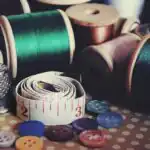
- Fabric pieces (calico, cotton)
- Sewing threads
- Hand sewing needles
- Thimble
- Scissors
- Measuring tape
- Tailor’s chalk
- Pins
- Samples of garments with different seams and finishes
Rationale for the Lesson
This lesson helps pupils understand the essential steps involved in making garments and how to achieve a professional finish. Knowing different seams and edge finishes enables pupils to create durable and attractive clothing items, which is useful for personal use or future entrepreneurial ventures.
Prerequisite/Previous Knowledge
Pupils have basic knowledge of sewing tools and equipment, and they can perform simple hand stitches.
Lesson Content/Board Summary
GARMENT MAKING PROCESSES
Definition of Garment Making Processes
Garment making processes refer to the sequence of steps and techniques involved in converting fabric into a finished clothing item. These processes include cutting, seaming, and finishing the edges of the fabric.
Types of Seams
A seam is a line of stitching that joins two or more pieces of fabric together. Different seams are used for various purposes depending on the garment design, fabric type, and desired strength or finish.
The following are common types of seams:
- Open Plain Seam: This is a basic seam where two fabric pieces are joined with a single row of stitches. The raw edges are then finished separately (e.g., by overcasting or zigzag stitching) and pressed open. It is suitable for most fabrics and allows for flat pressing.
- French Seam: This is a neat, durable seam that encloses raw edges, making it ideal for sheer fabrics or garments where a neat finish is required on both sides. It involves two rows of stitching.
- Run and Fell Seam: Also known as a lapped seam, this is a strong and flat seam where one raw edge is turned under and stitched flat onto the fabric. It is commonly used for sportswear, workwear, and children’s clothing, providing strength and preventing fraying.
Edge Finishing Techniques
Edge finishing techniques are methods used to prevent fabric edges from fraying, provide strength, and improve the appearance of a garment.
The following are common edge finishing techniques:
- Hemming: This is the process of folding and stitching the raw edge of a fabric to the inside of a garment. Hems provide a neat and durable finish to garment edges such as sleeves, trousers, and skirts.
- Lace Attachment: This involves sewing lace trims onto the raw edges of a garment for decorative purposes and to provide a finished edge. Lace can be attached with a straight stitch, zigzag stitch, or by hand.
Teaching Methods/Instructional Techniques
Discussion, Lecture, Demonstration, Question and Answer, Visual Aids
Instructional Procedures
Step 1: Introduction
Time: 5 minutes
Teaching Skill: Set Induction
Teacher’s Activity: The teacher greets the pupils and asks them to mention different parts of a finished garment. The teacher then relates their answers to the processes involved in joining fabrics.
Pupils’ Activity: Pupils respond by mentioning parts like sleeves, collars, and hems. They listen attentively.
Learning Point: Pupils are introduced to the concept of garment construction and the importance of joining fabric pieces.
Step 2: Explanation of Garment Making Processes and Seams
Time: 10 minutes
Teaching Skill: Explanation/Demonstration
Teacher’s Activity: The teacher defines garment making processes and explains what a seam is. The teacher then introduces and demonstrates how to make an open plain seam, a French seam, and a run and fell seam using fabric samples.
Pupils’ Activity: Pupils listen, observe the demonstration, and ask questions for clarification.
Learning Point: Pupils understand the definition of garment making processes and can identify and observe the construction of different types of seams.
Step 3: Practical Activity – Seams
Time: 10 minutes
Teaching Skill: Practical Application/Supervision
Teacher’s Activity: The teacher distributes fabric pieces, needles, and thread to pupils. The teacher guides pupils to practice making the open plain, French, and run and fell seams on their fabric samples, providing individual assistance as needed.
Pupils’ Activity: Pupils actively engage in making samples of the different seams under the teacher’s supervision.
Learning Point: Pupils develop practical skills in constructing various types of seams.
Step 4: Explanation of Edge Finishing Techniques
Time: 5 minutes
Teaching Skill: Explanation/Demonstration
Teacher’s Activity: The teacher explains the purpose of edge finishing techniques. The teacher then demonstrates how to perform hemming (e.g., slip hemming, machine hemming) and how to attach lace to a fabric edge.
Pupils’ Activity: Pupils observe the demonstrations carefully and take notes.
Learning Point: Pupils understand the importance of edge finishing and observe the techniques for hemming and lace attachment.
Step 5: Practical Activity – Edge Finishing
Time: 10 minutes
Teaching Skill: Practical Application/Supervision
Teacher’s Activity: The teacher provides additional fabric pieces and lace. The teacher guides pupils to practice hemming and attaching lace to their fabric samples, ensuring correct technique.
Pupils’ Activity: Pupils practice hemming and attaching lace, seeking help when necessary.
Learning Point: Pupils gain practical experience in applying edge finishing techniques.
Step 6: Evaluation/Review
Time: 5 minutes
Teaching Skill: Questioning/Assessment
Teacher’s Activity: The teacher evaluates the learning by asking the following questions:
- Define garment making processes.
- List three types of seams discussed in the lesson.
- Describe how a French seam is constructed.
- Mention two common edge finishing techniques.
Pupils’ Activity: Pupils answer orally and in writing.
Learning Point: Pupils demonstrate understanding of the lesson.
Step 7: Conclusion
Time: 5 minutes
Teaching Skill: Summarization
Teacher’s Activity: The teacher summarizes the key points of the lesson, emphasizing the importance of neat and strong seams and finishes for garment durability and appearance. The teacher also assigns homework.
Pupils’ Activity: Pupils listen to the summary and copy the homework assignment.
Learning Point: Pupils consolidate their understanding of garment making processes, seams, and edge finishes.
Lesson Keywords
- Seam – A line of stitching that joins two or more pieces of fabric.
- Hemming – The process of folding and stitching the raw edge of a fabric to the inside of a garment.
- French seam – A neat, durable seam that encloses raw edges.
- Run and fell seam – A strong, flat seam where one raw edge is turned under and stitched flat.
- Open plain seam – A basic seam where fabric pieces are joined and edges are finished separately and pressed open.
- Edge finishing – Techniques used to prevent fabric edges from fraying and to improve garment appearance.
- Lace attachment – Sewing lace trims onto fabric edges for decoration and finish.
Differentiation
For pupils who grasp concepts quickly, they will be encouraged to experiment with different widths for seams or try more complex lace attachment patterns. For those who need more support, the teacher will provide one-on-one guidance during practical sessions and simplified visual aids. Peer-to-peer learning will also be encouraged, allowing stronger pupils to assist their classmates.
Note for teachers using this lesson plan
Ensure all necessary materials are prepared before the lesson begins to maximize practical time. Emphasize safety precautions when using needles and scissors. Encourage pupils to aim for neatness and precision in their practical work. Visual examples of well-made and poorly-made seams and finishes can be very effective in illustrating the learning points.

Community Join the conversation Open discussion +