

Class: Senior Secondary School 1 (SS1, SS 1, SSS1, SSS 1)
Term: 3rd Term
Week: 4
Age: 15 years
Duration: 45 minutes
Subject: Clothing and Textiles
Curriculum Theme: Clothing and Textiles
Previous Lesson: Making Simple Garments: Tacking for First Fitting.
Topic: BASIC STITCHES
Subject Matter: temporary stitches, permanent stitches, decorative stitches, practical stitching exercises
Specific Objectives
By the end of the lesson, pupils should be able to:
Cognitive Domain:
- Define basic stitches.
- Identify different types of basic stitches.
- State the uses of various basic stitches.
Affective Domain:
- Appreciate the importance of neat and appropriate stitches in garment construction.
- Develop patience and attention to detail while performing stitching tasks.
Psychomotor Domain:
- Demonstrate the making of at least two temporary stitches.
- Demonstrate the making of at least two permanent stitches.
- Demonstrate the making of at least two decorative stitches.
Social Domain:
- Collaborate effectively with peers during practical stitching exercises.
Reference Materials
The following resources were used in planning this lesson:
- 9 Years Basic Education Curriculum for Clothing and Textiles.
- State Unified Scheme of Work for Senior Secondary School Clothing and Textiles.
- Adedokun, A.O. (2018). Clothing and Textiles for Senior Secondary Schools 1-3. Ibadan: University Press PLC.
Instructional Materials
The teacher will teach this lesson with the aid of:
- Fabric pieces (e.g., calico, cotton).
- Sewing thread in various colours.
- Assorted hand sewing needles.
- Scissors.
- Thimble.
- Examples of garments or fabric samples showing different stitches.
Rationale for the Lesson
This lesson helps pupils acquire fundamental sewing skills that are essential for practical textile work. Understanding and mastering basic stitches enables pupils to mend clothes, construct simple items, and perform various textile crafts, which are valuable life skills.
Prerequisite/Previous Knowledge
Pupils should have basic knowledge of common sewing tools and their uses.
Lesson Content/Board Summary
BASIC STITCHES
Definition of Basic Stitches
Basic stitches are fundamental hand-sewing techniques used to join fabric pieces, finish edges, or add decoration. They form the foundation of all sewing work.
Types of Basic Stitches
Basic stitches can be broadly classified into three main types:
- Temporary Stitches
- Permanent Stitches
- Decorative Stitches
Temporary Stitches
Temporary stitches are used to hold fabric pieces together temporarily before permanent stitching. They are usually removed after permanent stitching is completed.
The following are examples of temporary stitches:
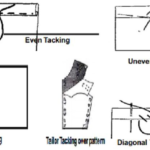
- Even Basting: Used for holding two or more layers of fabric together evenly.
- Uneven Basting: Used for holding two layers of fabric where less accuracy is required.
- Diagonal Basting: Used to hold linings or interfacings to main fabric, especially on curved edges.
- Tailor’s Tacks: Used to transfer pattern markings from pattern pieces to fabric.
Permanent Stitches
Permanent stitches are used to create strong, lasting seams, finish edges, or attach components permanently. They are not intended to be removed.
The following are examples of permanent stitches:
- Running Stitch: A simple stitch used for gathering, seaming, and mending.
- Backstitch: A strong stitch resembling machine stitching, used for seams and repairs.
- Hemming Stitch: Used to secure folded edges of fabric, such as hems, with small, inconspicuous stitches.
- Whipping Stitch: Used to join two finished edges together or to neaten raw edges.
- Overcasting Stitch: Used to prevent raw edges of fabric from fraying.
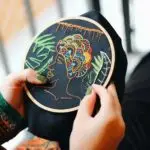
Decorative Stitches
Decorative stitches are used to add ornamentation and aesthetic appeal to textile items. They enhance the visual design of a piece.
The following are examples of decorative stitches:
- Chain Stitch: Forms a series of interconnected loops resembling a chain.
- Feather Stitch: Used for decorative borders and to hold down fabric edges.
- Satin Stitch: Used to fill in shapes with smooth, close-packed stitches.
- French Knot: A small, raised knot used for texture and detail.
Practical Stitching Exercises
Pupils will practice making various temporary, permanent, and decorative stitches on fabric pieces using needles and thread.
Teaching Methods/Instructional Techniques
Discussion, Lecture, Demonstration, Question and Answer, Visual Aids
Instructional Procedures
Step 1: Introduction
Time: 5 minutes
Teaching Skill: Set Induction
Teacher’s Activity: The teacher greets the pupils and reviews the previous lesson briefly. The teacher then asks pupils if they have ever mended a torn cloth or seen someone sew by hand, leading them to the topic of basic stitches.
Pupils’ Activity: Pupils respond to questions and share their experiences.
Learning Point: Pupils are introduced to the topic and connect it to their prior knowledge.
Step 2: Definition and Types of Basic Stitches
Time: 7 minutes
Teaching Skill: Explanation/Definition
Teacher’s Activity: The teacher defines basic stitches and introduces the three main types: temporary, permanent, and decorative. The teacher explains the general purpose of each type.
Pupils’ Activity: Pupils listen attentively and take notes.
Learning Point: Pupils understand what basic stitches are and their broad categories.
Step 3: Temporary Stitches – Demonstration and Practice
Time: 10 minutes
Teaching Skill: Demonstration/Practical Application
Teacher’s Activity: The teacher demonstrates how to make even basting and tailor’s tacks on a fabric sample, explaining their uses. Pupils are then guided to practice these stitches on their fabric pieces.
Pupils’ Activity: Pupils observe the demonstration and then practice making the stitches on their fabric pieces.
Learning Point: Pupils learn to make and understand the uses of temporary stitches.
Step 4: Permanent Stitches – Demonstration and Practice
Time: 10 minutes
Teaching Skill: Demonstration/Practical Application
Teacher’s Activity: The teacher demonstrates how to make running stitch and backstitch, explaining their importance for strong seams. Pupils are then guided to practice these stitches.
Pupils’ Activity: Pupils observe the demonstration and practice making the permanent stitches.
Learning Point: Pupils learn to make and understand the uses of permanent stitches.
Step 5: Decorative Stitches – Demonstration and Practice
Time: 8 minutes
Teaching Skill: Demonstration/Practical Application
Teacher’s Activity: The teacher demonstrates how to make a simple decorative stitch like chain stitch or French knot, showing how it enhances appearance. Pupils attempt to practice.
Pupils’ Activity: Pupils observe and try to replicate the decorative stitch.
Learning Point: Pupils are introduced to decorative stitches and their aesthetic value.
Step 6: Evaluation/Review
Time: 5 minutes
Teaching Skill: Questioning/Assessment
Teacher’s Activity: The teacher evaluates the learning by asking the following questions:
- Define basic stitches.
- Mention two types of temporary stitches and their uses.
- List two examples of permanent stitches.
- State one example of a decorative stitch.
- Why is it important to learn basic stitches?
Pupils’ Activity: Pupils answer orally and in writing.
Learning Point: Pupils demonstrate understanding of the lesson.
Step 7: Conclusion
Time: 5 minutes
Teaching Skill: Summarization/Consolidation
Teacher’s Activity: The teacher summarizes the key points of the lesson, emphasizing the importance of practice for mastering basic stitches. The teacher assigns homework: Pupils should practice at least one temporary, one permanent, and one decorative stitch at home and bring their samples to the next class.
Pupils’ Activity: Pupils listen to the summary and copy the homework assignment.
Learning Point: The lesson is concluded, and learning is reinforced with an assignment.
Lesson Keywords
- Stitch – A loop or knot made by a needle and thread in sewing.
- Temporary Stitches – Stitches used for temporary holding, removed after permanent stitching.
- Permanent Stitches – Stitches used to create lasting seams and finishes.
- Decorative Stitches – Stitches used for ornamentation and embellishment.
- Basting – A temporary stitch used to hold fabric layers together.
- Running Stitch – A simple, permanent stitch used for gathering or seaming.
- Backstitch – A strong, permanent stitch resembling machine stitching.
Differentiation
For pupils who grasp concepts quickly, the teacher can encourage them to explore more complex decorative stitches or assist peers. For pupils needing more support, the teacher will provide individualized guidance and simplified stitching tasks, focusing on mastering one stitch type at a time.
Note for teachers using this lesson plan
Ensure sufficient fabric pieces, needles, and thread are available for all pupils to have adequate practical time. Emphasize safety when using needles. Encourage pupils to practice regularly to develop fine motor skills and accuracy in stitching.
Community Join the conversation Open discussion +