

Class: Primary Two
Term: First Term
Subject: Basic Science and Technology
Curriculum Theme: Physical & Health Education
Previous Lesson: Practicing Manipulative Movement
Topic: Dangers In basic Movement
Content/Learning Area: Listing dangers in basic movement, Explaining the importance of looking before crossing the road, Identifying safe and unsafe climbing practices
Time Allocation: 40 minutes
Performance Objectives
By the end of the lesson, pupils should be able to:
- Cognitive Domain:
1. List three dangers in basic movement.
2. Explain why it is important to look before crossing the road.
3. Identify safe and unsafe climbing practices.
- Affective Domain:
1. Show awareness of potential dangers in basic movement.
2. Value the importance of safety precautions.
- Psychomotor Domain:
1. Demonstrate safe road crossing techniques.
2. Show how to safely climb stable objects.
- Social Domain:
1. Cooperate with others to ensure safety.
2. Communicate safety concerns effectively.
Reference Materials
- 9 – Years Basic Education curriculum
- Abuja Educational Resource Center Scheme of work
- NAPPS National unified Scheme of work
- online Details
- Relevant Textbooks
Instructional Materials
To deliver this lesson, the teacher will employ the help of the following materials:
- Whiteboard or chart paper
- Markers or crayons
- Pictures illustrating safe and unsafe practices
Rationale for the Lesson
Understanding dangers in basic movement is crucial for children’s safety and well-being. This lesson equips them with knowledge and skills to avoid accidents and make informed decisions, promoting responsible behavior and preventing injuries.
Prerequisite/Previous Knowledge
Pupils have some basic understanding of movement and simple safety rules.
Lesson Content
Dangers in Basic Movement
Many dangers exist during basic movements. It’s critically important to be aware of these to stay safe.
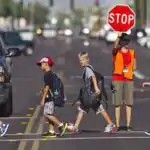
Crossing the Road
Crossing the road can be hazardous if not done carefully.
These include:
- Always look both ways before crossing.
- Use designated crosswalks whenever possible.
- Avoid distractions like phones or toys while crossing.
- Cross only when the road is clear of vehicles.
- Make eye contact with drivers to ensure they see you.
Climbing
Climbing without caution can lead to falls and injuries.
These include:
- Only climb on sturdy objects.
- Avoid climbing on unstable furniture or playground equipment.
- Ensure a soft landing area is available.
- Do not climb too high without supervision.
- Use proper climbing techniques to maintain balance.
Playing Near water
Playing near water can be risky without proper supervision.
These include:
- Never play near water without adult supervision.
- Always swim with a grown-up.
- Avoid running or pushing others near the water’s edge.
- Learn basic swimming skills and water safety rules.
- Be aware of potential hazards like slippery surfaces or strong currents.
Teaching Methods
To deliver this lesson, the teacher will adopt the following methods: Discussion,Question and Answer,Exhibition,and Role-playing.
Instructional Procedures
To deliver this lesson, the teacher will adopt the following steps:
Step 1: Introduction
Time: 5 minutes
Teaching Skill: Set Induction
Teacher’s Activity: Asks pupils about their experiences moving around, focusing on safe and unsafe situations.
Pupils’ Activity: Share their experiences and participate in the discussion.
Step 2: Description of Key Concepts
Time: 10 minutes
Teaching Skill: explaining
Teacher’s Activity: Explains the dangers of crossing roads without looking, climbing unstable objects, and playing near water.
Pupils’ Activity: Listen attentively and ask clarifying questions.
Step 3: Demonstration/Guided Practise
Time: 10 minutes
Teaching Skill: Demonstrating
Teacher’s Activity: Demonstrates safe road crossing and climbing techniques using pictures or role-playing.
Pupils’ Activity: Observe the demonstration and participate in role-playing.
Step 4: Autonomous Practice
Time: 5 minutes
Teaching Skill: Monitoring
Teacher’s activity: Guides pupils as they practice safe movement techniques individually or in small groups.
Pupils’ Activity: Practice safe movement techniques.
Step 5: Note-Taking
Time: 5 minutes
Teaching Skill: Note-taking
Teacher’s Activity: Guides pupils in summarizing key points in their notebooks.
Pupils’ Activity: Write down key points and draw pictures.
Step 6: Evaluation/Review
Time: 5 minutes
teaching Skill: Questioning
Teacher’s Activity: Asks review questions to assess understanding.
Pupils’ Activity: Answer review questions.
Objective-aligned checks:
- List three dangers in basic movement.
- Explain why it is important to look before crossing the road.
- Identify safe and unsafe climbing practices.
Step 7: Conclusion
Time: 2 minutes
Teaching Skill: Summarizing
Teacher’s Activity: Summarizes the key safety points and encourages pupils to practice safe movement habits.
Pupils’ Activity: Listen and affirm their commitment to safety.
Lesson Keywords
- Crosswalk – A marked part of a road where pedestrians have right of way to cross.
- Supervision – The act of watching over someone to ensure their safety.
- Hazard – A potential source of danger.
- Technique – A way of carrying out a particular task.
- Precaution – A measure taken in advance to prevent something dangerous from happening.
Lesson Evaluation
To evaluate the learning, the teacher asks pupils to:
- Name three dangers you learned about in basic movement.
- Why is it critically important to look both ways before crossing the road?
- Explain why climbing on unstable objects is hazardous.
- What should you do to stay safe when playing near water?
- Can you think of any other dangers related to basic movement?
Assignment/Homework
- Draw a picture showing a safe way to cross the road.
- List three rules for safe climbing.
- Write a short paragraph about why it is important to have adult supervision near water.
Differentiation
- For slower learners: Provide one-on-one assistance and use simpler language.
- For advanced learners: Encourage them to identify additional safety hazards and develop their own safety rules.
- For visual/auditory/kinesthetic learners: Use visual aids, verbal explanations, and hands-on activities to cater to different learning styles.
Note for Teachers
Ensure to use real-life examples and scenarios to make the lesson relatable and engaging for the pupils. Emphasize the importance of following safety rules to prevent accidents and injuries.

Community Join the conversation Open discussion +