

Class: Junior Secondary School 1 (JSS1, JSS 1)
Term: 2nd Term
Week: 8
Age: 12 years
Duration: 45 minutes
Subject: Mathematics
Curriculum Theme: Mathematics
Previous Lesson: Addition and Subtraction of Directed Numbers Using Number Line
Topic: Basic Properties of Some Common Three-dimensional Figures
Subject Matter: Basic properties of cubes, cuboids, pyramids, cylinders, e.g. faces, vertices and edges
Specific Objectives
By the end of the lesson, pupils should be able to:
- Cognitive Domain:
(a) Identify common three-dimensional figures such as cubes, cuboids, pyramids, and cylinders.
(b) State the number of faces, edges, and vertices of each solid shape.
(c) Distinguish between these solids based on their properties. - Affective Domain:
(a) Appreciate the importance of geometric solids in everyday life and environment. - Psychomotor Domain:
(a) Construct simple models of cube and cuboid using cardboard or sticks. - Social Domain:
(a) Work cooperatively in groups to identify and describe shapes around them.
Reference Materials
The following resources were used in planning this lesson:
- 9 Years Basic Education Curriculum
- Lagos State Unified Scheme of work for Junior Secondary Schools
- Math Is Fun – “Solid Geometry” (https://www.mathsisfun.com/geometry/solid-geometry.html)
- BBC Bitesize – “3D Shapes and Their Properties” (https://www.bbc.co.uk/bitesize/topics/zjv39j6/articles/zcsjqty)
- Relevant Textbooks
Instructional Materials
The teacher will teach this lesson with the aid of:
- Models of cube, cuboid, pyramid, and cylinder
- Cardboard or clay for constructing models
- Charts showing 3D shapes with faces, edges, and vertices labeled
- Whiteboard and markers
- Multimedia presentation or pictures of 3D objects in real life
Rationale for the Lesson
This lesson helps pupils understand the physical characteristics of solid shapes, enabling them to relate geometric figures to real-life objects and improve spatial reasoning.
Prerequisite/Previous Knowledge
Pupils are familiar with plane shapes such as squares, rectangles, and triangles, and can identify their sides and angles.
Lesson Content/Board Summary
Basic Properties of Some Common Three-Dimensional Figures
Three-dimensional (3D) figures are solid shapes that have length, breadth, and height. They occupy space and can be seen all around us in objects like boxes, cans, and pyramids.
Cube
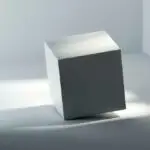
A cube is a solid figure with all its sides equal. Each face is a square, and all faces are of the same size.
The following are the properties of a cube:
- It has 6 faces.
- It has 12 edges.
- It has 8 vertices (corners).
- All faces are squares.
- All edges are of equal length.
Example:
If the length of one edge of a cube is 5 cm, find the total length of all edges.
Total length of all edges = 12 × 5 cm = 60 cm.
Cuboid
A cuboid is a solid shape with rectangular faces. It looks like a box or a brick.
The following are the properties of a cuboid:
- It has 6 faces (rectangular).
- It has 12 edges.
- It has 8 vertices.
- Opposite faces are equal and parallel.
- All angles are right angles (90°).
Example:
If the dimensions of a cuboid are 4 cm, 3 cm, and 2 cm, find the total length of all edges.
Total edges = 4(l + b + h) = 4(4 + 3 + 2) = 36 cm.
Pyramid
A pyramid is a solid figure with a polygon as its base and triangular faces meeting at a common point (apex).
The following are the properties of a pyramid:
- It has a polygon base (triangular, square, etc.).
- It has sloping triangular faces that meet at the top (apex).
- The number of faces, edges, and vertices depends on the base shape.
Examples include:
- A triangular pyramid (tetrahedron) has 4 faces, 6 edges, and 4 vertices.
- A square pyramid has 5 faces, 8 edges, and 5 vertices.
Cylinder
A cylinder is a solid figure with two equal circular faces at both ends and one curved surface joining them.
The following are the properties of a cylinder:
- It has 2 circular faces (top and bottom).
- It has 1 curved surface.
- It has no vertices and no edges.
- The distance between the circular faces is called the height.
Example:
If the radius of a cylinder is 3 cm and its height is 7 cm,
Curved surface area = 2πrh = 2 × 3.142 × 3 × 7 = 131.97 cm² (approx.).
Teaching Methods/Instructional Techniques:
Discussion, Lecture, Explanation, Demonstration, Visual Aids, Group Work, Question and Answer
Instructional Procedures
To deliver this lesson, the teacher will adopt the following steps:
Step 1: Introduction
Time: 5 minutes
Teaching Skill: Set Induction
Teacher’s Activity: Teacher displays various familiar 3D objects like a dice, a box, a pyramid-shaped object, and a can, then asks pupils to name and describe them.
Pupils’ Activity: Pupils identify and describe the shapes.
Learning Point: Pupils become aware that solid figures exist all around them.
Step 2: Description of Cubes and Cuboids
Time: 10 minutes
Teaching Skill: Explanation
Teacher’s Activity: The teacher explains and shows the properties of cubes and cuboids using physical models and charts.
Pupils’ Activity: Pupils observe, note the similarities and differences.
Learning Point: Pupils understand the properties of cubes and cuboids.
Step 3: Description of Pyramids and Cylinders
Time: 10 minutes
Teaching Skill: Demonstration
Teacher’s Activity: The teacher displays models of a pyramid and a cylinder, explaining their faces, edges, and vertices.
Pupils’ Activity: Pupils examine models and ask questions.
Learning Point: Pupils can identify pyramids and cylinders and state their properties.
Step 4: Practical Examples and Application
Time: 10 minutes
Teaching Skill: Illustration
Teacher’s Activity: Teacher works through example problems showing how to calculate total edge length and curved surface area.
Pupils’ Activity: Pupils solve similar examples in groups.
Learning Point: Pupils can apply formulas to find simple properties of solids.
Step 5: Note-Taking
Time: 5 minutes
Teaching Skill: Explanation
Teacher’s Activity: Teacher writes the board summary for pupils to copy.
Pupils’ Activity: Pupils copy the lesson notes neatly.
Learning Point: Pupils retain a written summary of the lesson content.
Step 6: Evaluation/Review
Time: 3 minutes
Teaching Skill: Questioning
Teacher’s Activity: The teacher evaluates the learning by asking the following questions:
- State three properties of a cube.
- How many faces has a cuboid?
- Mention two differences between a pyramid and a cylinder.
- How many edges does a square pyramid have?
- What is the shape of a cylinder’s base?
Pupils’ Activity: Pupils answer orally.
Learning Point: Pupils demonstrate comprehension of the properties of 3D shapes.
Step 7: Conclusion
Time: 2 minutes
Teaching Skill: Reinforcement
Teacher’s Activity: Teacher summarizes the lesson and encourages pupils to identify 3D shapes in their surroundings.
Pupils’ Activity: Pupils listen and respond.
Learning Point: Pupils understand that 3D shapes are important in everyday life.
Home Task: Solve three new exercises on Basic Properties of Some Common Three-dimensional Figures. Show each step and check each answer.
Lesson Keywords
- Face – a flat or curved surface of a solid figure
- Edge – a line where two faces meet
- Vertex – a point where edges meet
- Solid – a three-dimensional shape with volume
- Apex – the top point where triangular faces of a pyramid meet
Differentiation
Teacher gives simplified examples and visual aids for slower learners, while advanced pupils solve numerical examples and construct models independently.
Note for teachers using this lesson plan
Always use real-life objects to relate 3D shapes to the environment. Encourage hands-on construction using cardboard and ensure that pupils handle models carefully.


Community Join the conversation Open discussion +