

Note for teachers using this lesson plan
Teachers should prepare flashcards showing various equivalent fractions and have access to a device for playing educational videos on converting fractions to decimals and percentages. Ensure students have a foundational understanding of basic fractions before this lesson. By the end of the lesson, students should be able to confidently convert between fractions, decimals, and percentages, find equivalent fractions, and order fractions.
Class: JSS 1
Term: First Term
Week: 10
Age: 12 years
Duration: 45 minutes
Subject: Mathematics
Curriculum Theme: NUMBER NUMERATION
Focal competence: Applying equivalent fractions while sharing items or money
Key competencies/values: Collaboration
Skills:
- Solve problems on quantitative aptitude involving fractions
Previous Lesson: Place Value in Binary Numbers
Topic: Fractions
Subject Matter: Equivalent fractions, Ordering of fractions, Conversion of fractions to decimals and vise-versa, Conversion of fractions to percentages and vise-versa
Specific Objectives
By the end of the lesson, pupils/students should be able to:
Cognitive Domain
- Define equivalent fractions.
- Identify the numerator and denominator in a fraction.
- Convert fractions to decimals and decimals to fractions.
- Convert fractions to percentages and percentages to fractions.
- Arrange given fractions in ascending and descending order.
Affective Domain
- Appreciate the importance of fractions in everyday sharing.
- Collaborate with peers to solve problems involving fractions.
Psychomotor Domain
- Demonstrate the conversion of fractions using diagrams or models.
- Solve quantitative aptitude problems involving fractions.
Social Domain
- Participate actively in group discussions on fraction conversions.
Reference Materials
The following resources were used in planning this lesson:
- 2025 Revised 9 Years Basic Education Curriculum
- Relevant State Unified Scheme of Work
- New General Mathematics for Junior Secondary Schools 1
- The HeadTeacher Scheme of work
Instructional Materials
The teacher will teach this lesson with the aid of:
- Flash cards with worked examples on fractions
- Video player or projector to watch videos on how to Convert fractions to decimals and percentages or vice versa
- Fraction charts or diagrams
- Whiteboard and markers
Rationale for the Lesson
This lesson is essential for building a strong foundation in numerical reasoning, as fractions are fundamental to understanding quantities and proportions. It equips students with practical skills for everyday situations like sharing resources and interpreting data. Mastery of these concepts prepares students for more advanced mathematical topics.
Prerequisite/Previous Knowledge
Students should have a basic understanding of what a fraction represents, including simple fractions like halves, thirds, and quarters. They should also be familiar with basic multiplication and division operations.
Lesson Content/Board Summary
Fractions: Equivalent Fractions, Ordering, and Conversions
Fraction Notation
A fraction represents a part of a whole. It consists of two main parts:
- Numerator: The top number, which shows how many parts are being considered.
- Denominator: The bottom number, which shows the total number of equal parts the whole is divided into.
For example, in the fraction (frac{3}{4}), 3 is the numerator and 4 is the denominator.
Equivalent Fractions
Equivalent fractions are fractions that represent the same value, even though they have different numerators and denominators.
To find equivalent fractions, you multiply or divide both the numerator and the denominator by the same non-zero number.
Example:
To find an equivalent fraction for (frac{1}{2}):
- Multiply numerator and denominator by 2: (frac{1 times 2}{2 times 2} = frac{2}{4})
- Multiply numerator and denominator by 3: (frac{1 times 3}{2 times 3} = frac{3}{6})
So, (frac{1}{2}), (frac{2}{4}), and (frac{3}{6}) are all equivalent fractions.
Ordering of Fractions
To arrange fractions in ascending (smallest to largest) or descending (largest to smallest) order, you need to compare them. This is easiest when they have a common denominator.
Steps to order fractions:
- Find the Least Common Multiple (LCM) of the denominators. This will be the common denominator.
- Convert each fraction to an equivalent fraction with the common denominator.
- Compare the numerators of the new fractions.
Example: Arrange (frac{1}{2}), (frac{2}{3}), (frac{1}{4}) in ascending order.
- LCM of 2, 3, 4 is 12.
- Convert fractions:
- (frac{1}{2} = frac{1 times 6}{2 times 6} = frac{6}{12})
- (frac{2}{3} = frac{2 times 4}{3 times 4} = frac{8}{12})
- (frac{1}{4} = frac{1 times 3}{4 times 3} = frac{3}{12})
- Compare numerators: 3, 6, 8.
So, the ascending order is (frac{3}{12}, frac{6}{12}, frac{8}{12}), which means (frac{1}{4}, frac{1}{2}, frac{2}{3}).
Conversion of Fractions to Decimals and Vice-Versa
Fraction to Decimal
To convert a fraction to a decimal, divide the numerator by the denominator.
Example 1
Question: Convert (frac{3}{4}) to a decimal.
Solution:
Step 1: Divide the numerator by the denominator.
(3 div 4)
Step 2: Perform the division.
(3 div 4 = 0.75)
Answer: (0.75)
Decimal to Fraction
To convert a decimal to a fraction:
- Write the decimal as a fraction with the decimal number as the numerator and a power of 10 (10, 100, 1000, etc.) as the denominator, corresponding to the number of decimal places.
- Simplify the fraction to its lowest terms.
Example 2
Question: Convert (0.25) to a fraction.
Solution:
Step 1: Write the decimal as a fraction over a power of 10.
(0.25 = frac{25}{100}) (since there are two decimal places)
Step 2: Simplify the fraction.
(frac{25 div 25}{100 div 25} = frac{1}{4})
Answer: (frac{1}{4})
Conversion of Fractions to Percentages and Vice-Versa
Fraction to Percentage
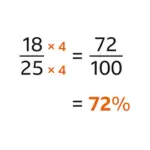
To convert a fraction to a percentage, multiply the fraction by 100%.
Example 1
Question: Convert (frac{3}{5}) to a percentage.
Solution:
Step 1: Multiply the fraction by 100%.
(frac{3}{5} times 100%)
Step 2: Perform the multiplication.
(frac{300}{5}% = 60%)
Answer: (60%)
Percentage to Fraction
To convert a percentage to a fraction:
- Write the percentage as a fraction with the number over 100.
- Simplify the fraction to its lowest terms.
Example 2
Question: Convert (75%) to a fraction.
Solution:
Step 1: Write the percentage as a fraction over 100.
(75% = frac{75}{100})
Step 2: Simplify the fraction.
(frac{75 div 25}{100 div 25} = frac{3}{4})
Answer: (frac{3}{4})
Teaching Methods/Instructional Techniques
Discussion, Demonstration, Guided Practice, Question and Answer, Explanation, Video Presentation, Group Work, Individual Practice
Instructional Procedures
Step 1: Introduction
Time: 5 minutes
Teaching Skill: Questioning/Recall
Teacher’s Activity: The teacher greets the students and reviews previous knowledge on basic fractions by asking questions like: “What is a fraction?” and “Can you give an example of a fraction and identify its numerator and denominator?” The teacher then introduces the topic of equivalent fractions, ordering, and conversions.
Pupils’ Activity: Students answer questions about basic fractions and listen attentively to the introduction of the new topic.
Learning Point: Basic fraction recall
Step 2: Equivalent Fractions
Time: 8 minutes
Teaching Skill: Explanation/Demonstration
Teacher’s Activity: The teacher explains what equivalent fractions are and demonstrates how to find them using multiplication and division. The teacher uses flashcards to show different equivalent fractions (e.g., (frac{1}{2}), (frac{2}{4}), (frac{3}{6})).
Pupils’ Activity: Students observe the flashcards, listen to the explanation, and participate in identifying equivalent fractions.
Learning Point: Understanding equivalent fractions
Step 3: Ordering of Fractions
Time: 7 minutes
Teaching Skill: Explanation/Guided Practice
Teacher’s Activity: The teacher explains the steps for ordering fractions by finding a common denominator. The teacher works through an example on the board, guiding students to convert fractions and compare their numerators.
Pupils’ Activity: Students follow the steps, ask questions, and attempt to order a simple set of fractions with teacher guidance.
Learning Point: Ordering fractions method
Step 4: Fraction to Decimal Conversion
Time: 5 minutes
Teaching Skill: Video Presentation/Explanation
Teacher’s Activity: The teacher plays a short video demonstrating how to convert fractions to decimals by dividing the numerator by the denominator. After the video, the teacher explains the process clearly and works through an example.
Pupils’ Activity: Students watch the video, listen to the explanation, and observe the worked example.
Learning Point: Fraction to decimal conversion
Step 5: Decimal to Fraction Conversion
Time: 5 minutes
Teaching Skill: Video Presentation/Explanation
Teacher’s Activity: The teacher plays another video showing how to convert decimals to fractions, emphasizing writing the decimal over a power of ten and simplifying. The teacher then provides an additional example on the board.
Pupils’ Activity: Students watch the video, pay attention to the steps, and practice simplifying fractions.
Learning Point: Decimal to fraction conversion
Step 6: Fraction to Percentage Conversion and Vice-Versa
Time: 5 minutes
Teaching Skill: Video Presentation/Explanation
Teacher’s Activity: The teacher shows a video on converting fractions to percentages (multiplying by 100%) and percentages to fractions (dividing by 100 and simplifying). The teacher reinforces these concepts with quick examples.
Pupils’ Activity: Students watch the video and engage in quick mental conversions or simple examples.
Learning Point: Fraction-percentage conversions
Step 7: Evaluation/Review
Time: 5 minutes
Teaching Skill: Questioning/Assessment
Teacher’s Activity: The teacher evaluates the learning by asking the following questions:
- What are equivalent fractions?
- Convert (frac{2}{5}) to a decimal.
- Convert (0.7) to a fraction.
- Convert (frac{1}{4}) to a percentage.
- Arrange (frac{1}{3}, frac{1}{2}, frac{1}{6}) in ascending order.
Pupils’ Activity: Pupils answer orally and in writing.
Learning Point: Assessment of understanding
Step 8: Note-Taking
Time: 4 minutes
Teaching Skill: Guided Writing
Teacher’s Activity: The teacher guides pupils/students to copy the essential Board Summary notes on equivalent fractions, ordering, and conversions into their notebooks.
Pupils’ Activity: Pupils/students copy the notes carefully into their notebooks.
Learning Point: Recording lesson content
Step 9: Conclusion
Time: 1 minute
Teaching Skill: Consolidation
Teacher’s Activity: The teacher briefly summarizes the key points of the lesson, emphasizing the interconnectedness of fractions, decimals, and percentages, and their practical application.
Pupils’ Activity: Students listen and reflect on the lesson’s main points.
Learning Point: Lesson summary and application
Continuous Assessment/Further Study
Type: Homework
Instruction: Complete the following exercises in your notebook:
- Write two equivalent fractions for (frac{3}{7}).
- Convert (0.6) to a fraction in its simplest form.
- Convert (frac{7}{10}) to a percentage.
- Convert (40%) to a fraction in its simplest form.
- Arrange the following fractions in descending order: (frac{3}{4}, frac{1}{2}, frac{5}{8}).
Lesson Keywords
- Fraction – A part of a whole, represented by a numerator and a denominator.
- Numerator – The top number in a fraction, indicating the number of parts taken.
- Denominator – The bottom number in a fraction, indicating the total number of equal parts.
- Equivalent fractions – Fractions that represent the same value.
- Decimal – A number that uses a decimal point to show parts of a whole.
- Percentage – A fraction expressed as a number out of 100, denoted by the % symbol.
- Ascending order – Arranging numbers from smallest to largest.
- Descending order – Arranging numbers from largest to smallest.
Differentiation
For weaker learners: Provide additional visual aids such as fraction strips or circles to demonstrate equivalent fractions. Focus on one type of conversion at a time with more guided practice. Provide simplified worksheets with fewer steps.
For faster learners: Challenge them with more complex fractions, mixed numbers, or problems involving real-life scenarios like calculating discounts or proportions in recipes. Encourage them to explain their methods to peers.
Suggested Lesson Videos
For videos on equivalent fractions, ordering fractions, and conversions, search on YouTube for: JSS1 equivalent fractions ordering conversions
Teacher Guide for Using This Lesson Plan
Before the lesson, ensure you have your flashcards ready for equivalent fractions and that the video player is set up for the conversion videos. Begin by quickly reviewing basic fraction concepts to ensure all students are on the same page. When teaching equivalent fractions, use concrete examples or diagrams to make the concept clear. For ordering fractions, guide students through finding the LCM carefully. During the conversion sections, after showing the videos, work through additional examples on the board, encouraging students to explain the steps. Allow ample time for students to copy the Board Summary notes after the main teaching and evaluation. Pay attention to common errors, such as incorrect division for fraction-to-decimal conversion or forgetting to simplify fractions. Encourage collaboration during practice activities and use the continuous assessment to gauge individual understanding.

Community Join the conversation Open discussion +