

Class: Junior Secondary School 1 (JSS1, JSS 1)
Term: 2nd Term
Week: 10
Age: 12 years
Duration: 45 minutes
Subject: Mathematics
Curriculum Theme: Mathematics
Previous Lesson: Basic Properties of Sphere, Cone and Triangular Prism
Topic: Properties of Figures
Subject Matter: Rectangles, Squares, Isosceles Triangles, Equilateral Triangles, Circles
Specific Objectives
By the end of the lesson, pupils should be able to:
- Cognitive Domain:
(a) State the properties of rectangles, squares, isosceles triangles, equilateral triangles, and circles.
(b) Differentiate between these plane figures based on their properties. - Affective Domain:
(a) Appreciate the importance of shapes in real-life structures and designs. - Psychomotor Domain:
(a) Draw and label rectangles, squares, triangles, and circles accurately using mathematical instruments. - Social Domain:
(a) Work collaboratively in groups to identify and describe properties of figures found in their environment.
Reference Materials
The following resources were used in planning this lesson:
- 9 Years Basic Education Curriculum
- Lagos State Unified Scheme of work for Junior Secondary Schools
- BBC Bitesize – “2D Shapes” (https://www.bbc.co.uk/bitesize/topics/zjv39j6/articles/ztpwdmn)
- Relevant Textbooks
Instructional Materials
The teacher will teach this lesson with the aid of:
- Charts showing different plane shapes
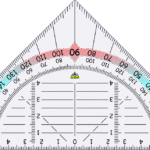
- Ruler, compass, and protractor
- Cardboard cutouts of geometric shapes
- Graph board and markers
- Mathematical set
Rationale for the Lesson
This lesson enables students to identify, describe, and understand the properties of basic plane figures which are foundational to geometry and real-life designs.
Prerequisite/Previous Knowledge
Pupils already know the basic plane shapes and can identify simple geometric figures such as rectangles, squares, and triangles from their environment.
Lesson Content/Board Summary
Properties of Figures
Rectangle
A rectangle is a four-sided figure with opposite sides equal and all angles equal to 90°.
The following are the properties of a rectangle:
- It has four sides and four right angles.
- Opposite sides are equal and parallel.
- Diagonals are equal and bisect each other.
- Each diagonal divides the rectangle into two congruent triangles.
Example:
If the length of a rectangle is 8 cm and its breadth is 4 cm:
Perimeter = 2 × (L + B) = 2 × (8 + 4) = 24 cm
Area = L × B = 8 × 4 = 32 cm²
Square
A square is a four-sided figure with all sides equal and all angles 90°.
The following are the properties of a square:
- All sides are equal in length.
- All interior angles are right angles.
- Opposite sides are parallel.
- Diagonals are equal and bisect each other at right angles.
- Each diagonal divides the square into two isosceles right triangles.
Example:
If the side of a square is 5 cm:
Perimeter = 4 × side = 4 × 5 = 20 cm
Area = side² = 5² = 25 cm²
Isosceles Triangle
An isosceles triangle has two sides equal and two angles equal.
The following are the properties of an isosceles triangle:
- Two sides are equal in length.
- Angles opposite the equal sides are equal.
- It has one line of symmetry.
Example:
If an isosceles triangle has equal sides of 6 cm and a base of 8 cm, the equal angles are the same.
Equilateral Triangle
An equilateral triangle has all three sides and angles equal.
The following are the properties of an equilateral triangle:
- All sides are equal in length.
- Each angle measures 60°.
- It has three lines of symmetry.
Example:
If each side is 4 cm:
Perimeter = 3 × 4 = 12 cm
Circle
A circle is a plane figure with all points equidistant from a fixed point called the center.
The following are the properties of a circle:
- It has no sides or angles.
- The distance from the center to any point on the circle is the radius.
- The line passing through the center and touching both sides of the circle is the diameter.
- The circumference is the distance around the circle.
- Diameter = 2 × Radius.
Example:
If the radius of a circle is 7 cm:
Diameter = 2 × 7 = 14 cm
Circumference = 2πr = 2 × 22/7 × 7 = 44 cm
Teaching Methods/Instructional Techniques:
Discussion, Lecture, Explanation, Demonstration, Group Work, Visual Aids, Question and Answer
Instructional Procedures
To deliver this lesson, the teacher will adopt the following steps:
Step 1: Introduction
Time: 5 minutes
Teaching Skill: Set Induction
Teacher’s Activity: Teacher displays charts of various figures and asks pupils to identify them.
Pupils’ Activity: Pupils name the shapes they see such as square, rectangle, and triangle.
Learning Point: Pupils recall previously learned geometric figures.
Step 2: Properties of Rectangle and Square
Time: 10 minutes
Teaching Skill: Explanation
Teacher’s Activity: Teacher explains the properties of rectangles and squares and demonstrates using diagrams.
Pupils’ Activity: Pupils observe and list the properties.
Learning Point: Pupils understand the properties of rectangles and squares.
Step 3: Properties of Triangles
Time: 10 minutes
Teaching Skill: Discussion
Teacher’s Activity: Teacher discusses the properties of isosceles and equilateral triangles and relates them to real-life examples like roof shapes and traffic signs.
Pupils’ Activity: Pupils participate by identifying examples of triangles in their surroundings.
Learning Point: Pupils understand the differences and similarities between isosceles and equilateral triangles.
Step 4: Properties of Circle
Time: 10 minutes
Teaching Skill: Demonstration
Teacher’s Activity: Teacher draws a circle using a compass, labels the parts (radius, diameter, circumference), and explains their relationships.
Pupils’ Activity: Pupils draw their own circles and label the parts correctly.
Learning Point: Pupils understand the properties and parts of a circle.
Step 5: Note-Taking
Time: 5 minutes
Teaching Skill: Explanation
Teacher’s Activity: Teacher writes the board summary for pupils to copy.
Pupils’ Activity: Pupils copy notes neatly into their notebooks.
Learning Point: Pupils retain accurate notes of the lesson.
Step 6: Evaluation/Review
Time: 3 minutes
Teaching Skill: Questioning
Teacher’s Activity: The teacher evaluates the learning by asking the following questions:
- List three properties of a rectangle.
- What are the properties of an equilateral triangle?
- State the relationship between radius and diameter in a circle.
- Calculate the area of a square with side 6 cm.
Pupils’ Activity: Pupils answer orally and show workings where needed.
Learning Point: Pupils demonstrate understanding of properties of figures.
Step 7: Conclusion
Time: 2 minutes
Teaching Skill: Reinforcement
Teacher’s Activity: Teacher summarizes the key points, commends pupils’ participation, and gives an assignment.
Pupils’ Activity: Pupils listen and note the assignment.
Learning Point: Pupils review what was learned about properties of figures.
Home Task: Solve three new exercises on Properties of Figures. Show each step and check each answer.
Lesson Keywords
- Rectangle – a four-sided shape with opposite sides equal and all angles 90°
- Square – a four-sided shape with all sides and angles equal
- Triangle – a shape with three sides and three angles
- Circle – a round plane figure with all points equidistant from the center
- Radius – distance from the center of a circle to any point on its circumference
Differentiation
Teacher provides simplified explanations for slow learners and allows faster learners to assist peers during drawing exercises and group discussions.
Note for teachers using this lesson plan
Ensure pupils practice drawing each figure using mathematical tools. Emphasize the practical use of these shapes in construction, design, and daily life.


Community Join the conversation Open discussion +