

Class: Junior Secondary School 1 (JSS1, JSS 1)
Term: 2nd Term
Week: 1
Age: 12 years
Duration: 45 minutes
Subject: Mathematics
Curriculum Theme: Mathematics
Previous Lesson:
Topic: Approximation
Subject Matter: Obtaining approximate values for calculation involving four basic arithmetic processes (operations), Rounding off of numbers to the nearest 10, 100, 1000.
Specific Objectives
By the end of the lesson, pupils should be able to:
- Cognitive Domain:
(a) Identify numbers that can be rounded up or down to the nearest 10, 100, and 1000.
(b) Carry out approximate calculations involving addition, subtraction, multiplication, and division. - Affective Domain:
(a) Appreciate the usefulness of approximation in real-life calculations. - Psychomotor Domain:
(a) Round off given numbers correctly using the rules of approximation.
(b) Perform simple arithmetic operations with approximated numbers. - Social Domain:
(a) Work cooperatively in groups to solve problems involving approximation.
Reference Materials
The following resources were used in planning this lesson:
- 9 Years Basic Education Curriculum
- Lagos State Unified Scheme of work for Junior Secondary Schools
- Math is Fun – “Rounding Numbers” (https://www.mathsisfun.com/rounding-numbers.html)
- Relevant Textbooks
Instructional Materials
The teacher will teach this lesson with the aid of:
- Place value chart
- Number line charts
- Flash cards with examples of numbers
- Whiteboard and marker
- Real-life examples (e.g., prices, measurements)
Rationale for the Lesson
This lesson helps pupils understand how to simplify numbers for quick estimation and practical calculations in everyday life.
Prerequisite/Previous Knowledge
Pupils already understand the place value of numbers and can perform basic arithmetic operations such as addition, subtraction, multiplication, and division.
Lesson Content/Board Summary
Approximation
Approximation is the process of finding a value close to the actual number. It is often used when exact values are not needed or when quick mental calculations are required.
Rounding Off Numbers
Rounding off means changing a number to the nearest 10, 100, or 1000 depending on the place value to make it easier to work with.
The following are the rules for rounding off numbers:
- Identify the place value you are rounding to (10, 100, or 1000).
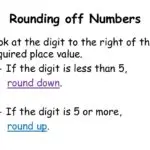
- Look at the digit to the right of that place value.
- If the digit is 5 or more, round up by adding 1 to the rounding digit.
- If the digit is less than 5, keep the rounding digit the same and change the remaining digits to zero.
Examples include:
- Round 78 to the nearest 10
- The digit at ones place is 8 (≥5), so we round up.
- 78 ≈ 80.
- Round 236 to the nearest 100
- The tens digit is 3 (<5), so we round down.
- 236 ≈ 200.
- Round 4,780 to the nearest 1000
- The hundreds digit is 7 (≥5), so we round up.
- 4,780 ≈ 5,000.
Approximate Values in Basic Arithmetic Operations
Approximation can be used in addition, subtraction, multiplication, and division to estimate answers quickly.
The following are examples:
- Addition:
- 48 + 73 ≈ 50 + 70 = 120
- Subtraction:
- 164 – 78 ≈ 160 – 80 = 80
- Multiplication:
- 49 × 21 ≈ 50 × 20 = 1000
- Division:
- 198 ÷ 50 ≈ 200 ÷ 50 = 4
Approximations help us check if answers to calculations are reasonable and to estimate results faster in everyday activities such as shopping, budgeting, and measuring.
Teaching Methods/Instructional Techniques:
Discussion, Lecture, Explanation, Demonstration, Group Work, Question and Answer, Use of Visual Aids
Instructional Procedures
To deliver this lesson, the teacher will adopt the following steps:
Step 1: Introduction
Time: 5 minutes
Teaching Skill: Set Induction
Teacher’s Activity: The teacher asks pupils how they would quickly guess the total cost of buying items like ₦78 and ₦23 without using a calculator. Leads pupils to see the importance of rounding numbers.
Pupils’ Activity: Pupils respond with ideas and experiences.
Learning Point: Pupils are introduced to approximation as a way of simplifying calculations.
Step 2: Explanation of Rounding Off
Time: 10 minutes
Teaching Skill: Explanation
Teacher’s Activity: The teacher explains the concept of rounding off and demonstrates the steps using a number line and examples on the board.
Pupils’ Activity: Pupils observe and participate by identifying which numbers round up or down.
Learning Point: Pupils understand the rules and process of rounding off numbers.
Step 3: Examples on Rounding to 10, 100, and 1000
Time: 10 minutes
Teaching Skill: Demonstration
Teacher’s Activity: The teacher provides examples of rounding numbers to the nearest 10, 100, and 1000 and guides pupils through class exercises.
Pupils’ Activity: Pupils solve similar examples on their own and compare answers.
Learning Point: Pupils can correctly round numbers to different place values.
Step 4: Approximation in Arithmetic Operations
Time: 10 minutes
Teaching Skill: Guided Practice
Teacher’s Activity: The teacher uses examples of the four basic operations to show how rounding simplifies calculations.
Pupils’ Activity: Pupils perform approximate calculations in pairs.
Learning Point: Pupils learn how to use approximation in arithmetic operations.
Step 5: Note-Taking
Time: 5 minutes
Teaching Skill: Explanation
Teacher’s Activity: The teacher dictates or writes the lesson summary for pupils to copy into their notebooks.
Pupils’ Activity: Pupils copy notes neatly.
Learning Point: Pupils have a written record for study and revision.
Step 6: Evaluation/Review
Time: 3 minutes
Teaching Skill: Questioning
Teacher’s Activity: The teacher evaluates the learning by asking the following questions:
- What does it mean to round off a number?
- Round 83 to the nearest 10.
- Round 346 to the nearest 100.
- Estimate the sum of 47 and 64.
Pupils’ Activity: Pupils respond orally and solve on the board.
Learning Point: Pupils’ understanding of rounding and approximation is confirmed.
Step 7: Conclusion
Time: 2 minutes
Teaching Skill: Reinforcement
Teacher’s Activity: The teacher summarizes the lesson and emphasizes the usefulness of approximation in everyday calculations.
Pupils’ Activity: Pupils listen attentively and ask questions.
Learning Point: Pupils appreciate the practical value of approximation.
Home Task: Solve three new exercises on Approximation. Show each step and check each answer.
Lesson Keywords
- Approximation – finding a value close to the exact number
- Rounding – reducing a number to the nearest 10, 100, or 1000
- Estimation – making an intelligent guess of a value
- Place Value – the position of a digit in a number
- Arithmetic – basic operations of addition, subtraction, multiplication, and division
Differentiation
Teacher provides simpler rounding examples for slower learners and more challenging estimation problems for advanced learners, ensuring all pupils participate actively.
Note for teachers using this lesson plan
Emphasize real-life applications of approximation, such as estimating time, cost, or distance. Use practical examples and visual aids for better understanding.


Community Join the conversation Open discussion +