

Class: Junior Secondary School 1 (JSS 1 / JS1)
Term: 3rd Term
Week: 3
Age: 12 years
Duration: 45 minutes
Subject: Mathematics
Curriculum Theme: Mathematics
Previous Lesson: Area of Irregular and Regular Shapes, Derive the Formula of.
Topic: VOLUMES
Subject Matter: Volumes of cubes, Cuboids: Triangular prism
Specific Objectives
By the end of the lesson, pupils should be able to:
Cognitive Domain:
- Define volume and state its standard units.
- State the formulas for calculating the volume of a cube, cuboid, and triangular prism.
- Recall the formula for the area of a triangle.
Affective Domain:
- Appreciate the importance of calculating volumes in real-life situations.
- Show interest in solving problems involving volumes of solids.
Psychomotor Domain:
- Calculate the volume of given cubes and cuboids.
- Calculate the volume of given triangular prisms.
- Solve word problems involving the volumes of these solids.
Social Domain:
- Work collaboratively with peers to solve volume problems.
- Share their solutions and reasoning with the class.
Reference Materials
The following resources were used in planning this lesson:
- 9 Years Basic Education Curriculum
- State Unified Scheme of Work
- New General Mathematics for Junior Secondary Schools 1
Instructional Materials
The teacher will teach this lesson with the aid of:
- Models of cubes, cuboids, and triangular prisms
- Measuring tape or ruler
- Charts displaying the formulas for volume of cubes, cuboids, and triangular prisms
Rationale for the Lesson
Understanding volume helps pupils determine the space occupied by three-dimensional objects. This knowledge is important for everyday tasks like packing, construction, and understanding capacities of containers, providing a foundation for more advanced mathematical concepts.
Prerequisite/Previous Knowledge
Pupils should be able to identify three-dimensional shapes, calculate the area of squares, rectangles, and triangles, and perform basic multiplication.
Lesson Content/Board Summary
Volume of Solids
Introduction to Volume
Volume is the amount of three-dimensional space occupied by an object or a substance. It is a measure of how much space a solid object takes up. The standard units for volume are cubic units, such as cubic centimetres (cm³) and cubic metres (m³).
Volume of a Cube
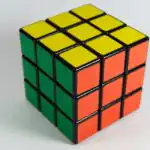
A cube is a three-dimensional solid object bounded by six square faces, with three meeting at each vertex. All edges of a cube are of equal length.
The formula for the volume of a cube is:
Volume (V) = Length × Length × Length = L³
Where ‘L’ is the length of one side of the cube.
Example 1: Calculate the volume of a cube with a side length of 5 cm.
Step 1: State the formula.
V = L³
Step 2: Substitute the given value.
V = (5 cm)³
Step 3: Calculate the volume.
V = 5 cm × 5 cm × 5 cm = 125 cm³
Example 2: A cube has edges of 8 m. Find its volume.
Step 1: State the formula.
V = L³
Step 2: Substitute the given value.
V = (8 m)³
Step 3: Calculate the volume.
V = 8 m × 8 m × 8 m = 512 m³
Volume of a Cuboid
A cuboid is a three-dimensional shape with six rectangular faces. It has a length, a width (or breadth), and a height.
The formula for the volume of a cuboid is:
Volume (V) = Length × Width × Height = L × W × H
Where ‘L’ is the length, ‘W’ is the width (or breadth), and ‘H’ is the height.
Example 1: Find the volume of a cuboid with length 10 cm, width 4 cm, and height 3 cm.
Step 1: State the formula.
V = L × W × H
Step 2: Substitute the given values.
V = 10 cm × 4 cm × 3 cm
Step 3: Calculate the volume.
V = 120 cm³
Example 2: A rectangular tank is 2 m long, 1.5 m wide, and 1 m high. What is its volume?
Step 1: State the formula.
V = L × W × H
Step 2: Substitute the given values.
V = 2 m × 1.5 m × 1 m
Step 3: Calculate the volume.
V = 3 m³
Volume of a Triangular Prism
A triangular prism is a prism composed of two triangular bases and three rectangular sides. The bases are parallel and congruent triangles.
The formula for the volume of a triangular prism is:
Volume (V) = Area of the triangular base × Height of the prism
Since the area of a triangle = ½ × base × height (of the triangle), the formula becomes:
V = (½ × b × h) × H
Where ‘b’ is the base of the triangular face, ‘h’ is the height of the triangular face, and ‘H’ is the height (or length) of the prism.
Example 1: Calculate the volume of a triangular prism with a base triangle of base 6 cm and height 4 cm, and the prism’s height is 10 cm.
Step 1: State the formula.
V = (½ × b × h) × H
Step 2: Substitute the given values.
V = (½ × 6 cm × 4 cm) × 10 cm
Step 3: Calculate the area of the triangular base.
Area of base = ½ × 24 cm² = 12 cm²
Step 4: Calculate the volume.
V = 12 cm² × 10 cm = 120 cm³
Example 2: A triangular prism has a base with a base length of 8 m and a height of 5 m. If the length of the prism is 12 m, find its volume.
Step 1: State the formula.
V = (½ × b × h) × H
Step 2: Substitute the given values.
V = (½ × 8 m × 5 m) × 12 m
Step 3: Calculate the area of the triangular base.
Area of base = ½ × 40 m² = 20 m²
Step 4: Calculate the volume.
V = 20 m² × 12 m = 240 m³
Teaching Methods/Instructional Techniques
Discussion, Lecture, Demonstration, Question and Answer, Visual Aids
Instructional Procedures
Step 1: Introduction
Time: 5 minutes
Teaching Skill: Set Induction
Teacher’s Activity: The teacher greets the pupils and asks them to identify some 3D objects in the classroom, like a chalk box (cuboid) or a dice (cube). The teacher then introduces the concept of volume as the space these objects occupy.
Pupils’ Activity: Pupils respond to greetings and identify objects, listening attentively to the introduction.
Learning Point: Pupils are introduced to the concept of volume and its relevance to 3D objects.
Step 2: Volume of a Cube
Time: 10 minutes
Teaching Skill: Explanation/Demonstration
Teacher’s Activity: The teacher displays a model of a cube, explains its properties, and derives the formula for its volume (L³). The teacher then solves an example on the board, explaining each step.
Pupils’ Activity: Pupils observe the model, listen to the explanation, copy the formula, and work through the example in their notebooks.
Learning Point: Pupils learn the definition and formula for the volume of a cube and practice calculation.
Step 3: Volume of a Cuboid
Time: 10 minutes
Teaching Skill: Explanation/Demonstration
Teacher’s Activity: The teacher displays a model of a cuboid, explains its properties, and derives the formula for its volume (L × W × H). The teacher then solves another example on the board.
Pupils’ Activity: Pupils observe the model, listen to the explanation, copy the formula, and work through the example in their notebooks.
Learning Point: Pupils learn the definition and formula for the volume of a cuboid and practice calculation.
Step 4: Volume of a Triangular Prism
Time: 10 minutes
Teaching Skill: Explanation/Demonstration
Teacher’s Activity: The teacher displays a model of a triangular prism, explains how its volume is calculated (Area of base triangle × Height of prism), and derives the formula (½ × b × h × H). The teacher solves an example on the board.
Pupils’ Activity: Pupils observe the model, listen to the explanation, copy the formula, and work through the example in their notebooks.
Learning Point: Pupils learn the definition and formula for the volume of a triangular prism and practice calculation.
Step 5: Class Activity/Practice
Time: 5 minutes
Teaching Skill: Guided Practice
Teacher’s Activity: The teacher provides a few simple practice problems involving cubes, cuboids, and triangular prisms for pupils to solve individually or in pairs.
Pupils’ Activity: Pupils attempt to solve the practice problems in their notebooks.
Learning Point: Pupils apply the learned formulas to solve problems independently.
Step 6: Review and Correction
Time: 5 minutes
Teaching Skill: Feedback/Correction
Teacher’s Activity: The teacher asks pupils to share their answers to the practice problems and provides corrections and clarifications where necessary.
Pupils’ Activity: Pupils share their answers, listen to corrections, and make necessary adjustments in their notes.
Learning Point: Pupils receive immediate feedback and clarify any misconceptions.
Step 7: Evaluation/Review
Time: 5 minutes
Teaching Skill: Questioning/Assessment
Teacher’s Activity: The teacher evaluates the learning by asking the following questions:
- Define volume and state its standard unit.
- State the formula for the volume of a cube.
- State the formula for the volume of a cuboid.
- Calculate the volume of a cuboid with length 6 cm, width 3 cm, and height 2 cm.
Pupils’ Activity: Pupils answer orally and in writing.
Learning Point: Pupils demonstrate understanding of the lesson.
Step 8: Conclusion
Time: 5 minutes
Teaching Skill: Summarization/Assignment
Teacher’s Activity: The teacher summarizes the main points of the lesson, emphasizing the formulas for volume. The teacher then gives homework, asking pupils to find the volume of a cube with side 7m and a triangular prism with base 5cm, height 4cm, and prism length 12cm.
Pupils’ Activity: Pupils listen to the summary, copy the homework assignment, and ask any final questions.
Learning Point: Pupils consolidate their learning and are given further practice.
Home Task: Solve three new exercises on VOLUMES. Show each step and check each answer.
Lesson Keywords
- Volume – The amount of space occupied by a three-dimensional object.
- Cube – A 3D shape with six equal square faces.
- Cuboid – A 3D shape with six rectangular faces.
- Triangular prism – A prism with two parallel triangular bases and three rectangular sides.
- Length – The measurement or extent of something from end to end.
- Width – The measurement of something from side to side.
- Height – The measurement from base to top.
- Area – The extent or measurement of a surface or piece of land.
Differentiation
For pupils who grasp concepts quickly, the teacher will provide more complex word problems involving combined shapes or conversions between units. For those needing extra support, the teacher will provide simplified problems, visual aids, and one-on-one guidance, focusing on one type of solid at a time.
Note for teachers using this lesson plan
Ensure pupils understand the difference between the ‘height of the triangle’ and the ‘height of the prism’ when teaching triangular prisms. Emphasize the correct units for volume. Encourage pupils to draw diagrams for each problem to visualize the shapes.

Community Join the conversation Open discussion +