

Class: Primary One
Term: first Term
Subject: Pre-vocational Studies
Curriculum theme: Home Economics
Previous Lesson:
Topic: The Human Body
Content/Learning Area: Identification of Head, Hair, Eyes, and Nose, identification of Mouth and Ears, Identification of the Neck and Trunk, Identification of the Chest and Belly, Identification of the legs and Hands, identification of Nails and Other Important Parts
Time Allocation: 40 minutes
Performance Objectives
By the end of the lesson, pupils should be able to:
- Cognitive Domain:
1. Identify the major parts of the human body.
2. Describe the functions of different body parts.
3. Understand the importance of knowing your body.
- Affective Domain:
1. Show thankfulness for the complexity and wonder of the human body.
2. Develop a positive attitude towards learning about the human body.
- psychomotor Domain:
1. Draw a diagram of the human body and label its parts.
2. participate actively in class discussions and activities.
- Social Domain:
1. Work cooperatively with peers during group activities.
2. Listen attentively to the teacher and classmates.
reference Materials
- 9 – Years Basic Education Curriculum
- Abuja Educational Resource Centre Scheme of Work
- NAPPS National Unified Scheme of Work
- Relevant Textbooks
Instructional Materials
To deliver this lesson,the teacher will use the following materials:
- Whiteboard or chart
- Markers or chalk
- Pictures or diagrams of the human body
- relevant textbooks
Rationale for the lesson
This lesson is crucial for pupils to understand their bodies and how they function. This knowledge will help them make healthy choices and appreciate the complexity of the human body, laying the foundation for future science lessons.
Prerequisite/Previous Knowledge
The teacher will start by asking pupils what they already know about the human body. A brief review of the previous lesson will be conducted. The teacher will then introduce the topic of today’s lesson, emphasizing the importance of understanding our bodies.
Lesson Content
The Human Body: A Wonderful Machine
The human body is a complex and amazing machine, made up of manny different parts, each with its own unique function. It’s a living organism with many systems working together.
Major Parts of the Human Body
The human body consists of several major parts that perform specific functions.These include:
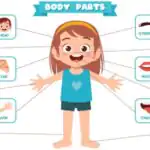
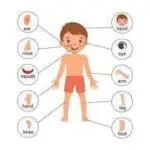
- Head: Contains the brain, eyes, ears, nose, and mouth.
- Trunk: The central part, including the chest, abdomen, and back; houses the heart, lungs, stomach, and intestines.
- Limbs: Arms and legs, used for movement.
- Neck: Connects the head to the trunk and allows for head movement.
- Pelvis: Located at the base of the trunk, supporting the spine and connecting to the legs.
Functions of Different Body Parts
Each part of the human body has a specific role to play in maintaining overall health and function.
They are:
- Eyes: Seeing.
- Ears: Hearing.
- Nose: Smelling.
- Mouth: Eating, speaking, breathing.
- Heart: pumping blood.
- Lungs: Breathing.
- Stomach: Digesting food.
- Intestines: Absorbing nutrients.
- Skin: Protection.
- Bones: Support and structure.
- Muscles: Movement.
- Brain: Controls thoughts, memory, and bodily functions.
- Kidneys: Filter waste from the blood.
- Liver: Processes nutrients and detoxifies harmful substances.
Importance of Knowing Your Body
Understanding our bodies helps us make healthy choices and appreciate how amazing we are. Knowing how our bodies work allows us to take better care of ourselves.
Fun Activities to Learn More
To reinforce learning, pupils can engage in various activities.
Examples are:
- Draw a picture of yourself and label the body parts.
- Play Simon Says using body parts.
- Create a story about a body part.
- Sing a song about body parts.
- Do a simple exercise routine and identify the muscles being used.
Teaching Methods
To deliver this lesson, the teacher will adopt the following methods: Discussion, Question and answer, Exhibition, Group work
instructional Procedures
To deliver this lesson, the teacher will adopt the following steps:
Step 1: Introduction
Time: 5 minutes
Teaching Skill: set Induction
Teacher’s Activity: Review previous lesson, introduce the topic, and engage pupils with questions about the human body.
Pupils’ Activity: Respond to teacher’s questions, participate in discussion.
Step 2: Explanation of Key Concepts
Time: 15 minutes
Teaching Skill: Explaining, illustrating
Teacher’s activity: Explain the major parts of the human body using diagrams and pictures. Explain the functions of each part.
Pupils’ Activity: Listen attentively, ask questions, take notes.
Step 3: Demonstration/Guided Practice
Time: 10 minutes
Teaching Skill: demonstrating, guiding
Teacher’s activity: Demonstrate how to label a diagram of the human body. Guide pupils in labeling their own diagrams.
Pupils’ activity: Observe the demonstration,participate in guided practice,label their diagrams.
Step 4: Independent Practice
Time: 5 minutes
Teaching Skill: Monitoring, assisting
Teacher’s Activity: Monitor pupils as they work independently on their diagrams. Provide assistance where needed.
Pupils’ Activity: Complete their diagrams independently.
Step 5: Note-Taking
Time: 2 minutes
Teaching Skill: Summarizing, guiding
Teacher’s Activity: Summarize the key points of the lesson. guide pupils in taking notes.
Pupils’ Activity: Take notes on the key points of the lesson.
Step 6: Evaluation/Review
Time: 3 minutes
Teaching Skill: questioning, assessing
Teacher’s Activity: Ask evaluation questions to assess pupils’ understanding.
Pupils’ Activity: Answer the evaluation questions.
Objective-aligned checks:
- Identify the major parts of the human body.
- Describe the functions of different body parts.
- Show thankfulness for the complexity and wonder of the human body.
Step 7: conclusion
time: 2 minutes
Teaching Skill: Summarizing, concluding
Teacher’s Activity: Summarize the main points of the lesson and assign homework.
Pupils’ Activity: Listen to the summary and note the homework assignment.
Lesson Keywords
- Head – The upper part of the body containing the brain.
- Trunk – The main part of the body, excluding the head and limbs.
- Limbs – Arms and legs used for movement.
- Heart – Organ that pumps blood throughout the body.
- lungs – Organs responsible for breathing.
Lesson evaluation
To evaluate the learning, the teacher asks pupils to:
- What are the three main parts of the human body?
- What is the function of the heart?
- What is the function of the lungs?
- Why is it important to know about your body?
- Name five important parts of the human body and their functions.
Assignment/Homework
- Draw a diagram of the human body and label its parts.
- Write a short paragraph about why it is important to take care of your body.
- List five things you can do to keep your body healthy.
Differentiation
- For slower learners: Provide one-on-one assistance and use simpler language.
- For advanced learners: Encourage them to research further and present their findings to the class.
- For visual/auditory/kinesthetic learners: Use visual aids, auditory explanations, and hands-on activities to cater to different learning styles.
Note for Teachers
Ensure to use clear and simple language to explain the concepts. Use visual aids and hands-on activities to make the lesson engaging and interactive. Encourage pupils to ask questions and participate actively in class discussions.


Community Join the conversation Open discussion +