

Class: Primary Two
Term: Second Term
Subject: Pre-vocational Studies
Curriculum Theme: Home Economics
Previous Lesson: The Different Room In The Home, Where Different Items Are Kept In The Home II
Topic: Home Furnishing
Content/Learning Area: Defining furnishing, Identifying types of home furnishings, Listing furniture found in the home
Time Allocation: 40 minutes
Performance Objectives
By the end of the lesson, pupils should be able to:
- Cognitive Domain:
1. Define furnishing.2.Identify two types of home furnishings.
3. List five furnitures found in the home.
- Affective Domain:
1. Appreciate the importance of home furnishings.
- Psychomotor Domain:
1. Identify furniture and fittings in pictures.
- Social Domain:
1. Work collaboratively in group activities.
Reference Materials
- 9 – Years Basic Education Curriculum
- Abuja Educational Resource center Scheme of Work
- NAPPS National Unified Scheme of Work
- Relevant Textbooks
Instructional Materials
To deliver this lesson, the teacher will use the following materials:
- Whiteboard or chart
- Markers or chalk
- Pictures of different home furnishings
- relevant textbooks
Rationale for the Lesson
understanding home furnishings is crucial for creating pleasant and functional living spaces. This lesson provides a foundation for future lessons on interior design and home management.
Prerequisite/Previous Knowledge
The teacher will start by asking pupils to name items they see in their homes. This will lead into a discussion about the purpose of these items, setting the stage for the lesson on home furnishings.
Lesson Content
Home Furnishing
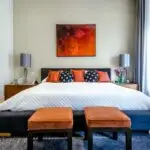
Home Furnishing includes items that make a home comfortable and functional. These include furniture, fittings, and decorative accessories.
What is Furnishing?
furnishings are the items that make a home comfortable and functional. They include furniture, fittings, and decorative accessories.
Types Of Home Furnishing
Home furnishings enhance the comfort and functionality of a home. These include:
- Furniture: Furniture are movable objects designed to support various human activities. Examples include chairs, tables, beds, stools, footrests, and lamps. other examples include sofas, cabinets, desks, shelves, and sideboards.
- Fittings: Fittings are fixed or attached elements contributing to a home’s functionality. Examples include doorknobs, handles, faucets, showers, wardrobes, bathtubs, toilets, ceiling fans, and light fixtures. Additional examples are built-in shelves, towel racks, curtain rods, and switch plates.
- Decorative Accessories: Decorative accessories enhance a space’s visual appeal. Examples include throw pillows, artwork, vases, candles, mirrors, rugs, photo frames, decorative bowls, statues, and bookends. More examples include plants, sculptures, wall hangings, clocks, and decorative trays.
Teaching Methods
To deliver this lesson, the teacher will adopt the following methods: Discussion, Question and answer, Show and tell
Instructional Procedures
To deliver this lesson, the teacher will adopt the following steps:
Step 1: Introduction (Set Induction)
Time: 5 minutes
Teaching Skill: Questioning
Teacher’s Activity: Ask pupils to name items in their homes and discuss their functions.Pupils’ Activity: Respond to teacher’s questions and participate in the discussion.
Step 2: Explanation of Key Concepts
Time: 10 minutes
Teaching Skill: Explaining
Teacher’s Activity: Define home furnishing and explain its importance.
Pupils’ Activity: Listen attentively and ask clarifying questions.
Step 3: Exhibition/Guided Practice
Time: 10 minutes
Teaching Skill: Demonstrating
Teacher’s Activity: Show pictures of different types of home furnishings and discuss their categories.
Pupils’ Activity: Identify the types of furnishings in the pictures.
Step 4: Autonomous practice
Time: 5 minutes
Teaching Skill: Monitoring
Teacher’s Activity: Ask pupils to list five pieces of furniture found in their homes.Pupils’ Activity: Complete the activity individually.
Step 5: Note-Taking
Time: 5 minutes
Teaching Skill: Guiding
Teacher’s Activity: Guide pupils in taking notes on key concepts.
Pupils’ Activity: Write down vital points in their notebooks.
Step 6: Evaluation/Review
Time: 5 minutes
Teaching Skill: questioning
Teacher’s activity: Ask review questions to assess understanding.
Pupils’ Activity: Answer the review questions.
Objective-aligned checks:
- Define furnishing.
- Identify two types of home furnishings.
- List five furnitures found in the home.
Step 7: Conclusion
Time: 5 minutes
Teaching Skill: Summarizing
Teacher’s Activity: Summarize the key concepts and assign homework.
Pupils’ Activity: Listen to the summary and note the homework assignment.
Lesson Keywords
- Furnishing – Items that make a home comfortable and functional.
- Furniture – Movable objects designed to support human activities.
- Fittings – Fixed or attached elements contributing to a home’s functionality.
- Decorative Accessories – Items that enhance a space’s visual appeal.
Lesson Evaluation
To evaluate the learning, the teacher asks pupils to:
- Name three types of home furnishings.
- Where do you find a bed? A dining table?
- list three pieces of furniture in the living room.
- Name bathroom fittings.
- Give examples of decorative accessories that make a room appealing.
assignment/Homework
- Draw your favourite piece of furniture.
- Describe the function of the furniture you drew.
Differentiation
- For slower learners: The teacher will provide one-on-one assistance and use simpler language.
- For advanced learners: The teacher will encourage them to research additional types of home furnishings.
- For visual/auditory/kinesthetic learners: Use visual aids, verbal explanations, and hands-on activities to cater to different learning styles.
Note for Teachers
Ensure to use real-life examples and visual aids to make the lesson engaging and relatable for the pupils. Encourage active participation and provide constructive feedback.



Community Join the conversation Open discussion +