

Class: Primary 6
Term: 3rd Term
subject: Cultural And Creative Arts
Curriculum Theme: Cultural and Creative Expression
previous Lesson: Methods Of Tie And Dye
Topic: Production Of Tie And Dye
Content/Learning Area: Production Of Tie And Dye
Time Allocation: 40 minutes
Performance Objectives
By the end of the lesson, pupils should be able to:
- Cognitive Domain: Explain the process of producing tie and dye on fabric
- Affective Domain: Show appreciation for the cultural value of tie and dye
- Psychomotor Domain: Demonstrate the steps in producing simple tie and dye patterns
- Social Domain: Cooperate with peers while working in groups to carry out tie and dye activities
Reference Materials
The following resources was used in planning this lesson:
- 9 Years Basic Education Curriculum
- Abuja Educational Resource Center Scheme of Work
- NAPPS National Unified Scheme of Work
- Online Information from: wikipedia – Tie-dye
- Relevant Textbooks
Instructional Materials
To deliver this lesson, the teacher will employ the help of the following materials: White cotton fabric, different fabric dyes, rubber bands, bowls and buckets, hand gloves, aprons, water, pictures of tie and dye designs, finished samples of tie and dye
Rationale for the Lesson
Understanding the process of tie and dye helps pupils appreciate traditional fabric decoration and explore creative expression through color and pattern.
Prerequisite/Previous knowledge
Pupils have seen or worn clothes with colorful patterns and have basic knowledge of color mixing and cultural crafts.
Lesson Content
Production of Tie and Dye
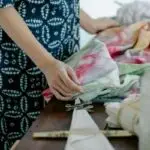
Tie and dye is a way of coloring fabric by tying parts of it and dipping it in dye to make beautiful patterns. It is a traditional method used in many cultures to decorate cloth.
Steps in Making Tie and Dye
Making tie and dye follows a simple process that helps create different patterns and colors on cloth.
The following are steps in making tie and dye:
- Wash and dry the white cloth
- tie the cloth in different parts using rubber bands
- Mix the dye with water in bowls
- Soak the tied cloth into the dye
- Leave it in the dye for some minutes
- Remove the cloth and untie it
- Dry the cloth under the sun
Production of Tie-dye
- Wash and dry suitable fabric.
- Plan the pattern and fold, twist or bind sections tightly.
- Prepare fabric dye exactly as directed under adult supervision.
- Apply or immerse the fabric without contaminating food utensils.
- Allow colour to set, rinse safely, remove ties and dry.
Use gloves and ventilation. Adults handle hazardous chemicals and hot water.
Teaching Methods
To deliver this lesson, the teacher will adopt the following methods: Discussion, Lecture, Exhibition, Explanation, Group Work, Visual Aids
Instructional Procedures
To deliver this lesson, the teacher will adopt the following steps:
Step 1: Introduction
Time: 5 min
Teaching Skill: Set Induction
Teacher’s Activity: Tells a short story about traditional cloth and shows samples of tie and dye cloth
Pupils’ Activity: Listen to story, observe samples and answer questions
Step 2: meaning of Tie and Dye
Time: 5 min
Teaching Skill: Explanation
Teacher’s Activity: Explains what tie and dye means and gives simple examples
Pupils’ Activity: Listen and ask questions
Step 3: Materials Used
Time: 5 min
Teaching Skill: Demonstration
Teacher’s Activity: Shows the materials one by one and explains their use
Pupils’ Activity: observe materials, ask and answer questions
Step 4: Steps in Production
Time: 10 min
Teaching Skill: Demonstration
Teacher’s Activity: Demonstrates the steps with actual materials and cloth
Pupils’ activity: Watch the process and repeat the steps in groups
Step 5: Types of Patterns
Time: 5 min
teaching Skill: Visual Aids
Teacher’s Activity: Shows different pattern samples and explains how each is made
Pupils’ Activity: Observe patterns and name them
Step 6: Note-Taking
Time: 3 min
Teaching Skill: Writing
Teacher’s Activity: Guides pupils to copy notes into their books
Pupils’ Activity: Copy notes into books
Step 7: Evaluation/Review
Time: 4 min
Teaching Skill: questioning
Teacher’s Activity: Asks questions based on the lesson and activities
Pupils’ Activity: Answer questions orally
Objective-aligned checks:
- Explain the process of producing tie and dye on fabric.
- Demonstrate the steps in producing simple tie and dye patterns.
Step 8: Conclusion
Time: 3 min
teaching Skill: Cognitive/Social
Teacher’s Activity: Summarizes lesson, appreciates pupils’ effort, and gives moral on cultural value
Pupils’ Activity: Listen and respond with what they learnt
Lesson Keywords
- Fabric – cloth used for making clothes
- Dye – a liquid color used to change the color of cloth
- Pattern – a repeated design or shape
- Spiral – a round shape that moves inwards or outwards
- Rubber band – a stretchy item used to tie the cloth
Lesson Evaluation
To evaluate the learning, the teacher asks pupils to:
- Explain the meaning of tie and dye
- List three materials used in tie and dye
- State four steps in producing tie and dye
- Mention two types of patterns in tie and dye
- Demonstrate how to tie cloth before dyeing
Assignment/Homework
(There is no homework in the attached lesson plan)
Differentiation
- For slower learners: Fast learners will be grouped to assist others in demonstrating the steps.
- For advanced learners: Pupils with difficulty will be given closer supervision and simple tasks.
- For visual/auditory/kinesthetic learners: (There is no differentiation for visual/auditory/kinesthetic learners in the attached lesson plan)
Note for Teachers
Ensure safety when handling dye. Use gloves and aprons, and always work in a well-ventilated space or outdoor area. Let pupils express creativity through different pattern styles.

Community Join the conversation Open discussion +