

Class: Junior Secondary School 2 (JSS2, JSS 2)
Term: 1st Term
Week: 6
Age: 13 years
Duration: 45 minutes
Subject: Cultural And Creative Arts
Curriculum Theme: Cultural And Creative Arts
Previous Lesson: Craft Making and Materials Used for Craft
Topic: Practical On Craft Making
Subject Matter: Production of woven mat using paper, Production of plate using clay
Specific Objectives
By the end of the lesson, pupils should be able to:
- Cognitive Domain:
(a) State the steps involved in making a woven mat with paper.
(b) Explain the process of producing a plate using clay. - Affective Domain:
(a) Appreciate the value of creativity and patience in craft production.
(b) Show interest in traditional craft practices. - Psychomotor Domain:
(a) Demonstrate the process of weaving a simple mat using paper strips.
(b) Mould a simple plate using clay. - Social Domain:
(a) Work cooperatively in groups during the practical activities.
Reference Materials
The following resources was used in planning this lesson:
- 9 Years Basic Education Curriculum
- Lagos State Unified Scheme of work for Junior Secondary Schools
- Wikipedia – Woven mat
- Relevant Textbooks
Instructional Materials
The teacher will teach this lesson with the aid of:
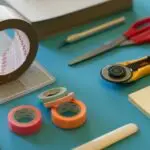
- Sheets of coloured paper
- Scissors and glue
- Ruler and pencil
- Samples of woven mats
- Clay and modelling tools
- Pictures or charts of clay objects
- Worktable or flat surface for demonstration
Rationale for the Lesson
This lesson will help pupils develop their creative skills through practical craftwork, promoting patience, coordination, and appreciation of local arts and traditional crafts.
Prerequisite/Previous Knowledge
Pupils have previously learned about different types of crafts and are familiar with basic tools and materials used in craft making.
Lesson Content/Board Summary
Practical on Craft Making
Production of Woven Mat Using Paper
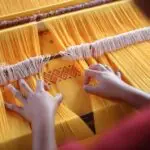
Weaving is the process of interlacing two sets of materials—one vertical and the other horizontal—to form a pattern or design. Paper weaving is a simple craft that helps learners understand the art of mat making using affordable materials.
The following are the steps in producing a woven mat using paper:
- Gather materials such as coloured paper, ruler, pencil, scissors, and glue.
- Fold one sheet of paper into two equal parts.
- Draw straight horizontal lines on the folded edge, leaving a margin of about one inch at the top.
- Cut along the lines carefully without cutting through the margin.
- Cut another sheet of coloured paper into long strips of equal width.
- Insert one strip over and under the slits of the folded sheet.
- Insert the next strip in the opposite pattern (under and over).
- Continue alternating the strips until the sheet is filled.
- Adjust and straighten the strips properly, then apply glue to hold them in place.
- Decorate the woven mat by trimming the edges neatly or adding borders.
Production of Plate Using Clay
Clay modelling is the process of shaping or forming objects out of moist clay. A plate made from clay can be produced through hand-building methods such as pinching, coiling, or slab techniques.
The following are the steps in producing a plate using clay:
- Gather materials like clay, water, knife, and smoothing tools.
- Knead or wedge the clay to remove air bubbles and make it soft.
- Flatten the clay into a smooth, round slab using the palm or a rolling pin.
- Shape the slab into a plate form by lifting and moulding the edges slightly upward.
- Smooth the surface with wet fingers or tools to remove cracks and rough spots.
- Allow the shaped plate to dry under shade until it becomes firm.
- Decorate the plate with patterns or designs while it is still damp.
- When fully dry, the plate can be fired in a kiln or sun-dried for hardening.
Teaching Methods/Instructional Techniques:
Discussion, Demonstration, Explanation, Group Work, Question and Answer, Practical Activity
Instructional Procedures
To deliver this lesson, the teacher will adopt the following steps:
Step 1: Introduction
Time: 5 minutes
Teaching Skill: Set Induction
Teacher’s Activity: The teacher asks pupils if they have ever seen a woven mat or clay plate, showing samples or pictures to stimulate interest.
Pupils’ Activity: Pupils respond and share experiences of using such items at home or in their communities.
Learning Point: Pupils gain interest in craft making and relate the lesson to familiar objects.
Step 2: Production of Woven Mat Using Paper
Time: 10 minutes
Teaching Skill: Demonstration
Teacher’s Activity: The teacher demonstrates step-by-step how to weave a mat using coloured paper, explaining each stage clearly.
Pupils’ Activity: Pupils observe and follow the teacher’s demonstration with their own materials.
Learning Point: Pupils understand and can reproduce the process of paper mat weaving.
Step 3: Production of Plate Using Clay
Time: 15 minutes
Teaching Skill: Explanation and Practical Activity
Teacher’s Activity: The teacher explains and demonstrates how to mould a simple plate with clay using hand-building techniques.
Pupils’ Activity: Pupils mould clay into simple plate shapes under teacher supervision.
Learning Point: Pupils learn to produce and design simple clay plates.
Step 4: Group Work and Display
Time: 8 minutes
Teaching Skill: Supervision and Guidance
Teacher’s Activity: The teacher supervises pupils’ work, guiding groups to correct mistakes and encouraging creativity.
Pupils’ Activity: Pupils collaborate to finish and display their woven mats and clay plates.
Learning Point: Pupils develop teamwork and creativity in craft production.
Step 5: Note-Taking
Time: 3 minutes
Teaching Skill: Explanation
Teacher’s Activity: The teacher writes the board summary for pupils to copy into their notebooks.
Pupils’ Activity: Pupils write notes neatly into their books.
Learning Point: Pupils have written materials for reference and revision.
Step 6: Evaluation/Review
Time: 3 minutes
Teaching Skill: Questioning
Teacher’s Activity: The teacher evaluates the learning by asking the following questions:
- Mention three materials used in making a woven mat with paper.
- List the steps involved in producing a clay plate.
- State two differences between paper weaving and clay modelling.
Pupils’ Activity: Pupils respond orally to the questions.
Learning Point: Pupils recall and apply knowledge from the lesson.
Step 7: Conclusion
Time: 1 minute
Teaching Skill: Reinforcement
Teacher’s Activity: The teacher summarizes the lesson, praises pupils’ effort, and encourages them to continue practising craft making.
Pupils’ Activity: Pupils listen attentively and show their works for correction.
Learning Point: Pupils appreciate creativity and handcraft skills.
Lesson Keywords
- Weaving – interlacing materials to form a mat or fabric
- Modelling – shaping or forming objects from clay or similar materials
- Kneading – pressing and folding clay to make it soft and even
- Craft – handmade work showing creativity and skill
- Decoration – adding designs or patterns to beautify an object
Differentiation
Teacher supports slower learners with one-on-one guidance and simplified steps, while fast learners assist others and explore creative designs.
Note for teachers using this lesson plan
Ensure materials are ready before the class. Supervise closely during practical activities to prevent waste and ensure safety. Encourage neatness and teamwork.


Community Join the conversation Open discussion +