

Class: Junior Secondary School 2 (JSS2, JSS 2)
Term: 2nd Term
Week: 2
Age: 13 years
Duration: 45 minutes
Subject: Cultural And Creative Arts
Curriculum Theme: Cultural And Creative Arts
Previous Lesson: Production Of Pattern
Topic: Practical Work On Pattern Making
Subject Matter: Producing designs using any of the types of pattern.
Specific Objectives
By the end of the lesson, pupils should be able to:
- Cognitive Domain:
(a) Define pattern making and its significance in Cultural and Creative Arts.
(b) Identify different types of patterns used in designs. - Affective Domain:
(a) Show interest and appreciation for creating unique patterns.
(b) Demonstrate patience and attention to detail during practical work. - Psychomotor Domain:
(a) Produce patterns using drawing and other artistic techniques.
(b) Use tools and materials effectively to create accurate designs. - Social Domain:
(a) Collaborate with peers during group pattern-making activities.
(b) Share ideas and provide constructive feedback on pattern designs.
Reference Materials
The following resources were used in planning this lesson:
- 9 Years Basic Education Curriculum
- Lagos State Unified Scheme of Work for Junior Secondary Schools
- North Metropolitan TAFE – Pattern Making Basics Skill Set
- Relevant Textbooks
Instructional Materials
The teacher will teach this lesson with the aid of:
- Drawing papers and sketchbooks
- Pencils, rulers, and erasers
- Colour pencils and markers
- Pattern templates and stencils
- Visual aids (charts or images of patterns)
- Projector or interactive whiteboard (if available)
Rationale for the Lesson
This lesson helps pupils develop creativity, precision, and appreciation for design patterns in art and cultural works.
Prerequisite/Previous Knowledge
Pupils are expected to have basic knowledge of drawing shapes, lines, and simple designs from prior Cultural and Creative Arts lessons.
Lesson Content/Board Summary
Practical Work On Pattern Making
Definition of Pattern Making
Pattern making is the process of creating repeated decorative designs using lines, shapes, and motifs. It forms the basis for many art and craft works, textiles, and decorative designs.
The following are key points about pattern making:
- Patterns can be geometric, organic, or abstract.
- Patterns are used in textiles, wallpapers, ceramics, and other creative arts.
- Patterns help in enhancing aesthetic appeal and visual interest.
Types of Patterns
Patterns can be categorized based on design repetition and style.
These include:
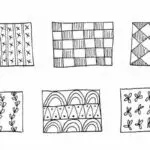
- Geometric Patterns: Designs created using shapes like squares, triangles, circles, and rectangles.
- Floral or Organic Patterns: Designs inspired by nature, such as flowers, leaves, and animals.
- Abstract Patterns: Designs with freeform shapes, lines, and irregular forms.
- Symmetrical Patterns: Designs that are balanced and mirror each side.
- Asymmetrical Patterns: Designs that are irregular but visually appealing.
Steps in Producing Patterns
Producing effective patterns requires systematic planning and execution.
The following are steps for creating patterns:
- Select the type of pattern suitable for the design.
- Sketch the basic outline lightly on paper.
- Add details to enhance the design.
- Use colour or shading to highlight the pattern.
- Review and adjust for symmetry and balance if required.
Importance of Pattern Making
Pattern making is essential in cultural and creative arts as it:
Examples include:
- Enhances creativity and artistic skills.
- Develops hand-eye coordination and precision.
- Preserves cultural heritage through traditional designs.
- Adds aesthetic value to everyday objects and artworks.
Teaching Methods/Instructional Techniques
Discussion, Lecture, Demonstration, Visual Aids, Group Work, Practical Exercises, Question and Answer
Instructional Procedures
To deliver this lesson, the teacher will adopt the following steps:
Step 1: Introduction
Time: 5 minutes
Teaching Skill: Set Induction
Teacher’s Activity: Review previous lesson on basic design elements and ask pupils to recall types of lines and shapes. Introduce the topic “Practical Work on Pattern Making” by showing examples of patterns.
Pupils’ Activity: Listen attentively, answer review questions, observe sample patterns.
Learning Point: Pupils understand the context and relevance of pattern making.
Step 2: Definition and Explanation of Pattern Making
Time: 7 minutes
Teaching Skill: Explanation
Teacher’s Activity: Define pattern making and explain its importance in Cultural and Creative Arts. Present different examples using charts or slides.
Pupils’ Activity: Copy definition and points into their notebooks.
Learning Point: Pupils can define and explain the concept of pattern making.
Step 3: Types of Patterns
Time: 10 minutes
Teaching Skill: Lecture and Visual Demonstration
Teacher’s Activity: Present types of patterns (geometric, floral, abstract, symmetrical, asymmetrical) and demonstrate examples.
Pupils’ Activity: Observe examples, take notes, and ask questions for clarity.
Learning Point: Pupils can identify and classify different pattern types.
Step 4: Practical Demonstration of Pattern Production
Time: 12 minutes
Teaching Skill: Demonstration/Practical
Teacher’s Activity: Demonstrate step-by-step pattern creation on the board or projector.
Pupils’ Activity: Attempt to produce their own patterns using available materials.
Learning Point: Pupils develop practical skills in creating patterns.
Step 5: Note-Taking
Time: 3 minutes
Teaching Skill: Guided Writing
Teacher’s Activity: Summarize key points and steps of pattern making for pupils to note down.
Pupils’ Activity: Write notes in their notebooks.
Learning Point: Pupils consolidate learning through note-taking.
Step 6: Evaluation/Review
Time: 5 minutes
Teaching Skill: Questioning and Assessment
Teacher’s Activity: The teacher evaluates the learning by asking the following questions:
- Define pattern making.
- List and explain three types of patterns.
- Describe the steps to produce a pattern.
- Explain the importance of pattern making in cultural and creative arts.
Pupils’ Activity: Answer questions and demonstrate mini-patterns where applicable.
Learning Point: Assess pupils’ understanding and mastery of the lesson.
Step 7: Conclusion
Time: 3 minutes
Teaching Skill: Reinforcement and Motivation
Teacher’s Activity: Recap main points, encourage pupils to practice pattern making at home, and preview the next lesson.
Pupils’ Activity: Listen and ask clarifying questions if any.
Learning Point: Pupils are motivated to practice and understand the relevance of pattern making.
Lesson Keywords
- Pattern Making – creating repeated decorative designs
- Geometric – designs using shapes
- Organic – designs inspired by nature
- Symmetry – balance in design
- Abstract – freeform artistic design
Differentiation
Pupils work in groups or individually depending on skill level; provide extra guidance for slower learners and extension tasks for advanced pupils.
Note for teachers using this lesson plan
Encourage creativity while maintaining accuracy; ensure sufficient materials for practical work; monitor group dynamics during activities.

Community Join the conversation Open discussion +