

Class: Junior Secondary School 2 (JSS2, JSS 2)
Term: 2nd Term
Week: 1
Age: 13 years
Duration: 45 minutes
Subject: Cultural And Creative Arts
Curriculum Theme: Cultural And Creative Arts
Previous Lesson:
Topic: Production Of Pattern
Subject Matter: Meaning of pattern, Types of patterns – Simple repeat, Diamond repeat, Mirror repeat.
Specific Objectives
By the end of the lesson, pupils should be able to:
- Cognitive Domain:
(a) Define the meaning of pattern in Cultural and Creative Arts.
(b) Identify and distinguish between simple repeat, diamond repeat, and mirror repeat patterns. - Affective Domain:
(a) Appreciate the use of patterns in everyday decorative art.
(b) Show interest in creating patterns in artworks. - Psychomotor Domain:
(a) Demonstrate the ability to produce simple repeat, diamond repeat, and mirror repeat patterns.
(b) Practice sketching patterns neatly on paper. - Social Domain:
(a) Collaborate with peers in group activities to create patterns.
(b) Share and discuss pattern designs with classmates respectfully.
Reference Materials
The following resources was used in planning this lesson:
- 9 Years Basic Education Curriculum
- Lagos State Unified Scheme of work for Junior Secondary Schools
- Wikipedia – Pattern
- DK Art and Design Textbook for Junior Secondary Schools
Instructional Materials
The teacher will teach this lesson with the aid of:
- Drawing papers and pencils
- Rulers and erasers
- Colored pencils and markers
- Pattern samples or charts
- Projector or printed visual aids showing different patterns
Rationale for the Lesson
This lesson helps pupils understand and create patterns, enhancing creativity, observation skills, and aesthetic appreciation in art.
Prerequisite/Previous Knowledge
Pupils should have basic skills in drawing shapes and lines and an understanding of symmetry from previous art lessons and informal observations.
Lesson Content/Board Summary
Production Of Pattern
Meaning of Pattern
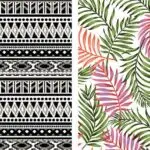
A pattern is a repeated decorative design or motif used in art and craft to create visual interest. Patterns can be geometric or organic and are often used in textiles, paintings, and architectural decorations.
The following are key points:
- Patterns create rhythm and balance in art.
- They can be simple or complex depending on repetition and design.
- Patterns can be used to enhance the aesthetic appeal of objects.
Types of Patterns
1. Simple Repeat Pattern
A simple repeat pattern involves the repetition of a single motif in a straight line or grid without any variation.
These include:
- Continuous motifs repeated horizontally or vertically.
- Basic shapes like circles, squares, or triangles repeated uniformly.
- Simple geometric designs for fabric and wall decoration.
2. Diamond Repeat Pattern
A diamond repeat pattern is created when motifs are repeated in a diagonal or diamond-shaped arrangement.
They are:
- Often used in textiles and floor tiles.
- Creates a dynamic and visually interesting design.
- Can combine different motifs within the diamond shape.
3. Mirror Repeat Pattern
A mirror repeat pattern occurs when one side of the motif is reflected to create a symmetrical effect.
Examples include:
- Motifs mirrored along a central axis.
- Symmetrical designs in wallpapers and borders.
- Enhances harmony and balance in visual art.
Teaching Methods/Instructional Techniques
Discussion, Lecture, Storytelling, Explanation, Visual Aids, Group Work, Demonstration
Instructional Procedures
To deliver this lesson, the teacher will adopt the following steps:
Step 1: Introduction (The Teaching Skill: Set Induction)
Time: 5 minutes
Teacher’s Activity: Review previous lesson on basic drawing techniques and ask pupils if they have noticed repeated designs around them.
Pupils’ Activity: Respond to questions and share examples from their surroundings.
Learning Point: Recognize patterns in the environment and relate to art.
Step 2: Definition of Pattern
Time: 5 minutes
Teaching Skill: Explanation
Teacher’s Activity: Define pattern using board summary; show visual examples.
Pupils’ Activity: Copy definition and examples into notebooks.
Learning Point: Understand the meaning and purpose of patterns.
Step 3: Simple Repeat Pattern
Time: 7 minutes
Teaching Skill: Demonstration
Teacher’s Activity: Demonstrate drawing a simple repeat pattern on the board and explain steps.
Pupils’ Activity: Practice drawing simple repeat patterns individually.
Learning Point: Ability to create simple repeated designs.
Step 4: Diamond Repeat Pattern
Time: 7 minutes
Teaching Skill: Demonstration
Teacher’s Activity: Show examples and demonstrate diamond repeat pattern on the board.
Pupils’ Activity: Sketch diamond repeat patterns in groups.
Learning Point: Learn to arrange motifs diagonally for dynamic designs.
Step 5: Mirror Repeat Pattern
Time: 7 minutes
Teaching Skill: Demonstration
Teacher’s Activity: Present mirrored motifs and demonstrate symmetry techniques.
Pupils’ Activity: Attempt mirror repeat patterns individually or in pairs.
Learning Point: Create symmetrical and visually balanced designs.
Step 6: Note-Taking
Time: 5 minutes
Teaching Skill: Explanation
Teacher’s Activity: Summarize key points on the board for pupils to copy.
Pupils’ Activity: Take notes carefully.
Learning Point: Reinforce learning through note-taking.
Step 7: Evaluation/Review
Time: 5 minutes
Teaching Skill: Questioning
Teacher’s Activity: The teacher evaluates the learning by asking the following questions:
- Define a pattern.
- Mention the three types of patterns learned today.
- Demonstrate a simple repeat pattern on paper.
Pupils’ Activity: Answer orally and demonstrate patterns.
Learning Point: Assess understanding and application of the lesson.
Step 8: Conclusion
Time: 4 minutes
Teaching Skill: Summarization
Teacher’s Activity: Recap the lesson, highlight key learning points, and assign practice activity.
Pupils’ Activity: Listen and ask clarification questions.
Learning Point: Consolidate understanding and motivate practice.
Lesson Keywords
- Pattern – repeated decorative design
- Simple Repeat – motifs repeated uniformly
- Diamond Repeat – motifs arranged diagonally
- Mirror Repeat – motifs reflected symmetrically
- Symmetry – balanced arrangement of elements
Differentiation
Pupils can be supported with visual aids, peer assistance, and simplified step-by-step demonstrations for those needing extra guidance.
Note for teachers using this lesson plan
Encourage pupils to observe patterns in their environment; provide extra worksheets for practice and display exemplary works to motivate learners.

Community Join the conversation Open discussion +